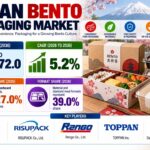


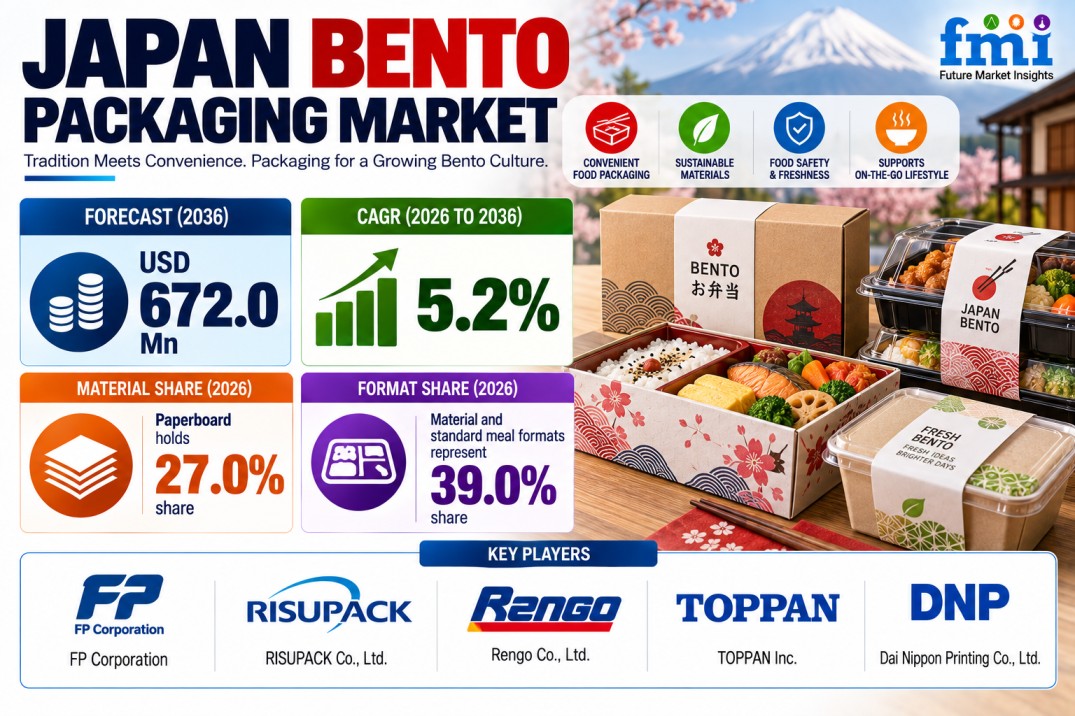
Future Market Insights (FMI) projects the Japan bento packaging market to reach USD 672.0 million by 2036, up from USD 404.8 million in 2026, representing a 5.2% CAGR from 2026 to 2036.
The market is shaped by the practical requirements of prepared-meal operators. Bento packaging must keep separate food components intact during filling, stacking, transport, pickup, and delivery. As a result, purchasing decisions increasingly depend on compartment geometry, closure performance, pack-out speed, heat tolerance, grease resistance, and compatibility with established food-service processes.
Material selection is another important consideration. Japan’s food-contact requirements affect the material pathways available to bento-packaging users before a new structure can be approved. The Consumer Affairs Agency’s positive-list regime applies to specified synthetic-resin food packaging. Operators therefore need to assess barrier performance alongside the records and requirements associated with the final food-contact design.
👉 Get Detailed Market Forecasts, Competitive Benchmarking, and Pricing Trends: https://www.futuremarketinsights.com/reports/sample/rep-gb-35291
Standard Formats Maintain a Significant Position
By format type, standard formats are projected to account for 37.0% of the market in 2026. Repeatable dimensions can simplify filling, lidding, case packing, handling, and replenishment.
Standard footprints also allow operators to modify compartment layouts or barrier specifications without completely changing the packaging format already used by staff and distribution networks.
The market is also seeing activity around new packaging formats. RISUPACK presented new bento-container formats at its 2025 autumn product event, highlighting continued development around prepared-food containers.
Paperboard Estimated to Hold 27.0% Share
By material, paperboard is estimated to account for 27.0% in 2026. Its printable surface and familiar converting routes make it relevant to prepared-meal packaging.
However, material substitution is not determined by substrate choice alone. Paper-led bento formats still need to meet grease, moisture, heat, sealing, and food-contact requirements. Operators must establish that the packaging performs under actual service conditions before making a material change.
This creates a qualification requirement for packaging suppliers developing lower-plastic or fiber-based solutions.
QSR Chains Account for 31.0% of End Use
QSR chains are forecast to represent 31.0% of the market by end use in 2026. Their operating model places particular importance on consistent pack specifications across multiple locations.
Containers need to close quickly and preserve food texture during pickup or delivery without creating unnecessary back-of-house SKUs. Pack selection therefore depends on closure speed, venting, stock availability, pack-out performance, and delivery conditions.
For multi-site operators, a material or format change must fit existing kitchen routines rather than simply provide a different substrate.
Broadline Distributors Lead the Sales Channel
Broadline foodservice distributors are expected to lead the sales channel category with a 42.0% share in 2026. Their consolidated assortment can reduce the number of separate deliveries required by operators managing several meal sizes and materials.
Direct chain contracts remain relevant for customized packaging programs. However, stocked product breadth can reduce switching friction for multi-site operators with mixed menus.
Shimojima issued a 2026 food and delicatessen catalog for supermarkets and foodservice customers featuring containers and PFAS-free items, reflecting continued product development and distribution activity in the category.
Recovery and Material Qualification Create New Requirements
Prepared-meal demand supports the market, while recovery requirements and material qualification can affect conversion timelines.
Substrate changes may require additional validation for sealing, heat performance, grease resistance, food-contact compliance, and recovery routes. This can extend the time needed for chain approval.
At the same time, closed-loop collection presents an opportunity for packaging companies to connect packaging supply with verifiable end-of-life systems. FP Corporation’s food-tray recycling model links used trays with a recovery system designed around the same packaging function.
The market is also seeing capacity and product-development activity. In April 2026, FP Corporation approved investment in a new Bando plant and distribution center. In August 2026, RISUPACK began a Kansai plant expansion for biomass-plastic food-container capacity. In July 2025, TOPPAN reported the first domestic use of an ALL-PP mono-material retort pouch for a Japanese food product following package-suitability and filling tests.
Access detailed market insights: https://www.futuremarketinsights.com/reports/brochure/rep-gb-35291
Competitive Landscape
The Japan bento packaging market includes companies operating across rigid meal and compartment systems, film and barrier materials, paper conversion, and foodservice distribution.
Notable companies reviewed by FMI include FP Corporation, RISUPACK Co., Ltd., Rengo Co., Ltd., TOPPAN Inc., Dai Nippon Printing Co., Ltd. (DNP), The Pack Corporation, Shimojima Co., Ltd., Koyo Pack Systems Ltd., Kureha Corporation, and Mitsui Chemicals, Inc.
Report Scope
The FMI report covers the market by format type, material, format size, end use, sales channel, and region. The study provides revenue estimates in USD million and CAGR percentages for the 2026–2036 forecast period.
The market definition includes revenue from bento-style and compartmented prepared-meal packaging within the defined format, material, size, end-use, and sales-channel universe. It excludes food revenue, upstream raw materials, packaging equipment, and adjacent packaging outside the defined boundary.
FMI’s methodology combines primary and secondary research with market triangulation. Primary research includes input from manufacturers, service providers, technology developers, distributors, end users, procurement teams, and subject-matter experts. Desk research covers government statistics, regulatory publications, trade data, industry associations, technical literature, standards, company filings, product information, and official corporate announcements.