

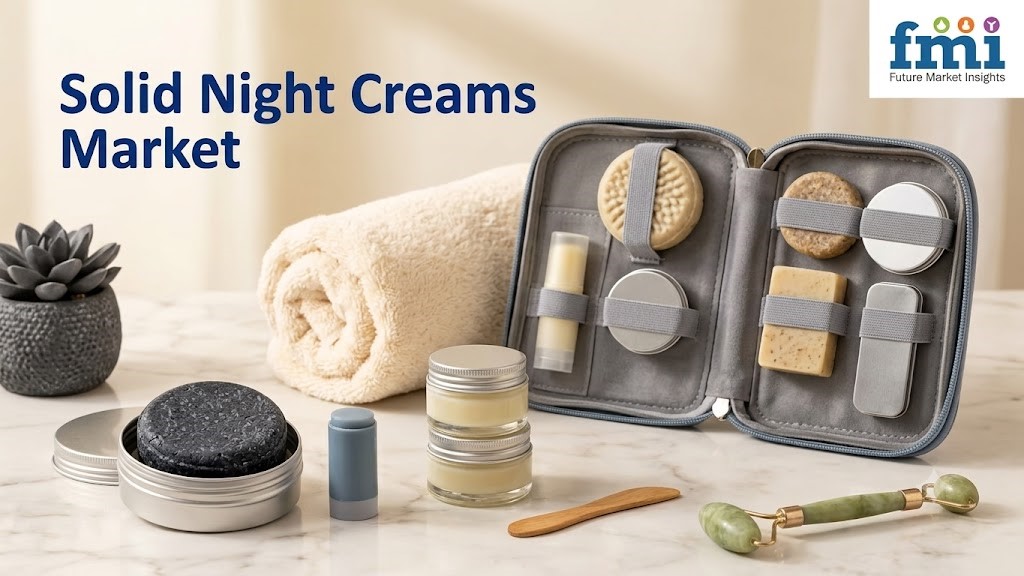
The global solid night creams market is valued at USD 9.5 billion in 2026 and is projected to reach USD 20.5 billion by 2036, expanding at an 8.0% CAGR from 2026 to 2036, according to Future Market Insights (FMI). Market growth is being supported by rising consumer demand for concentrated, water-light nighttime skincare formats that combine targeted treatment with simplified routines.
Environmental and packaging considerations are also encouraging adoption of solid formats, particularly refillable and minimal-packaging solutions. FMI highlights the European Commission Single-Use Plastics Directive in its analysis of the industry’s shift away from conventional packaging toward lower-plastic and waterless skincare formats.
Get detailed market forecasts, competitive benchmarking, and pricing trends: https://www.futuremarketinsights.com/reports/sample/rep-gb-31833
Global Segment Leaders
- Product Type — Moisturizing Night Creams: 42.8% — Leads because overnight hydration and barrier support have broad relevance across age groups and skin types.
- Distribution Channel — Offline Retail: 58.6% — Maintains the leading position because consumers can test solid textures, scent, and melt-on-skin performance in physical stores.
- Price Tier — Mid-Range: 47.3% — Leads as brands combine accessible pricing with performance-focused formulations and active ingredients such as bakuchiol and niacinamide.
Country-Level Performance
- China — 10.8% CAGR: Growth is driven by rising premium facial-care demand among urban middle-class consumers, structured nighttime routines, compact formats, and strong cross-border e-commerce penetration.
- India — 10.0% CAGR: Expansion is supported by millennials and Gen Z entering premium skincare, rapid growth of online beauty platforms, and rising demand for clean, compact, and simplified skincare formats.
- Germany — 9.2% CAGR: Growth is supported by the Circular Economy Act, high packaging-recycling requirements, and consumer demand for sustainable cosmetics.
- Brazil — 8.4% CAGR: Prestige beauty expansion, urban retail development, and demand for concentrated skincare products are supporting market growth.
- United States — 7.6% CAGR: Clean beauty adoption, ingredient transparency, and expanding mainstream retail availability are supporting demand for waterless solid formats.
- United Kingdom — 6.8% CAGR: Established prestige beauty infrastructure and strong consumer awareness of refillable and minimal-packaging products support growth.
- Japan — 6.0% CAGR: Japan’s mature prestige beauty market provides a steady base for adoption of emerging solid night cream formats.
Regional Context
Fast-growing markets include China, India, Germany, and Brazil. China’s 10.8% CAGR is associated with premium facial-care adoption, compact formats, cross-border e-commerce, and demand for concentrated treatments. India’s 10.0% growth reflects younger consumers entering premium skincare, expanding online beauty access, and interest in clean and simplified routines. Germany’s 9.2% CAGR is linked to packaging-recycling requirements and consumer environmental awareness, while Brazil’s 8.4% growth is supported by prestige beauty retail expansion and urban in-store exposure to solid formats.
Mature/slower-growing markets include the United States, United Kingdom, and Japan. The United States is supported by clean beauty adoption and expanding mainstream retail availability, while the United Kingdom benefits from established prestige retail infrastructure and sustainability awareness. Japan is described as a mature prestige beauty market with steady growth opportunities.
The full report covers North America, Europe, Asia Pacific, Latin America, and the Middle East & Africa, with 40+ countries covered in addition to the specifically named markets.
Competitive Landscape
The competitive landscape includes L’Oréal S.A., Estée Lauder Companies Inc., Shiseido Co. Ltd., Procter & Gamble Co., Unilever PLC, Beiersdorf AG, Avon Products Inc., Clarins Inc., Amorepacific Group, and KOSÉ Corporation. FMI describes competition as increasingly focused on proprietary solid-base technologies, plant-wax blends, concentrated actives, and sustainability positioning. Recent developments cited in the report include L’Oréal Group’s March 2023 launch of a waterless beauty innovation hub in Paris, Estée Lauder Companies’ September 2023 introduction of refillable solid night balm compacts for Aveda, and Unilever’s January 2024 acquisition of Garnier Green Labs assets to accelerate solid-format development.
Explore More Related Studies Published by FMI Research:
https://www.openpr.com/news/4648406/shoe-insert-market-to-reach-usd-86-1-billion-by-2036-at-5-6-cagr
https://www.openpr.com/news/4648426/portable-dishwasher-market-to-reach-usd-2-3-billion-by-2036
https://www.openpr.com/news/4648489/contact-lenses-market-to-reach-usd-19-9-billion-by-2036-at-5-1
Business Impact
FMI helps organizations transform market complexity into strategic clarity, enabling leadership teams to identify growth opportunities faster, optimize resource allocation, strengthen competitive positioning, and make high-stakes business decisions with confidence.
To explore how FMI Custom Research can support your strategic priorities, please connect with our team at – sales@futuremarketinsights.com
About Future Market Insights (FMI)
Future Market Insights, Inc. (FMI) is an ESOMAR-certified, ISO 9001:2015 market research and consulting organization, trusted by Fortune 500 clients and global enterprises. With operations in the U.S., UK, India, and Dubai, FMI provides data-backed insights and strategic intelligence across 30+ industries and 1200 markets worldwide.