

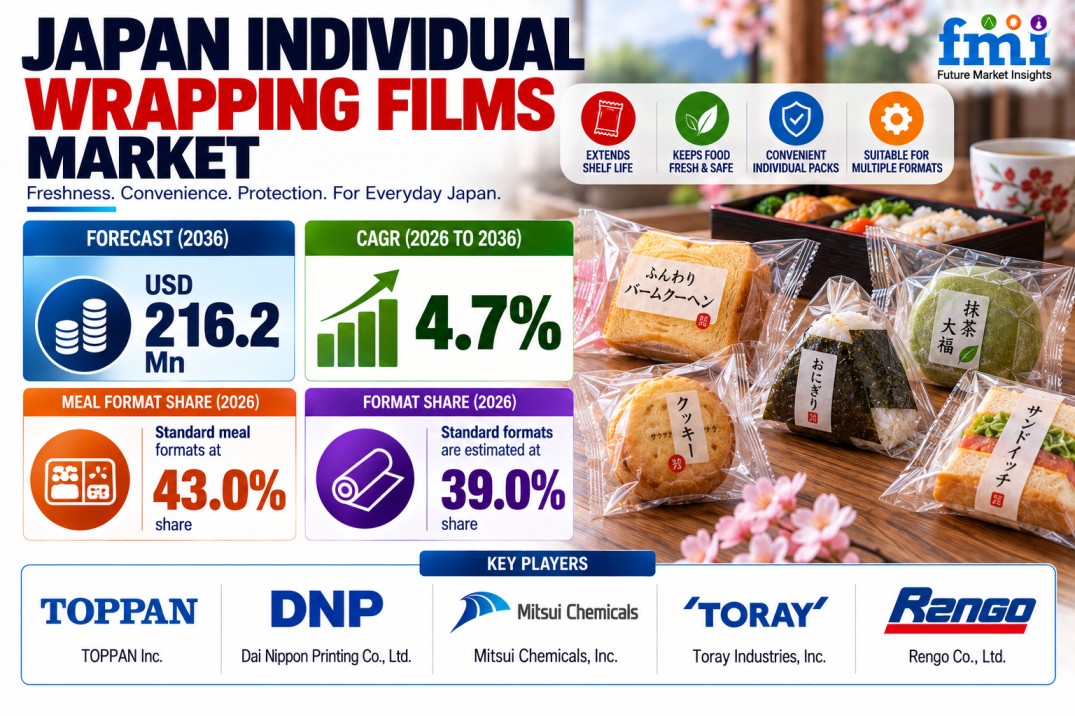
The Japan individual wrapping films market is projected to reach USD 216.2 million by 2036, increasing from USD 136.6 million in 2026 at a CAGR of 4.7%, according to Future Market Insights (FMI).
Demand for individual wrapping films is closely linked to recurring foodservice and prepared-food packaging activity. Each individually packed item requires a separate wrapping or lidding step, making film demand dependent on actual packaging and sealing events rather than broad foodservice sales alone.
As foodservice operators manage repeated meal preparation and delivery cycles, packaging specifications increasingly focus on containment, closure integrity, puncture resistance, and compatibility with existing kitchen processes.
👉 Get Detailed Market Forecasts, Competitive Benchmarking, and Pricing Trends: https://www.futuremarketinsights.com/reports/sample/rep-gb-35290
Standard Formats Account for 39.0% of the Market
By format type, standard formats are estimated to hold 39.0% of the market in 2026.
Stocked dimensions can reduce SKU variation and allow kitchens and distributors to work with established packaging inventories. Familiar case sizes can also simplify replenishment when menus change without requiring a new tooling cycle.
Custom-engineered formats remain relevant where operators require dedicated specifications, but standard formats provide a practical foundation for routine packaging operations.
Paperboard Represents 27.0% of Material Demand
The paperboard segment is likely to capture 27.0% of material demand in 2026. Paperboard offers rigid handling and printable surfaces in applications where reduced plastic content can be incorporated into the packaging structure.
However, material selection still requires technical qualification. Paper-led or fiber-based structures must provide suitable grease and moisture performance and remain compatible with the intended food-contact application.
For individual wrapping films, flexible construction, barrier performance, and seal compatibility remain important considerations. The characteristics of rigid paperboard packaging alone do not establish suitability for a flexible wrapping application.
Standard Meal Formats Lead by Size
Standard meal formats are expected to account for 43.0% of the format-size category in 2026.
Common meal portions allow kitchens to work with a core packaging footprint and simplify lid matching. Familiar dimensions can also make substitution easier when compartment options and closure steps remain compatible with existing case sizes.
The Ministry of the Environment’s FY2023 sorted-collection results, released in March 2025 under the Containers and Packaging Recycling Law, also reinforce the need to consider recovery routes when evaluating repeat-use packaging streams.
Delivery Platforms Create Specific Film Requirements
Delivery platforms are projected to represent 28.0% of end-use demand in 2026.
The interval between packing and consumption can be longer for delivered meals than for food consumed immediately at the point of purchase. This makes closure integrity, containment, stacking performance, and puncture resistance important considerations.
Film structures must retain containment during movement without introducing additional verification steps during kitchen handoff.
Broadline Distributors Lead the Sales Channel
Broadline foodservice distributors are forecast to hold 39.0% of sales-channel demand in 2026.
These distributors can place packaging alongside food and operating supplies, reducing the number of routine replenishment orders required by restaurants.
Stocked food-contact film specifications can fit existing inventory systems and case requirements. Direct chain contracts remain relevant where customers need custom specifications or dedicated volume forecasts.
Food-Contact Requirements Influence Material Changes
Food-contact regulation remains an important consideration for suppliers and buyers evaluating new film structures.
Japan’s Consumer Affairs Agency issued a Positive List Q&A in June 2025 covering synthetic resins used in food apparatus, containers, and packaging. The transition period for the positive-list regime ended on May 31, 2025, with the regime applying from June 1.
This means material changes can require additional approval work before a new polymer, coating, or structure moves into routine food-contact use.
FMI identifies this qualification process as a potential restraint because a new material may perform reliably during meal service but still require documentation and review before commercial adoption.
Mono-Material Conversion Creates a Defined Opportunity
Mono-material flexible packaging provides an opportunity to reduce material complexity where converters can retain the barrier performance and sealing window required for reliable pack formation.
In July 2025, TOPPAN reported the first domestic use of an ALL-PP mono-material retort pouch for a Japanese food product. Package-suitability and filling tests preceded the adoption.
The development illustrates the importance of testing packaging changes against actual filling and sealing requirements rather than evaluating material composition in isolation.
>> Access detailed market insights:https://www.futuremarketinsights.com/reports/brochure/rep-gb-35290
Competitive Landscape
The Japanese supplier base spans flexible-film and barrier-material specialists, paper and foodservice converters, food-wrap suppliers, tray producers, and packaging distributors.
Notable companies covered in the FMI market include TOPPAN Inc., Dai Nippon Printing Co., Ltd. (DNP), Mitsui Chemicals, Inc., Toray Industries, Inc., Rengo Co., Ltd., The Pack Corporation, Shimojima Co., Ltd., Kureha Corporation, FP Corporation, and RISUPACK Co., Ltd.
Recent developments include DNP’s development of an aluminum-deposited film reported in July 2025 and Mitsui Chemicals’ flexible-packaging process and adhesive development reported in May 2026.
Report Scope
The FMI study covers the Japan individual wrapping films market by format type, material, format size, end use, sales channel, and region.
The forecast period runs from 2026 to 2036, with quantitative estimates presented in USD million.
The market definition covers revenue from individual food-contact wrapping and containment formats within the specified market categories. Food revenue, delivery-service revenue, packaging equipment, and adjacent packaging are excluded from the market boundary.
FMI applies primary and secondary research with market triangulation. Primary research includes manufacturers, service providers, technology developers, distributors, end users, procurement teams, and subject-matter experts. Desk research covers regulatory publications, government statistics, trade data, industry associations, technical literature, standards, company filings, product information, and official corporate announcements.