

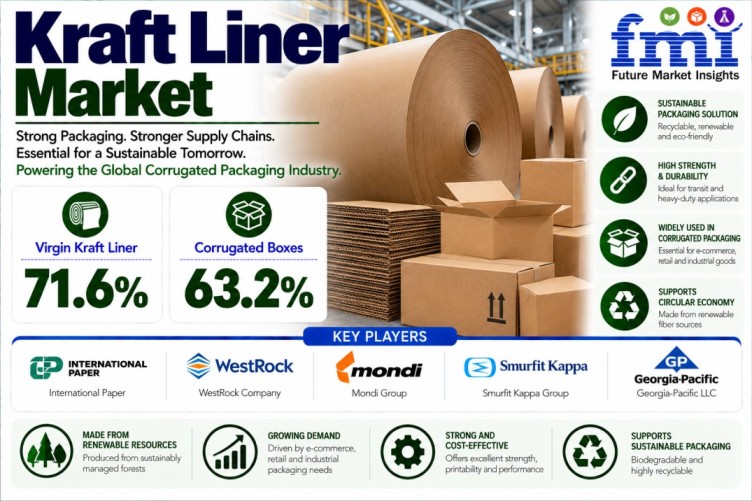
The global kraft liner market is projected to grow from US$12.4 billion in 2025 to US$19.6 billion by 2035, registering a compound annual growth rate (CAGR) of 4.7% during the 2025–2035 forecast period, according to Future Market Insights (FMI). Increasing demand for corrugated packaging, expanding e-commerce operations and the need for durable, recyclable packaging materials are supporting the market’s long-term development.
Kraft liner is an essential component of corrugated packaging, providing strength, durability and printability for shipping boxes and other packaging formats. As manufacturers, retailers and logistics providers seek reliable packaging materials that can withstand transportation and handling requirements, kraft liner producers are focusing on product performance, material efficiency and improved manufacturing capabilities.
>> Get Detailed Market Forecasts, Competitive Benchmarking, and Pricing Trends: https://www.futuremarketinsights.com/reports/sample/rep-gb-6674
Kraft Liner Market Outlook: Virgin Grades and Corrugated Boxes Lead Demand
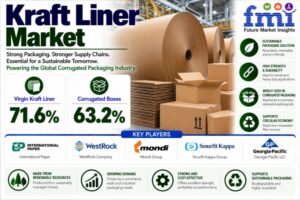
FMI’s analysis identifies virgin kraft liner as the leading grade segment, accounting for 71.6% of the market in 2025. Its tensile strength, surface smoothness and printing characteristics make it suitable for packaging applications where structural reliability and presentation quality are important.
By application, corrugated boxes are projected to account for 63.2% of market demand in 2025. Their widespread use across e-commerce, food and beverage, consumer goods and industrial supply chains supports the segment’s leading position.
The market is also shaped by demand for recycled and semi-recycled kraft liner grades. Packaging manufacturers are evaluating material costs, recycled content requirements and performance specifications when selecting linerboard for different applications. This creates opportunities for suppliers that can maintain strength and converting performance while incorporating recovered fiber.
E-commerce and Sustainable Packaging Support Market Growth
The expansion of online retail is increasing the need for corrugated shipping boxes that protect products throughout storage, distribution and last-mile delivery. Kraft liner’s strength and compatibility with corrugated manufacturing make it an important material for packaging producers serving e-commerce and logistics customers.
Food and beverage packaging is another important source of demand. Producers and distributors require packaging materials that can support product protection, handling and transportation across supply chains. Kraft liner manufacturers can address these requirements through grade development and application-specific material specifications.
The growing preference for recyclable packaging is also influencing purchasing decisions. Brand owners and packaging converters are assessing fiber sourcing, recycled content and material efficiency as part of broader packaging sustainability strategies.
Product Innovation and Manufacturing Trends
Several developments are shaping competition and product development in the kraft liner market:
- Lightweight, high-strength construction: Producers are working toward liner grades that balance structural performance with lower material consumption.
- Barrier coating integration: Moisture-resistant and grease-resistant coatings can extend kraft liner applications, particularly in packaging exposed to demanding storage or transportation conditions.
- Digital printing compatibility: Improved surface smoothness and ink receptivity can help converters meet growing requirements for high-quality graphics and customized packaging.
- Recovered fiber utilization: Recycled fiber formulations provide opportunities to address cost and sustainability objectives while maintaining required strength characteristics.
- Converting efficiency: Consistent basis weights and material specifications support reliable performance in automated corrugated box manufacturing.
For manufacturers, these trends create opportunities to differentiate products through technical performance, customized grades and stronger relationships with packaging converters.
Regional Opportunities: India Leads Country-Level Growth
FMI’s country analysis highlights different growth opportunities across major kraft liner markets. India is projected to record the highest CAGR of 6.4% between 2025 and 2035, supported by packaging industry expansion, e-commerce infrastructure development and investment in corrugated manufacturing.
Other country-level growth forecasts include:
- Indonesia: 5.9% CAGR, supported by industrial expansion and increasing consumer goods packaging requirements.
- China: 5.8% CAGR, driven by manufacturing activity and export packaging demand.
- Brazil: 5.1% CAGR, supported by agricultural packaging and consumer goods applications.
- United States: 3.9% CAGR, reflecting demand from established packaging operations and e-commerce supply chains.
- Germany: 3.7% CAGR, supported by industrial packaging requirements and quality-focused manufacturing.
- Japan: 3.2% CAGR, with demand linked to premium packaging and manufacturing innovation.
The European kraft liner market is projected to increase from US$3.2 billion in 2025 to US$4.6 billion by 2035, representing a CAGR of 3.6%. Germany is expected to maintain its leading position within the regional market, supported by its established packaging infrastructure and industrial applications.
For suppliers evaluating expansion, these regional differences underline the importance of aligning production capacity, distribution networks and product portfolios with local packaging requirements.
Competitive Landscape: Top Players in the Kraft Liner Market
The kraft liner market includes established paper manufacturers, integrated forest products companies and packaging suppliers. Competition is shaped by manufacturing scale, fiber sourcing, product consistency, technical capabilities and geographic reach.
Companies identified in FMI’s report include:
- International Paper
- WestRock Company
- Mondi Group
- Smurfit Kappa Group
- Georgia-Pacific LLC
- Nine Dragons Paper Holdings Limited
- Stora Enso Oyj
- UPM-Kymmene Corporation
- Klabin S.A.
- Packaging Corporation of America
- Sonoco Products Company
- Cascades Inc.
- Sappi Limited
- Metsä Board Corporation
- BillerudKorsnäs AB
These companies operate across paper, packaging and fiber-based material markets. FMI’s competitive analysis identifies product portfolios, manufacturing capabilities, regional presence and strategic positioning as important areas for evaluating market participants. The report profiles the companies and examines the competitive structure of the industry.
Access Detailed Market Insights: https://www.futuremarketinsights.com/reports/kraftliner-market
Business Outlook: Priorities for Kraft Liner Manufacturers
The projected market expansion creates several strategic considerations for producers, packaging converters and investors.
First, manufacturers can evaluate opportunities in high-strength lightweight grades that help customers optimize packaging performance and material consumption. Second, investments in barrier coating technologies and digital-print-compatible surfaces may help suppliers address specialized packaging requirements.
Regional expansion is another consideration. India’s projected growth and the opportunities across Indonesia and China may support investment in local production, distribution and converter partnerships. In established markets such as the United States and Germany, suppliers can focus on product consistency, converting efficiency and application-specific performance.
Finally, companies should assess the balance between virgin and recovered fiber in their portfolios. Customers increasingly need materials that meet both packaging performance requirements and sustainability objectives.