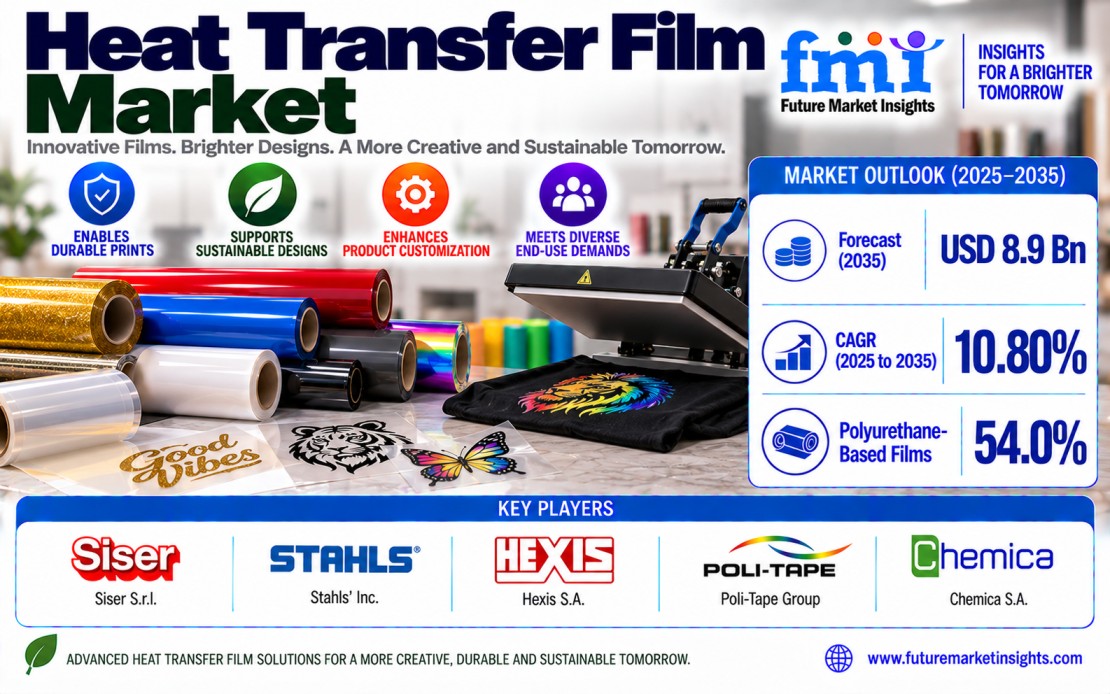
The global Heat Transfer Film Market is forecast to expand from US$3.2 billion in 2025 to US$8.9 billion by 2035, registering a compound annual growth rate (CAGR) of 10.8%, according to Future Market Insights (FMI). Demand is supported by personalized apparel, customized sportswear, promotional merchandise and decorative applications that require durable, visually consistent graphics.
Heat transfer films enable manufacturers and decorators to apply designs, logos and graphics to textiles and other surfaces using heat and pressure. Their flexibility supports short production runs, varied designs and customized products, making them useful for apparel brands, print shops, sportswear producers and promotional product businesses.
>> Get Detailed Market Forecasts, Competitive Benchmarking, and Pricing Trends: https://www.futuremarketinsights.com/reports/sample/rep-gb-6667
Polyurethane-Based Films Lead Product Demand
FMI projects polyurethane-based films to account for 54% of the market in 2025, making them the leading film type. Their stretchability, soft feel and durability support applications where graphics must withstand repeated wear and washing.
PVC-based films, polyester-based films, vinyl films and other film types provide alternatives for different price points, substrates and performance requirements. Selection depends on the intended surface, desired finish, flexibility, adhesion and expected service conditions.
For manufacturers, the commercial opportunity lies in delivering consistent transfer quality while meeting customer expectations for comfort, durability and visual appeal. Film suppliers that support a range of fabrics and application methods can help decorators accommodate changing product designs and production volumes.
Cold-Peel Films Support High-Quality Decoration
Cold-peel films are expected to account for 44% of the backing-type segment in 2025, according to FMI. These films are valued in applications that prioritize graphic clarity, detailed designs and a smooth finish.
Hot-peel and warm-peel formats also serve the market, with the appropriate choice depending on the film construction, adhesive system, substrate and application process. Transfer temperature, pressure, dwell time and peeling procedure can affect final print quality.
For production managers, validating the complete transfer process is essential. Testing across different fabrics, colors and washing conditions can help reduce rejected garments, improve repeatability and protect customer satisfaction.
Customization and Digital Production Drive Market Growth
Several trends are shaping the heat transfer film market.
Personalized apparel: Consumers and businesses increasingly seek customized clothing, names, logos and distinctive graphic designs. Heat transfer films support short runs and design variation without requiring the same setup approach as some traditional decoration methods.
Sportswear and performance clothing: Sports teams, clubs and apparel manufacturers require graphics that remain attached to stretchable fabrics and withstand repeated use. Film flexibility, adhesion and wash resistance are therefore important purchasing criteria.
Promotional merchandise: Businesses use decorated garments and branded products for campaigns, events and corporate identity. Transfer films offer a practical option for producing customized designs across varied order sizes.
Adhesive and coating innovation: Suppliers are working to improve durability, stretch performance, graphic detail and compatibility with digital printing and heat-press systems. These capabilities can help distinguish premium products from commodity alternatives.
For buyers, the strongest commercial case often comes from balancing film cost with application speed, transfer consistency, waste rates and finished-product quality.
China Leads Country-Level Growth Forecasts
FMI projects China to record a 12.3% CAGR from 2025 to 2035, the fastest growth among the highlighted countries. The country’s extensive textile manufacturing base and expanding apparel decoration activity support its position as a key growth market.
Other country forecasts include:
- United States: 10.4% CAGR
- Germany: 9.9% CAGR
- United Kingdom: 9.6% CAGR
- Japan: 9.4% CAGR
The United States offers opportunities linked to personalization, sportswear and a developed apparel decoration ecosystem. Germany and the United Kingdom are relevant markets for suppliers serving established fashion and textile businesses, while Japan’s emphasis on quality and precision supports demand for reliable decoration materials.
FMI also projects the European heat transfer film market to grow from US$1.1 billion in 2025 to US$2.7 billion by 2035, at a 9.4% CAGR.
Businesses evaluating expansion should consider local textile production, access to decorators, distribution partnerships and customer qualification requirements alongside headline growth rates.
Access Detailed Market Insights: https://www.futuremarketinsights.com/reports/heat-transfer-films-market
Competitive Landscape: Key Companies Identified by FMI
The market includes global materials suppliers and specialist manufacturers serving apparel decoration, promotional merchandise and industrial applications. FMI identifies the following companies in its competitive landscape:
- Avery Dennison Corporation
- Siser S.r.l.
- Stahls’ Inc.
- Hexis S.A.
- Poli-Tape Group
- Chemica S.A.
- Specialty Materials LLC (ThermoFlex Plus)
- SEF Textile
- Neenah Inc. (Mativ)
- Hanse Corporation
Competition is shaped by film durability, adhesive engineering, color quality, stretchability, application consistency and compatibility with modern heat-press and digital printing systems. Suppliers also differentiate through product variety, technical guidance and distribution reach.
For businesses selecting a supplier, testing transfer performance on the intended substrate is important. Product specifications, application instructions and wash testing can help determine whether a film is suitable for the intended use.
Strategic Priorities for Industry Decision-Makers
The market outlook points to three priorities. First, manufacturers should align film type and backing format with the intended substrate, finish and production process. Second, decorators should assess total production cost—including setup time, failed transfers and rework—rather than relying on film price alone. Third, suppliers targeting high-growth markets should strengthen local distribution, technical support and product availability.
As customization expands across apparel and promotional products, dependable transfer performance and flexibility across different order sizes can help businesses compete on quality and service.