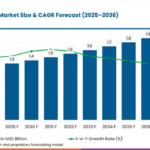


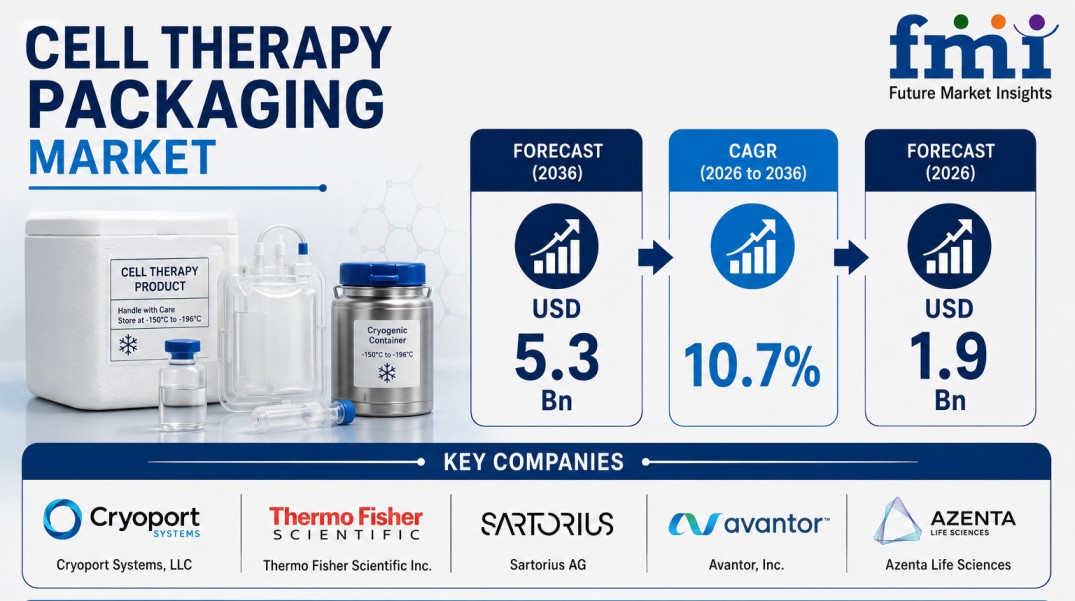
The cell therapy packaging market is witnessing strong expansion as cell-based therapies move from clinical development toward commercial treatment networks. According to Future Market Insights, the market is estimated to reach USD 1.9 billion in 2026 and is projected to grow to USD 5.3 billion by 2036, registering a 10.7% CAGR during the forecast period.
The increasing adoption of cell and gene therapies is creating demand for packaging systems capable of preserving sterility, temperature control, product integrity, and patient identity throughout the treatment journey. Packaging engineers must ensure that containers, labels, monitoring components, and protective systems remain reliable from final filling and storage through transportation and receipt at specialized treatment centers. The expansion of clinical programs and approved cell and gene therapy products is further supporting demand. As more therapies enter regulated supply networks, pharmaceutical and biotechnology companies require qualified packaging configurations that can maintain consistent performance across patient-specific shipments, manufacturing facilities, clinical sites, and treatment centers.
Key Growth Drivers in the Cell Therapy Packaging Market
Cryogenic packaging is expected to remain the leading product category, accounting for 38.0% share in 2026. Frozen cell products require highly controlled storage and transportation conditions, making cryogenic bags, vials, protective overpacks, and temperature-controlled shipping systems essential components of cell therapy logistics. Packaging qualification is particularly important because cell therapies can be highly sensitive to temperature fluctuations, handling conditions, and delays. Packaging providers therefore need to demonstrate closure integrity, material compatibility, thermal performance, and controlled thawing characteristics before products can be used routinely across clinical or commercial networks.
By application, autologous cell therapy is projected to account for 39.0% share in 2026. Unlike generic pharmaceutical products, autologous therapies are linked to individual patients from collection through administration. This creates significant demand for traceable packaging and patient-specific identification systems. Treatment centers require packaging configurations that support chain-of-identity requirements and allow products to remain correctly identified during transportation, manufacturing delays, rescheduling, and final administration. This makes labeling, monitoring, and controlled handoffs increasingly important throughout the supply chain.
Biopharmaceutical Companies Lead End-User Demand
Biopharmaceutical companies are expected to represent 36.0% of the end-user segment in 2026. These companies are responsible for defining packaging specifications, conducting stability studies, establishing release procedures, and managing change control across therapy development and commercialization.
Direct sales are also expected to remain important, with the channel projected to account for 42.0% share in 2026. Direct relationships allow packaging manufacturers to work closely with pharmaceutical quality teams, CDMOs, and treatment networks during technical qualification and specification development. As cell therapy programs expand across multiple locations, direct supply agreements can also help standardize packaging configurations and simplify deviation investigations. Specialty distributors continue to play a role in routine replenishment where less application engineering is required.
Sustainability, Qualification and Technology Trends
The cell therapy packaging market is evolving toward integrated packaging systems that connect primary containment, cryogenic protection, monitoring, and traceability. Distributed manufacturing and treatment networks require packaging configurations capable of maintaining product integrity across multiple handoffs.
A major restraint is the complexity of qualification. Packaging systems may need to undergo thermal cycling, physical handling tests, closure integrity assessments, and monitoring validation before being approved for use. These requirements can increase development timelines and costs, particularly when packaging configurations are changed during clinical or commercial programs. At the same time, closed manufacturing systems represent an important opportunity. Standardized interfaces between sterile packaging components and processing equipment can reduce manual transfers and improve consistency across cell therapy manufacturing workflows.
Country-Level Market Outlook
The United States is projected to grow at an 11.2% CAGR through 2036, making it the fastest-growing country among the markets highlighted. Established cell therapy centers, specialist manufacturing capacity, and national cold-chain infrastructure support demand. However, long transportation routes and patient-specific scheduling requirements make reliable packaging and deviation management particularly important.
Japan is expected to register an 11.0% CAGR, supported by concentrated regenerative medicine capabilities and specialist treatment networks. Packaging providers serving the Japanese market may face additional qualification requirements related to documentation, consultations, and coordination with domestic manufacturing and healthcare partners.
In Germany, the market is forecast to expand at a 10.9% CAGR. The country benefits from advanced therapy expertise across university hospitals and manufacturing facilities. Cross-border clinical networks also increase the need for standardized packaging specifications and consistent documentation.
The United Kingdom is projected to grow at a 10.7% CAGR, supported by academic hospitals, licensed manufacturing facilities, and point-of-care cell therapy development. Regional variation between manufacturing and treatment sites creates demand for consistent receipt procedures and packaging training.
South Korea is expected to record a 10.1% CAGR through 2036. The market is supported by biopharmaceutical manufacturing clusters, specialist hospitals, and regulatory development surrounding advanced regenerative medicine. Concentrated treatment networks are creating demand for packaging solutions capable of supporting narrow administration schedules and patient-linked products.
Competitive Landscape
The competitive environment includes companies specializing in cryogenic transportation, primary containment, biopharmaceutical processing, cold-chain logistics, and cell therapy manufacturing systems. Key participants include Cryoport Systems, LLC, Thermo Fisher Scientific Inc., Sartorius AG, Avantor, Inc., Azenta Life Sciences, CSafe Global, Ori Biotech Ltd., and BioLife Solutions, Inc.
Cryoport Systems, Azenta Life Sciences, and CSafe Global have strong positions in cryogenic storage and temperature-controlled transportation. Thermo Fisher Scientific, Sartorius, Avantor, and Ori Biotech connect packaging requirements with broader cell therapy manufacturing and processing workflows. BioLife Solutions focuses on primary containment and biopreservation technologies supporting cell and gene therapy applications.
Recent developments demonstrate the industry’s movement toward integrated and scalable solutions. Thermo Fisher Scientific launched the Gibco CTS Compleo Fill and Finish System in April 2026 to support scalable cell therapy formulation and filling. Ori Biotech received FDA Advanced Manufacturing Technology designation in September 2025 for its closed cell therapy manufacturing platform. Cryoport Systems introduced the Cryoport Express Cryogenic HV3 Shipping System in February 2025 for biologics requiring temperatures at or below minus 150°C.
Future Outlook
The cell therapy packaging market is expected to maintain strong growth as more cell-based therapies progress through clinical development and commercial treatment networks. The market’s expansion from USD 1.9 billion in 2026 to USD 5.3 billion by 2036 reflects rising requirements for cryogenic storage, patient-specific identification, sterile containment, temperature-controlled transportation, and monitoring.
Future demand will increasingly favor packaging suppliers that can provide more than individual containers. Companies capable of supporting complete qualification programs, integrating monitoring and traceability, maintaining thermal performance, and providing technical support across manufacturing and treatment locations are likely to strengthen their competitive positions. As cell therapy moves toward broader commercialization, packaging will become an increasingly important component of the overall product quality and patient-safety infrastructure. The ability to maintain product identity and integrity across every stage of the supply chain will remain central to market development through 2036.
Related Research Reports:
NFC-Integrated Autoinjector Secondary Packaging Market: https://www.futuremarketinsights.com/reports/nfc-integrated-autoinjector-secondary-packaging-market
Tamper-Evident Pharma Serialization Labels Market: https://www.futuremarketinsights.com/reports/tamper-evident-pharma-serialization-labels-market
Monomaterial PET Pharmaceutical Blister Packs Market: https://www.futuremarketinsights.com/reports/monomaterial-pet-pharmaceutical-blister-packs-market
About Future Market Insights (FMI)
Future Market Insights is a leading provider of market intelligence, consulting services, and syndicated research reports. FMI delivers actionable insights across packaging, logistics, industrial manufacturing, food and beverage, healthcare, chemicals, and emerging technologies, helping organizations identify growth opportunities and make informed strategic decisions in rapidly evolving markets.
Contact
Future Market Insights Inc.
Christiana Corporate
200 Continental Drive, Suite 401
Newark, Delaware 19713, USA