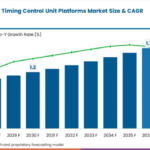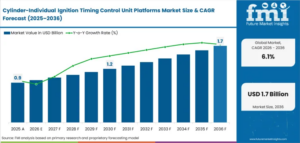


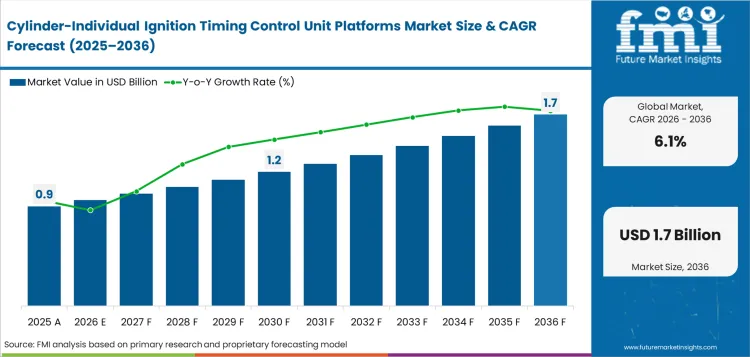
The global cylinder-individual ignition timing control unit platforms market was valued at USD 0.9 billion in 2025 and is projected to reach USD 1.0 billion in 2026. Propelled by stringent global emissions regulations and the rapid expansion of hybrid gasoline powertrains, the market is forecast to expand at a Compound Annual Growth Rate (CAGR) of 6.1% from 2026 to 2036, reaching USD 1.7 billion by 2036. According to comprehensive market intelligence from Future Market Insights (FMI), the sector will generate an absolute incremental revenue opportunity of USD 0.7 billion over the ten-year forecast period. This growth is driven by automotive original equipment manufacturers (OEMs) adopting finer spark timing to optimize combustion efficiency, eliminate knock under high compression, and meet stringent multi-pollutant targets without completely redesigning existing engine architectures.
Get detailed market forecasts, competitive benchmarking, and pricing trends:
https://www.futuremarketinsights.com/reports/sample/rep-gb-33171
Key Market Highlights at a Glance
• 2025 Baseline Market Size: USD 0.9 billion
• 2026 Estimated Market Size: USD 1.0 billion
• 2036 Forecasted Market Size: USD 1.7 billion
• Ten-Year Compound Annual Growth Rate (CAGR 2026-2036): 6.1%
• Absolute Incremental Revenue Opportunity (2026-2036): USD 0.7 billion
• Leading Control Architecture Segment (2026 Share): Integrated ECM platforms, commanding a 46.0% market share
• Leading Ignition Strategy Segment (2026 Share): Cylinder spark timing, holding a 48.0% market share
• Leading Vehicle Type Segment (2026 Share): Passenger cars, accounting for a 58.0% market share
• Leading Fuel Type Segment (2026 Share): Gasoline applications, capturing a 63.0% market share
• Leading Sales Channel Segment (2026 Share): OEM integration, dominating with a 72.0% market share
• Fastest-Growing Country Market: China, expanding at a 6.8% CAGR
• Second Fastest-Growing Country Market: India, expanding at a 6.6% CAGR
Why Is the Cylinder-Individual Ignition Timing Control Unit Platforms Market Growing?
Demand across the global cylinder-individual ignition timing control unit platforms market is accelerating due to three core engineering, regulatory, and powertrain integration drivers:
• Engine Calibration and Knock Management Under Higher Compression: Automakers are leveraging individual cylinder spark timing to prevent knock events and stabilize combustion in turbocharged, high-compression engines without requiring complete structural redesigns.
• Hybrid Gasoline Powertrain Dynamics: Frequent engine cycling in hybrid electric vehicles (HEVs) requires precise restart behavior and clean torque transitions during rapid load changes, making per-cylinder ignition calibration essential.
• Tightening Global Emissions and Fuel Economy Regulations: Regulatory bodies are enforcing strict multi-pollutant standards, such as the EPA multi-pollutant rules for model years 2027 to 2032 introduced in March 2024 and the Euro 7 emissions standards adopted by the European Council in April 2024. Furthermore, the EPA reported in February 2026 that model year 2024 new vehicles in the United States achieved a record average fuel economy level of 27.2 mpg, highlighting the continuous pressure on automakers to refine engine efficiency.
“The opportunity in cylinder-individual ignition timing control is in calibration control that can protect fuel economy under real driving conditions,” stated Nikhil Kaitwade, Principal Consultant at Future Market Insights. “Suppliers can sustain if they prove stable spark timing and knock response across engine families that will keep running beside electric platforms.”
Speak to Analyst: Customize insights for your business strategy:
https://www.futuremarketinsights.com/customization-available/rep-gb-33171
Which Control Architecture and Ignition Strategy Segments Lead the Market?
Control Architecture: Integrated ECM Platforms Take the Lead
The integrated ECM platforms segment is projected to account for a 46.0% share of control architecture demand in 2026. Automotive manufacturers increasingly prefer combining ignition timing, fuel injection, and air management into a single Engine Control Module (ECM) to streamline hardware layouts, enhance processing speed, and reduce system weight.
• Integrated ECM Platforms: Projected to hold a 46.0% share in 2026 as engine management functions combine within single control units.
• Standalone & Hybrid Controllers: Account for the remaining 54.0% of architecture demand, catering to high-performance, modular, or specialized powertrain configurations.
Ignition Strategy: Cylinder Spark Timing Dominates Functionality
Cylinder spark timing is forecast to hold a 48.0% share in 2026 within the ignition strategy category. Direct per-cylinder adjustment allows timing logic to respond instantly to real-time sensor inputs, such as those from cylinder pressure transducers. For instance, General Motors highlighted the use of cylinder pressure transducers for real-time spark timing adjustments in an April 2024 SAE technical paper, while Kistler introduced its 6054CU20 cylinder pressure sensor in February 2025 to withstand extreme pre-ignition conditions.
• Cylinder Spark Timing: Captures 48.0% of function demand in 2026, serving as the core software and hardware specification for modern spark-ignition platforms.
• Alternative Control Strategies: Comprise the remaining 52.0% share, covering broader bank-level adjustments and hybrid ignition management routines.
How Do Vehicle Type, Fuel Type, and Sales Channels Perform?
Vehicle Type and Fuel Type Segment Breakdowns
Passenger cars are projected to lead vehicle type demand with a 58.0% market share in 2026, supported by broad production volumes of gasoline and hybrid models globally. Commercial vehicles and two-wheelers account for the remaining 42.0%. In terms of fuel type, gasoline platforms capture a 63.0% market share in 2026, as spark ignition remains the primary combustion method for internal combustion and hybrid passenger vehicles.
• Passenger Cars: Holds a dominant 58.0% share in 2026 across global consumer vehicle production.
• Gasoline Platforms: Captures a 63.0% fuel-type market share in 2026, driven by high global spark-ignition volume.
Sales Channel Analysis: OEM Integration Dominates
The OEM integration sales channel is expected to hold a 72.0% share of sales channel demand in 2026. Because cylinder-individual timing software and hardware are heavily calibrated and validated prior to vehicle production, aftermarket sales remain minimal at 28.0%, primarily restricted to specialized motorsport and high-performance applications.
• OEM Integration: Commands 72.0% of sales channel share in 2026 due to direct factory line-fit requirements.
• Aftermarket Channel: Represents 28.0% share, limited by complex factory calibration and embedded security protocols.
Latest Automotive Industry Analysis Reports:
https://www.futuremarketinsights.com/industry-analysis/automotive
Market Dynamics: Drivers, Restraints, and Trends
Key Market Drivers
Primary drivers include stringent global tailpipe emission mandates, the growth of hybrid powertrains requiring rapid restart management, and real-time combustion monitoring enabled by advanced knock and pressure sensors.
Key Market Restraints
High software calibration costs, complex multi-cylinder processing requirements, and limited aftermarket replacement potential restrain broader standalone unit sales outside factory installation.
Key Market Trends
Automakers are integrating encrypted vehicle communications and secure post-sale update support into powertrain controllers. As engine control becomes software-defined, secure calibration nodes protect fuel pressure commands and ignition mapping across vehicle networks.
Country Outlook: China and India Lead Global Market Growth
• China: Projected CAGR of 6.8% (2026-2036)
• India: Projected CAGR of 6.6% (2026-2036)
• United States: Sustained steady growth supported by light truck and SUV calibration needs.
• Germany: Growth driven by premium vehicle engineering and Euro 7 compliance requirements.
China Market Story
China represents the fastest-growing country market, expanding at a 6.8% CAGR through 2036. Massive domestic automobile production and strong local sourcing of engine control electronics drive sustained volume expansion for integrated ECM platforms.
India Market Story
India is the second fastest-growing market, projected to expand at a 6.6% CAGR through 2036. Rapid expansion in passenger vehicle sales and high production of two-wheelers utilizing spark ignition keep demand active across local component manufacturing.
Competitive Landscape
The global cylinder-individual ignition timing control unit platforms market is defined by established Tier-1 automotive technology suppliers with deep expertise in engine control units and powertrain calibration. Leading companies differentiate themselves through software-defined engine management depth, sensor integration capabilities, and cybersecurity readiness.
• Robert Bosch GmbH: Global automotive technology leader offering integrated engine control modules with advanced multi-cylinder spark timing algorithms.
• Denso Corporation: Major Japanese automotive supplier providing high-precision powertrain control units and embedded engine calibration software.
• Continental AG: Leading Tier-1 supplier delivering modular engine management platforms with integrated knock control processing.
• Delphi Technologies (BorgWarner Inc.): Specialized powertrain supplier offering advanced ignition controllers optimized for hybrid and gasoline platforms.
• Hitachi Astemo, Ltd.: Automotive systems company providing integrated engine management units with real-time combustion monitoring support.
• Marellli Holdings Co., Ltd.: Global powertrain systems provider specializing in compact engine control units for passenger car applications.