

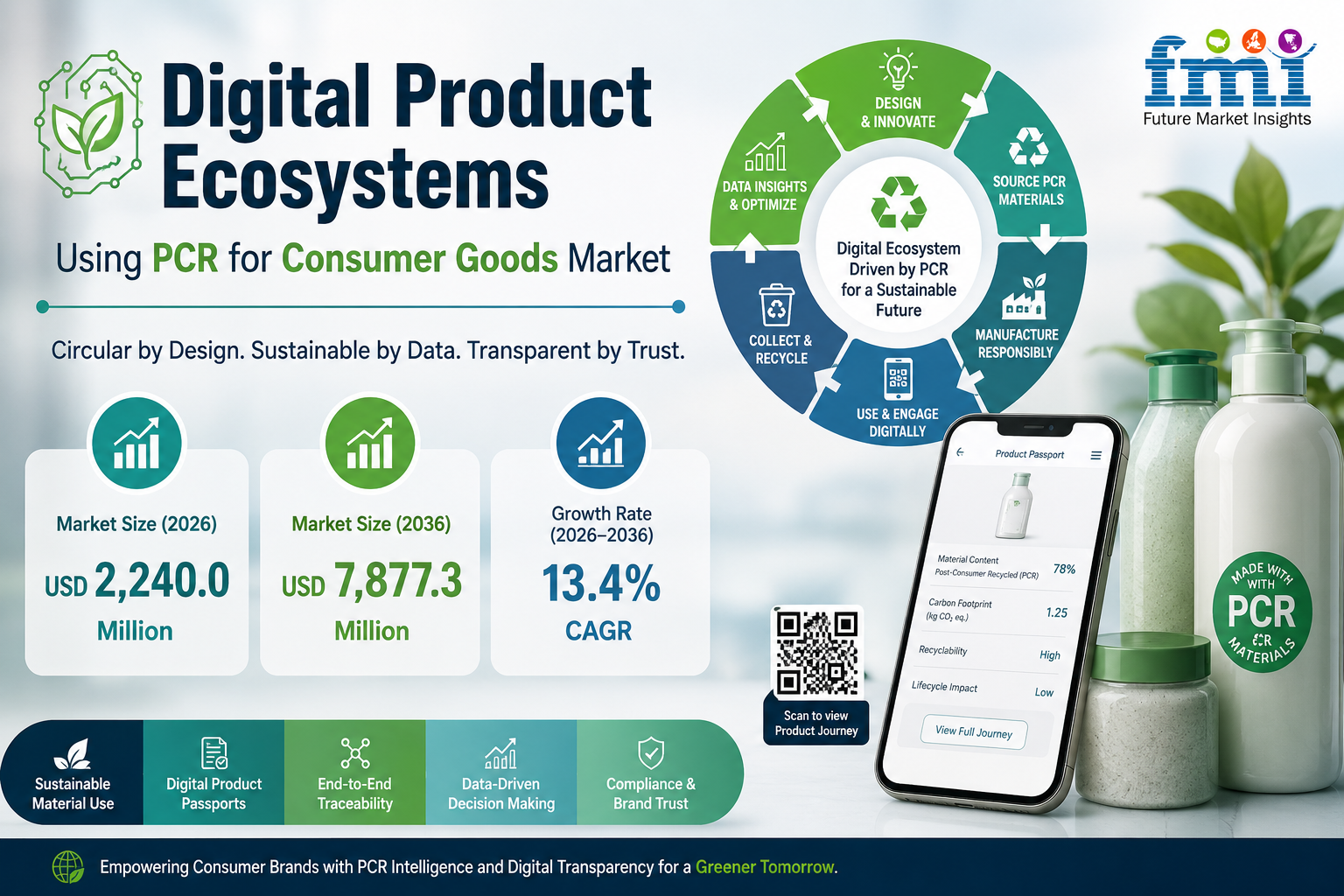
The global Digital Product Ecosystems Using PCR for Consumer Goods Market is projected to grow from USD 2,240.0 million in 2026 to USD 7,877.3 million by 2036, expanding at a 13.4% CAGR during the forecast period. Growth is being driven by increasing regulatory requirements for recycled-content verification, rising demand for supply-chain transparency, digital product passport adoption, and the need for automated compliance across consumer goods value chains.
According to Future Market Insights (FMI), digital product ecosystems using post-consumer recycled (PCR) materials are evolving beyond sustainability initiatives into strategic digital infrastructure. Digital product passports, connected packaging, block chain-enabled traceability, and cloud platforms are enabling brands to connect PCR sourcing with product-level data, certification, compliance, procurement, and recovery processes.
Quick Stats: Digital Product Ecosystems Using PCR for Consumer Goods Market
- Market Size (2026): USD 2,240.0 Million
- Market Size (2036): USD 7,877.3 Million
- Growth Rate:4% CAGR (2026–2036)
- Leading End-use: FMCG & Durable Goods (45.0% share)
- Leading Ecosystem Type: Digital Product Passport Ecosystems (37.0% share)
- Fastest-Growing Major Market: India (16.0% CAGR)
Market Overview
Digital product ecosystems using PCR integrate recycled-material information, product identification, supply-chain tracking, and digital platforms to improve visibility across the product lifecycle. These systems help consumer goods companies verify recycled content, connect certifications with finished products, monitor material flows, and prepare standardized compliance documentation.
The market is gaining momentum as regulators and brands demand reliable proof of PCR usage. Digital systems reduce dependence on fragmented supplier records by automating data capture, certification linkage, reporting, and audit preparation.
Growth Drivers
Key factors supporting market growth include:
- Rising regulatory requirements for verified recycled content.
- Increasing adoption of digital product passports.
- Growing demand for PCR traceability and supply-chain transparency.
- Expansion of cloud, blockchain, IoT, and API-enabled platforms.
- Increasing focus on circular economy and EPR initiatives.
- Growing demand for automated compliance and audit-ready reporting.
FMI analysis indicates that compliance economics will become a major adoption driver. Ecosystem providers that combine regulatory alignment, interoperability, secure data governance, and scalable integration capabilities are likely to gain a competitive advantage.
Analyst Perspective
Rahul Pandita, Principal Analyst at Future Market Insights, said:
“Digital product ecosystems using PCR are moving from sustainability-led technology projects toward core compliance and supply-chain infrastructure. As consumer goods companies face growing pressure to verify recycled content and demonstrate material traceability, platforms that connect physical PCR flows with reliable product-level data will become increasingly important.”
Segment Analysis
By End-use
FMCG & Durable Goods lead the market with a 45.0% share, supported by high product volumes, multiple SKUs, complex supplier networks, and frequent consumer interaction. Digital ecosystems help brands coordinate procurement, packaging, production, distribution, and sustainability data through centralized platforms.
By Ecosystem Type
Digital Product Passport Ecosystems account for a leading 37.0% share. These systems consolidate product-level information into structured digital records, enabling product identification, PCR verification, lifecycle documentation, supplier coordination, and compliance reporting.
Connected packaging ecosystems, platform-integrated PCR tracking, and secure product ecosystems are also gaining adoption as companies seek deeper data visibility and authentication.
Regional Outlook
- India is projected to be the fastest-growing major market at a 0% CAGR, supported by rapid digitization, expanding FMCG participation, mobile-first platforms, and scalable greenfield adoption.
- China is expected to grow at a 2% CAGR, driven by high-volume consumer markets, QR-based systems, e-commerce integration, and centralized data platforms.
- The United States is projected to expand at a 4% CAGR, supported by cloud-native infrastructure, large consumer goods portfolios, and demand for scalable supply-chain visibility.
- Germany is forecast to grow at a 8% CAGR, with strong emphasis on data integrity, interoperability, digital identifiers, and structured implementation.
- Japan is expected to register an 0% CAGR, reflecting demand for reliable, precise, and governance-focused digital ecosystems.
Competitive Landscape
Competition is centered on traceability, data interoperability, secure identification, regulatory compliance, and analytics. Leading companies are developing enterprise integrations, digital product passports, blockchain-enabled provenance systems, cloud infrastructure, and sustainability reporting capabilities.
Key Companies Profiled
- SAP SE
- Circularise B.V.
- Salesforce, Inc. (Net Zero Cloud)
- Digimarc Corporation
- Alibaba Cloud
- AntChain Technologies
- NEC Corporation
- Fujitsu Limited
Future Outlook
The market is expected to maintain strong growth through 2036 as recycled-content requirements, digital traceability, and circular economy policies converge. Future opportunities are likely to center on digital product passports, connected packaging, blockchain-enabled PCR verification, cloud-based material databases, secure product identifiers, and automated compliance reporting.
For consumer goods manufacturers, competitiveness will depend on integrating PCR data across procurement, manufacturing, distribution, and recovery systems. As regulatory expectations increase, digital product ecosystems using PCR are positioned to become core infrastructure for transparent, compliant, and circular consumer goods value chains.
Explore More Insights from the Consumer Product Industry Analysis
https://www.openpr.com/news/4591105/ceramic-travel-mug-market-to-reach-usd-591-2-million-by-2036
https://www.openpr.com/news/4591114/fogless-mirror-market-set-to-reach-usd-832-5-million-by-2036-as
FMI Custom Research: Strategic Intelligence for Confident Decision-Making
In today’s rapidly evolving business environment, leadership teams need more than market data—they need clear, actionable intelligence tailored to their strategic objectives. FMI’s Custom Research solutions are designed around the specific business questions organizations need answered, enabling executives to evaluate growth opportunities, validate investments, assess competitive dynamics, and reduce uncertainty before making critical decisions. By combining deep industry expertise, primary research, and proprietary market intelligence, FMI delivers insights that help organizations move from assumptions to evidence-based strategies with greater speed and confidence.
Key Executive Benefits
- Decision-Ready Insights: Research tailored to your specific business challenges, growth plans, and investment priorities.
- Reduced Strategic Risk: Validate market opportunities, customer demand, and competitive positioning before committing resources.
- Market Entry Confidence: Assess opportunity size, regulatory barriers, channel dynamics, and competitive landscapes with precision.
- Competitive Advantage: Gain proprietary intelligence unavailable through syndicated reports or internal datasets.
- Faster Growth Decisions: Accelerate expansion, product development, portfolio optimization, and investment planning.
- Primary Market Validation: Access real-world customer, buyer, and stakeholder insights that support high-confidence decision-making.
- Global Industry Expertise: Powered by 100+ analysts, 20,000+ published reports, and 1.6 million+ hours of research experience.
- Proven Track Record: Over 7,000 market-entry engagements completed across six regions and 14 industry sectors with strong client retention.
Business Impact
FMI helps organizations transform market complexity into strategic clarity, enabling leadership teams to identify growth opportunities faster, optimize resource allocation, strengthen competitive positioning, and make high-stakes business decisions with confidence.
To explore how FMI Custom Research can support your strategic priorities, please connect with our team at – sales@futuremarketinsights.com
Contact Us:
Future Market Insights Inc.
Christiana Corporate, 200 Continental Drive,
Suite 401, Newark, Delaware – 19713, USA
T: +1-347-918-3531
For Sales Enquiries: sales@futuremarketinsights.com
Website: https://www.futuremarketinsights.com
LinkedIn| Twitter| Blogs | YouTube