

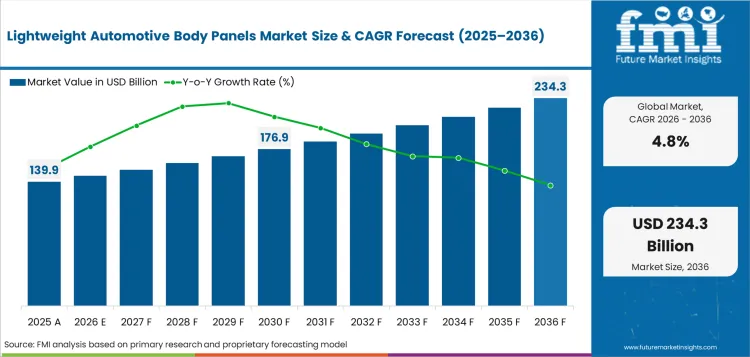
The global lightweight automotive body panels market was valued at USD 139.9 billion in 2025 and is estimated to reach USD 146.6 billion by 2026-end. Expanding at a steady Compound Annual Growth Rate (CAGR) of 4.8% between 2026 and 2036, the market is projected to reach USD 234.3 billion by 2036. According to comprehensive industry research by Future Market Insights (FMI), the sector will generate an absolute incremental revenue opportunity of USD 87.7 billion over the ten-year forecast period. Growth is propelled by global vehicle manufacturers implementing platform-level weight reduction, mitigating heavy battery pack mass in electric vehicles (EVs), meeting stringent fleet carbon emission targets, and optimizing payload capabilities across commercial delivery fleets.
Get detailed market forecasts, competitive benchmarking, and pricing trends:
https://www.futuremarketinsights.com/reports/sample/rep-gb-1532
Key Market Highlights at a Glance
• 2025 Baseline Market Size: USD 139.9 billion
• 2026 Estimated Market Size: USD 146.6 billion
• 2036 Forecasted Market Size: USD 234.3 billion
• Ten-Year Compound Annual Growth Rate (CAGR 2026-2036): 4.8%
• Absolute Incremental Revenue Opportunity: USD 87.7 billion
• Leading Vehicle Type Segment (2026 Share): Light commercial vehicles (LCVs), commanding a 68.0% market share
• Leading End-Use Segment (2026 Share): OEM manufacturing, holding a 48.0% market share
• Leading Material Type Segment (2026 Share): Aluminum-based panels, capturing a 42.0% market share
• Leading Manufacturing Technology Segment (2026 Share): Stamping technology, capturing a 46.0% market share
• Leading Product Type Segment (2026 Share): Lightweight body panels, representing a 22.0% market share
• Fastest-Growing Country Market: China, expanding at a 6.8% CAGR
• Second Fastest-Growing Country Market: United States, expanding at a 6.1% CAGR
Why Is the Lightweight Automotive Body Panels Market Growing?
Demand across the global lightweight automotive body panels market is expanding due to three primary engineering, environmental, and fleet management drivers:
• Offsetting Electric Vehicle Battery Pack Mass: Heavy battery packs add substantial baseline weight to EV platforms, forcing body-in-white engineers to reduce closure and panel weight to preserve vehicle driving range without adding complex assembly line steps.
• Stringent Global Fuel Economy and CO2 Emission Standards: European Commission rules enforce fleet targets of 93.6 g CO2/km for passenger cars and 153.9 g CO2/km for light vans between 2025 and 2029. Concurrently, the EPA reported in February 2026 a model year 2024 fuel economy baseline of 27.2 mpg for new vehicles in the United States, pressing OEMs to incorporate lightweight structures during early platform planning.
• Expanding Global EV Production and Fleet Usage: According to the International Energy Agency (IEA, May 2025), global electric car sales exceeded 17 million units in 2024, with China accounting for over 11 million units. This massive electrification scale increases demand for lightweight closures, while high-mileage delivery vans drive ongoing replacement cycles.
“Lightweight body panel sourcing is becoming a platform-level decision for vehicle makers,” stated Nikhil Kaitwade, Principal Consultant for Automotive at Future Market Insights. “Vans and electric vehicles need lower mass without weaker repair strength. Aluminum panels support high-volume forming while composite panels suit complex shapes. Joining quality protects platform launches.”
Speak to Analyst: Customize insights for your business strategy:
https://www.futuremarketinsights.com/customization-available/rep-gb-1532
Lightweight Automotive Body Panels Market Segmentation Analysis
Which Vehicle Type Segment Dominates Global Demand?
The light commercial vehicles (LCVs) segment leads the vehicle type category, projected to hold a 68.0% market share in 2026. High-utilization delivery vans and commercial light trucks require optimized payload capacity and durable replacement panels due to frequent route wear and collision repairs. Passenger cars and heavy commercial vehicles account for the remaining 32.0% combined market share.
• Light Commercial Vehicles: Projected to account for 68.0% share in 2026, driven by logistics fleet expansion and payload optimization needs.
• Passenger Cars & Heavy Commercial Vehicles: Represent the remaining 32.0% market share across high-volume personal transportation and long-haul transport platforms.
Which Material Type and Manufacturing Technology Segments Lead Production?
Aluminum-based panels represent the primary material choice, anticipated to capture a 42.0% market share in 2026. Aluminum offers excellent formability, crashworthiness, and mass reduction across hoods, doors, and roof structures. Thermoplastics and composites are also capturing high-value closure applications; Magna noted in its 2024 Form 40-F that rear thermoplastic swing doors deliver a 20% to 30% weight saving compared to conventional steel. In terms of manufacturing, stamping technology leads with a 46.0% market share in 2026 due to its high repeatability in mass production.
• Aluminum-Based Panels: Captures a leading 42.0% share in 2026, supported by strong adoption in hoods, doors, and tailgate structures.
• Stamping Technology: Commands 46.0% of manufacturing technology use in 2026, serving as the dominant process for high-volume automotive stamping lines.
Which End-Use and Product Type Segments Hold Primary Market Share?
By end use, OEM manufacturing leads with a 48.0% market share in 2026, as vehicle makers prioritize factory-approved fit, structural integrity, and precise launch timing control. Aftermarket collision repair channels account for the remaining 52.0% of long-term commercial value. Product-wise, lightweight body panels (comprising doors and hoods absorbing early lightweighting work) hold a 22.0% market share in 2026, followed by bumper systems, door panels, hood panels, trunk lids, and roof structures. Innovations like Gestamp’s One Piece Rear Frame, announced in May 2024, combine full rear sections into single hot-stamped parts to simplify body assembly and enhance crash control.
• OEM Manufacturing: Represents 48.0% of end-use market value in 2026 due to direct integration into vehicle assembly programs.
• Lightweight Body Panels: Holds a 22.0% product share in 2026, leading specific panel sub-categories across major platform redesigns.
Latest Automotive Industry Analysis Reports:
https://www.futuremarketinsights.com/industry-analysis/automotive
Market Dynamics: Drivers, Restraints, and Trends
Key Market Drivers
Major market drivers include fleet decarbonization mandates, rising EV platform deployments, the need to maximize commercial vehicle payload capacities, and structural manufacturing advancements like hot stamping and multi-material joining.
Key Market Restraints
High initial tooling and raw material costs for advanced composites and aluminum alloys, complex multi-material joining requirements on standard assembly lines, and repair difficulties in general collision shops serve as key market restraints.
Key Market Trends
Automakers are increasingly adopting large-scale single-piece stamped or molded structural components to reduce part counts. Additionally, mixed-material body engineering-combining high-strength steel, aluminum, and thermoplastics-is becoming the industry standard for next-generation vehicle architectures.
Regional Outlook: China and the United States Lead Market Acceleration
• China: Projected CAGR of 6.8% (2026-2036)
• United States: Projected CAGR of 6.1% (2026-2036)
• Europe: Driven by strict fleet CO2 targets and high adoption of lightweight commercial vans.
China Market Dynamics
China represents the fastest-growing national market globally, expanding at a 6.8% CAGR. Accelerated growth is driven by massive EV manufacturing volumes, expanding domestic light commercial vehicle fleets, and strong government support for lightweight automotive material innovation.
United States Market Dynamics
The United States follows as the second fastest-growing market, advancing at a 6.1% CAGR. Demand is propelled by strong consumer and commercial preference for pickup trucks, SUVs, and delivery vans, where aluminum hoods, tailgates, and composite closures are widely deployed to meet fuel economy standards.
Competitive Landscape
The global lightweight automotive body panels market features tier-one body structure suppliers, stamping specialists, and advanced material producers. Industry leaders are strengthening their market positions by offering mixed-material engineering capabilities, hot-stamping expertise, and single-piece structural parts that reduce assembly complexity for OEMs. Prominent market participants include:
• Magna International Inc.: Global mobility technology leader supplying lightweight thermoplastic closures, aluminum body structures, and exterior systems.
• Gestamp Automoción S.A.: Specialized automotive supplier pioneering hot-stamping technologies and single-piece structural frame components.
• BENTELER International: Global Automotive supplier developing lightweight aluminum and steel body-in-white components and sub-assemblies.
• Plastic Omnium (OPmobility): Leading producer of lightweight composite body panels, bumper systems, and thermoplastic tailgate assemblies.
• Thyssenkrupp AG: Major industrial supplier providing advanced high-strength steel and aluminum body panels and stamping solutions.
• Novelis Inc.: World leader in aluminum rolling and recycling, supplying specialized automotive aluminum sheet for lightweight body panels.