

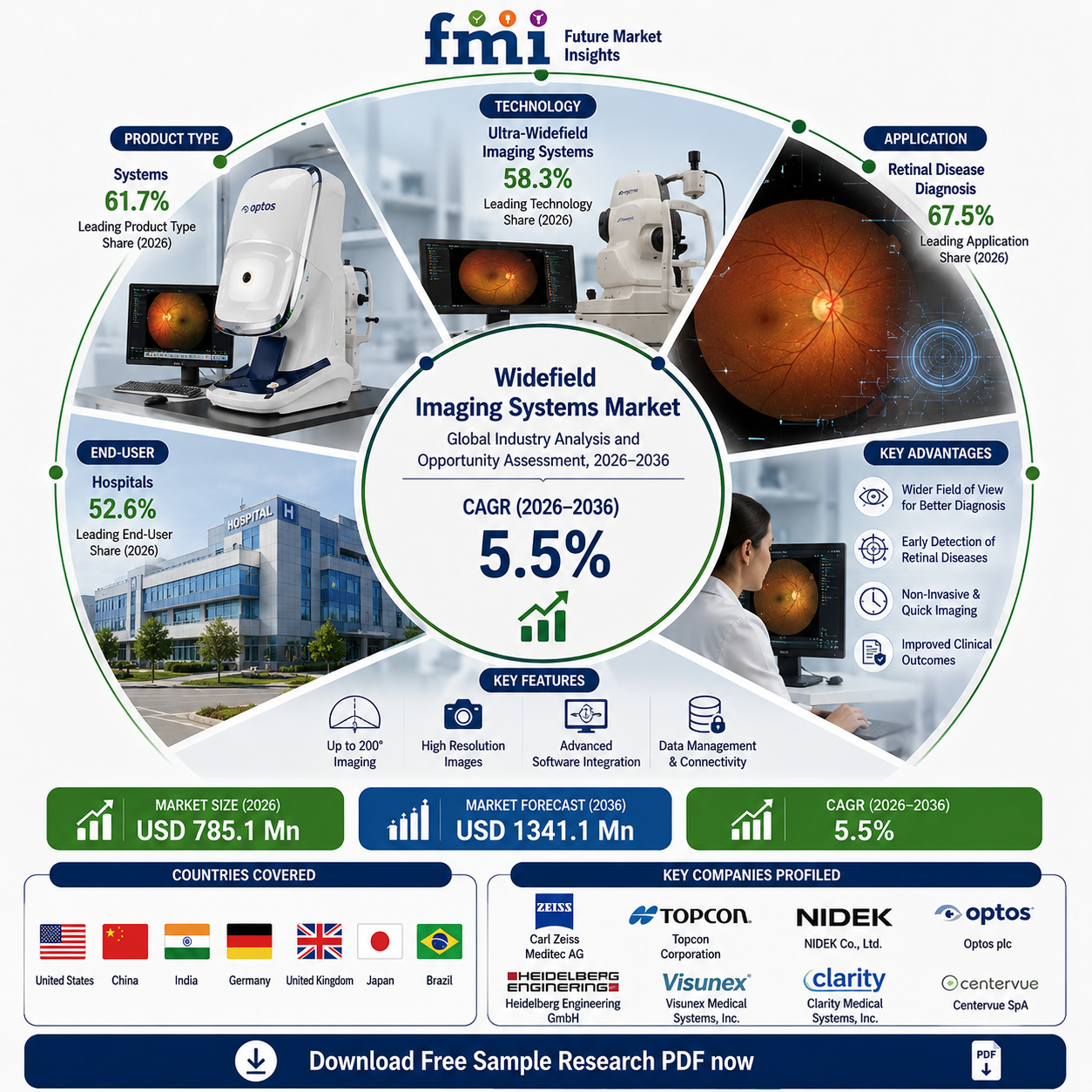
NEWARK, Del., Aug. 11, 2026 — The global Widefield Imaging Systems Market is entering a sustained growth phase as ophthalmology providers increasingly adopt advanced retinal imaging technologies capable of capturing broader areas of the retina than conventional fundus photography. According to Future Market Insights (FMI), the market is projected to grow from USD 785.1 million in 2026 to USD 1,341.1 million by 2036, registering a 5.5% CAGR during the forecast period.
Growth is being supported by the rising prevalence of diabetic retinopathy, increasing demand for peripheral retinal assessment, expanding ophthalmic screening programs, and continued modernization of hospital and specialty eye-care infrastructure. Advances in ultra-widefield imaging, OCT integration, fluorescein angiography, and AI-assisted retinal analysis are also improving the diagnostic capabilities of imaging platforms.
The market is expected to create an absolute dollar opportunity of approximately USD 556.0 million between 2026 and 2036. Adoption will increasingly depend on whether imaging platforms can provide broader retinal coverage, high-resolution visualization, efficient clinical workflows, and multimodal integration while addressing capital-cost constraints faced by ophthalmic practices.
👉 Get Detailed Market Forecasts, Competitive Benchmarking, and Pricing Trends
Key Widefield Imaging Systems Market Highlights at a Glance
- Market Size (2026): USD 785.1 Million
- Forecast Market Size (2036): USD 1,341.1 Million
- Forecast Period: 2026–2036
- CAGR (2026–2036): 5.5%
- Absolute Dollar Opportunity: Approximately USD 556.0 Million
- Leading Component: Instrument (71.0% Market Share in 2026)
- Leading Indication: Diabetic Retinopathy (33.6% Market Share in 2026)
- Leading Modality: Standalone (64.0% Market Share in 2026)
- Fastest-Growing Country: India (9.2% CAGR through 2036)
- Key Growth Regions: North America, Europe, and Asia Pacific
- Key Segments Covered: Component, Modality, Indication, Region
Analyst Viewpoint
“Widefield imaging is becoming increasingly important as ophthalmologists seek broader visualization of the peripheral retina alongside conventional posterior-pole assessment. The growing burden of diabetic retinopathy and retinal vascular disease is strengthening demand for imaging systems capable of identifying peripheral lesions and non-perfusion that may not be visible through standard retinal photography. Vendors that combine extensive field coverage with OCT integration, multimodal imaging, AI-assisted analysis, and efficient clinical workflows are likely to strengthen their position as ophthalmic providers modernize diagnostic infrastructure.”
Why Is the Widefield Imaging Systems Market Growing?
The increasing burden of retinal diseases and the need for more comprehensive visualization of the retina are creating demand for widefield imaging technologies across hospitals, retina specialty clinics, and diagnostic centers.
Traditional fundus photography generally provides a narrower field of view, limiting visualization of peripheral retinal structures. Widefield and ultra-widefield systems address this limitation by enabling clinicians to examine substantially larger areas of the retina and identify peripheral abnormalities that may otherwise remain undetected.
Key Growth Drivers
- Rising prevalence of diabetic retinopathy and other retinal disorders.
- Increasing demand for peripheral retinal visualization.
- Expansion of diabetic retinopathy screening programs.
- Growing adoption of ultra-widefield retinal imaging.
- Increasing modernization of ophthalmic diagnostic infrastructure.
- Rising use of multimodal retinal imaging.
- Advances in AI-assisted retinal image analysis.
- Increasing clinical interest in peripheral retinal lesions and non-perfusion.
Widefield imaging can provide clinicians with a broader anatomical view of the retina, supporting diagnosis, disease monitoring, treatment planning, and longitudinal assessment of retinal conditions.
Which Component Segment Leads the Widefield Imaging Systems Market?
Instrument dominates the market, accounting for 71.0% of component demand in 2026.
Widefield cameras, imaging platforms, optical systems, sensors, and supporting hardware represent the primary capital investment for ophthalmic facilities adopting widefield retinal imaging technologies.
The dominance of the instrument segment reflects the continued importance of dedicated imaging hardware in expanding retinal field coverage and supporting high-quality visualization.
Component Segment Highlights
- Instrument remains the largest component category.
- Widefield cameras provide broader retinal visualization.
- Advanced optical systems improve peripheral imaging.
- OCT integration expands multimodal diagnostic capabilities.
- Imaging hardware remains a major ophthalmic capital investment.
- AI-enabled analysis increasingly complements imaging platforms.
Why Does Diabetic Retinopathy Dominate Indication Demand?
Diabetic Retinopathy is projected to account for 33.6% of indication demand in 2026, making it the leading indication segment.
The increasing prevalence of diabetes worldwide is strengthening demand for retinal screening and monitoring infrastructure. Widefield imaging is particularly valuable in diabetic retinopathy because peripheral lesions, neovascularization, and areas of retinal non-perfusion can provide important information about disease severity and progression.
Clinical research has demonstrated that ultra-widefield imaging can identify peripheral diabetic retinopathy lesions that may not be visible using conventional standard-field photography. This broader visualization can influence disease assessment and provide additional information for clinical management.
Indication Highlights
- Diabetic retinopathy remains the leading indication.
- Growing diabetes prevalence supports screening demand.
- Ultra-widefield imaging improves peripheral lesion detection.
- Retinal non-perfusion assessment supports disease evaluation.
- Imaging can contribute to longitudinal diabetic retinopathy monitoring.
- Wider retinal visualization supports more comprehensive disease assessment.
Why Is Standalone the Leading Modality Segment?
Standalone systems are projected to account for 64.0% of modality demand in 2026.
Dedicated widefield imaging platforms remain an important configuration for ophthalmology departments, retina specialty clinics, and diagnostic centers requiring specialized retinal imaging capabilities.
Standalone systems can provide dedicated workflows for widefield retinal examination while allowing providers to integrate retinal imaging into existing ophthalmic diagnostic processes.
Modality Highlights
- Standalone systems represent the leading modality.
- Dedicated instruments support specialized retinal imaging workflows.
- Standalone platforms remain relevant across retina clinics.
- Specialized imaging improves peripheral retinal examination.
- Multimodal integration is expanding system capabilities.
How Is Ultra-Widefield Imaging Improving Retinal Disease Assessment?
The clinical value of widefield imaging is increasingly extending beyond simply increasing the field of view.
Traditional fundus photography is generally focused on the posterior pole, while widefield technologies allow clinicians to examine a substantially larger portion of the retina. Ultra-widefield systems can capture approximately 200 degrees of the retina in certain configurations, providing visualization of peripheral regions that may otherwise be difficult to assess.
Optos pioneered non-contact laser-based retinal imaging, with its ultra-widefield systems designed to capture extensive retinal views. However, peripheral retinal visualization can still be affected by factors such as eyelid obstruction, pupil limitations, and imaging geometry.
Image-steering and software-based image merging approaches have therefore been developed to improve visualization of areas that may remain obscured in standard axial imaging.
These capabilities are increasingly important for assessing diabetic retinopathy, retinal vascular occlusions, peripheral retinal lesions, retinal ischemia, and other conditions in which peripheral pathology can influence disease assessment.
Market Dynamics
Market Drivers
Growing diabetic retinopathy prevalence, expansion of retinal screening programs, increasing demand for peripheral retinal visualization, ophthalmic infrastructure modernization, advances in ultra-widefield imaging, multimodal imaging adoption, and increasing use of AI-assisted retinal analysis continue driving the global market.
Market Restraints
High capital costs, equipment budget constraints, limited access to specialized ophthalmic professionals, workflow integration challenges, and the cost of advanced OCT-integrated platforms continue restricting broader adoption, particularly among smaller ophthalmic clinics.
Market Trends
Innovation continues reshaping the widefield imaging systems industry.
Major trends include:
- Ultra-widefield retinal imaging.
- AI-assisted retinal image analysis.
- OCT-integrated widefield platforms.
- Multimodal retinal imaging.
- Automated detection of peripheral retinal lesions.
- Image-steering and image-merging technologies.
- Advanced fluorescein angiography imaging.
- Increasing use of widefield imaging in diabetic retinopathy assessment.
- Greater focus on peripheral retinal non-perfusion.
Regional and Country Outlook
North America remains an important market for widefield imaging systems due to advanced ophthalmic infrastructure, established retinal care networks, high adoption of advanced diagnostic technologies, and increasing demand for comprehensive retinal disease assessment.
Europe continues supporting market development through established healthcare systems, ophthalmic screening programs, retinal disease management initiatives, and growing adoption of advanced imaging technologies.
Asia Pacific is expected to remain an important growth region as diabetes prevalence increases, ophthalmic infrastructure expands, and healthcare providers invest in modern retinal diagnostic technologies.
India is emerging as the fastest-growing country market, with a projected 9.2% CAGR through 2036. Expanding diabetic retinopathy screening, increasing healthcare infrastructure investment, and growing access to advanced ophthalmic diagnostics are expected to support procurement.
Japan and China are also important markets as ophthalmology providers increasingly adopt advanced retinal imaging, OCT technologies, and multimodal diagnostic platforms.
Regional adoption will continue to depend on healthcare expenditure, diabetes screening coverage, ophthalmic infrastructure, equipment affordability, reimbursement conditions, and availability of trained eye-care professionals.
Competitive Landscape
Competition remains focused on field-of-view coverage, image quality, multimodal imaging capabilities, OCT integration, AI-assisted analysis, workflow efficiency, and system reliability.
Leading companies are strengthening their market positions through comprehensive ophthalmic imaging portfolios, technology development, clinical collaborations, software innovation, and integration of advanced retinal imaging modalities.
Carl Zeiss Meditec and Topcon are expected to compete through broad ophthalmic imaging portfolios, while Optos and Heidelberg Engineering continue to benefit from capabilities in ultra-widefield coverage and multimodal retinal imaging.
Key Companies
- Carl Zeiss Meditec
- Topcon
- Optos
- Heidelberg Engineering
These companies compete across imaging hardware, ultra-widefield retinal visualization, OCT integration, multimodal imaging, software, and advanced retinal diagnostic capabilities.
Frequently Asked Questions
- What is the projected size of the Widefield Imaging Systems Market by 2036?
The global Widefield Imaging Systems Market is projected to reach USD 1,341.1 million by 2036, increasing from USD 785.1 million in 2026.
- What is the expected CAGR of the Widefield Imaging Systems Market?
The market is forecast to expand at a 5.5% CAGR between 2026 and 2036.
- Which component segment dominates the market?
Instrument leads the market, accounting for 71.0% of component demand in 2026.
- Which indication segment holds the largest market share?
Diabetic Retinopathy is expected to lead with 33.6% of indication demand in 2026.
- Which modality segment dominates the market?
Standalone systems are projected to account for 64.0% of modality demand in 2026.
- Which country is expected to record the fastest growth?
India is projected to register the fastest growth, with a 9.2% CAGR through 2036, supported by expanding diabetic retinopathy screening and ophthalmic infrastructure investment.
- What factors are driving the Widefield Imaging Systems Market?
Rising diabetic retinopathy prevalence, increasing demand for peripheral retinal assessment, expansion of screening programs, advances in ultra-widefield imaging, multimodal retinal diagnostics, and AI-assisted image analysis continue driving the global Widefield Imaging Systems Market.
Related Reports:
https://sites.google.com/view/healthcarewellnessinsights/neurofibromatosis-therapeutics-market
https://sites.google.com/view/healthcarewellnessinsights/dermatology-devices-market
https://sites.google.com/view/healthcarewellnessinsights/diabetic-shoes-market
https://sites.google.com/view/healthcarewellnessinsights/muscle-stimulation-devices-market
https://sites.google.com/view/healthcarewellnessinsights/radio-frequency-beauty-equipment-market
About Future Market Insights (FMI)
Future Market Insights (FMI) is a global market intelligence and consulting firm providing comprehensive market research, competitive intelligence, and strategic business insights across industries. The firm delivers detailed forecasts, technology analysis, and data-driven recommendations that support informed decision-making for manufacturers, investors, distributors, and policymakers worldwide.
For Press & Corporate Inquiries
Rahul Singh
AVP – Marketing and Growth Strategy
Future Market Insights, Inc.
+91 8600020075
For Sales – sales@futuremarketinsights.com
For Media – Rahul.singh@futuremarketinsights.com
For Web – https://www.futuremarketinsights.com