

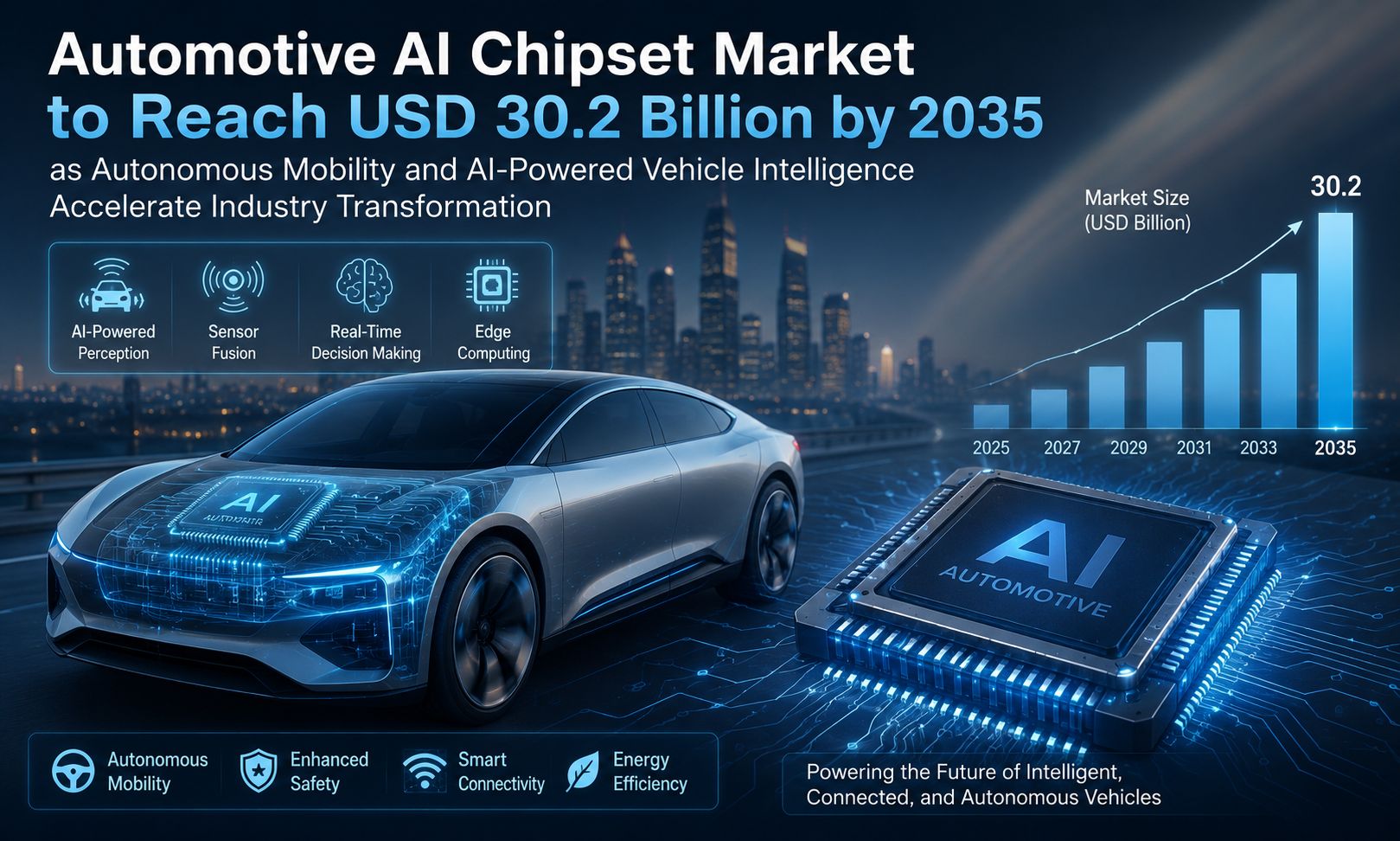
The global Automotive AI Chipset Market is entering a rapid growth phase as automakers, semiconductor companies, and mobility technology providers accelerate the adoption of AI-powered computing across next-generation vehicles. According to industry analysis, the market is projected to rise from USD 4.2 billion in 2025 to USD 30.2 billion by 2035, expanding at a CAGR of 21.6% during the forecast period.
The shift toward autonomous and semi-autonomous mobility, rising demand for real-time in-vehicle data processing, and expanding use of AI-driven driver assistance systems are reshaping the automotive electronics landscape. AI chipsets are becoming essential for ADAS, autonomous driving, predictive maintenance, in-vehicle infotainment, sensor fusion, and vehicle-to-everything (V2X) communication, enabling vehicles to become safer, smarter, and more responsive.
Electric vehicle manufacturers are also integrating AI chipsets to improve automation, energy efficiency, and software-defined vehicle capabilities. New approaches such as AI-on-chip architectures, neuromorphic computing, and energy-efficient AI accelerators are expected to drive the next wave of innovation in automotive hardware.
Get detailed market forecasts, competitive benchmarking, and pricing trends:
https://www.futuremarketinsights.com/reports/automotive-ai-chipset-market
Market Overview
The Automotive AI Chipset Market is evolving from a specialized advanced electronics segment into a central enabler of intelligent mobility. As vehicles become increasingly connected, software-defined, and autonomous, the need for high-performance AI processors is rising across both passenger and commercial vehicle platforms.
By 2035, market revenues are expected to reach USD 30.2 billion, up from USD 4.2 billion in 2025. Growth is being supported by the increasing deployment of autonomous driving systems, the integration of AI-powered sensing and perception technologies, and the demand for real-time edge computing in connected cars.
Automotive AI chipsets are now being designed to support computer vision, machine learning, natural language processing, sensor fusion, and predictive analytics, making them a foundational layer for modern automotive intelligence.
Key Growth Drivers
Several structural forces are accelerating adoption across the Automotive AI Chipset Market.
The most important drivers include:
- Rising deployment of autonomous and semi-autonomous vehicles
- Strong growth in ADAS adoption across global vehicle fleets
- Increasing demand for real-time data processing in connected cars
- Expansion of EV platforms with AI-enabled driving functions
- Growing use of sensor fusion and edge AI computing
- Rising focus on predictive maintenance and vehicle diagnostics
- Demand for in-vehicle personalization and intelligent infotainment
- Supportive government regulations for road safety and autonomous mobility
Automakers and semiconductor developers are increasingly prioritizing energy-efficient, low-latency, and high-compute AI architectures that can support both safety-critical and consumer-facing applications.
Technology and Innovation Trends
Innovation is at the core of market expansion.
AI chipsets are evolving rapidly to meet the performance requirements of autonomous systems, connected mobility, and advanced onboard computing. The market is moving beyond traditional chips toward specialized architectures that can process large volumes of data in real time while minimizing thermal load and energy use.
Key innovation trends include:
- Edge AI computing for localized real-time processing
- Neuromorphic processors inspired by human neural systems
- AI-on-chip integration for faster inference and lower latency
- 3D-stacked AI SoCs for compact high-performance automotive designs
- Energy-efficient AI accelerators for EV and hybrid platforms
- AI-enabled cybersecurity for connected vehicles
- V2X-ready chip architectures supporting intelligent transport networks
These innovations are expanding the role of AI chipsets from basic vehicle compute units into advanced decision-making platforms for safety, autonomy, and personalization.
Market Challenges and Restraints
Despite the strong outlook, the industry faces several barriers.
One of the biggest challenges is the high cost and complexity of AI semiconductor manufacturing. Automotive-grade chips must meet strict reliability, durability, and safety standards, which increases development time and production costs.
Other major restraints include:
- High computing and power requirements
- Thermal management challenges in compact vehicle systems
- Long integration cycles into existing automotive architectures
- Supply chain disruptions and semiconductor shortages
- Geopolitical trade restrictions affecting chip availability
- Regulatory compliance burdens for autonomous and safety systems
For mass-market deployment, manufacturers must balance performance, cost efficiency, and energy consumption while meeting automotive safety expectations.
Segment Analysis
GPU and ASIC Drive Market Growth as AI-Powered Automotive Systems Expand
Among chipset types, GPU and ASIC are expected to capture a major share of market demand due to their ability to support intensive parallel processing, real-time inference, and energy-efficient execution.
GPU Leads Market Demand with High-Performance AI Processing
Graphics Processing Units are widely used in ADAS, autonomous driving, and infotainment systems because they can handle large-scale computations needed for image recognition, sensor fusion, and decision-making.
GPUs are especially valuable for:
- Computer vision
- Object detection
- Real-time image analysis
- Deep learning model training and deployment
- Navigation and route planning
However, GPU adoption is sometimes constrained by energy use and heat dissipation, especially in battery-sensitive EV applications. This is driving interest in low-power AI GPU designs and edge-optimized automotive processors.
ASIC Gains Traction for Custom, Power-Efficient Automotive AI
Application-Specific Integrated Circuits are gaining momentum because they offer customized performance, lower power consumption, and highly optimized execution for specific automotive AI tasks.
ASICs are particularly useful for:
- Sensor fusion
- Automated driving logic
- Real-time perception
- Advanced vehicle safety systems
- Road hazard detection
Although ASICs are less flexible than GPUs, their high efficiency makes them a strong fit for next-generation automotive AI workloads.
Autonomous Driving and ADAS Remain the Core Application Areas
The largest demand for automotive AI chipsets comes from autonomous driving and ADAS, both of which rely on real-time processing, low latency, and intelligent sensor interpretation.
Autonomous Driving Drives Demand for High-Performance AI Compute
Autonomous vehicles use AI chipsets to enable:
- Object recognition
- Perception modeling
- Lane detection
- Sensor fusion
- Automated route planning
- Obstacle avoidance
As the industry moves toward Level 4 and Level 5 autonomy, demand is expected to rise for AI processors that can support ultra-fast inference and self-learning vehicle systems.
ADAS Expands as Safety Regulations Tighten
ADAS features such as lane departure warning, adaptive cruise control, collision detection, and blind-spot monitoring depend heavily on AI chipsets for real-time analytics.
This segment is expanding as governments and regulators increasingly require smarter safety systems in vehicles. AI chipsets help detect hazards faster, reduce human error, and improve driver assistance performance.
Additional application segments include:
- Voice and Gesture Recognition
- Infotainment System
- Predictive Maintenance
- Others
Passenger Vehicles and Commercial Vehicles Both Contribute to Market Expansion
The market is segmented by vehicle type into passenger vehicles and commercial vehicles.
Passenger vehicles currently account for major AI chipset adoption due to high consumer demand for advanced infotainment, safety features, and driver assistance systems.
Commercial vehicles are also emerging as an important growth category, supported by:
- Fleet automation
- Predictive maintenance
- AI-based route optimization
- Driver monitoring
- Smart logistics systems
Processing Type Outlook
The Automotive AI Chipset Market is also shaped by processing requirements across:
- Computer Vision
- Machine Learning
- Natural Language Processing
Computer vision remains the most critical processing type for autonomous driving and ADAS, while machine learning and NLP are increasingly important for personalization, predictive analytics, and voice-based interfaces.
Regional Analysis
Regional dynamics show strong growth across both mature and emerging automotive markets.
North America Leads in Market Share
North America holds the largest share of the Automotive AI Chipset Market, supported by significant investment in autonomous driving, the strong semiconductor ecosystem, and favorable government initiatives for AI-based mobility.
The United States and Canada are home to leading companies such as Tesla, NVIDIA, Intel, and Qualcomm, all of which are actively developing AI chipsets for next-generation vehicles.
Supportive safety regulation from organizations such as the NHTSA and the U.S. Department of Transportation is further encouraging adoption. The expansion of 5G, V2X communication, and AI-based fleet management is also reinforcing regional growth.
Europe Remains a Major Innovation Hub
Europe continues to play a leading role in the Automotive AI Chipset Market, especially in Germany, the UK, and France.
The region’s growth is being shaped by:
- Stringent vehicle safety standards
- ADAS regulation across the EU
- Strong investment in autonomous vehicle trials
- Energy-efficient mobility initiatives
- AI-focused transportation programs
Automakers such as BMW, Mercedes-Benz, and Volkswagen are investing heavily in AI chip technologies for driverless systems, neural decision-making, and connected mobility.
Asia-Pacific Registers the Highest CAGR
Asia-Pacific is expected to record the fastest growth through 2035, driven by strong automotive production, rapid EV adoption, and government-backed smart mobility initiatives.
China, Japan, South Korea, and India are key growth markets. The region benefits from:
- Large-scale semiconductor manufacturing
- Expanding EV ecosystems
- Autonomous vehicle research
- Smart city development
- AI-led mobility transformation
China in particular is seeing strong investment from companies such as Huawei, Baidu, and Alibaba, while Japan and South Korea are accelerating AI integration in automotive safety, battery management, and driver-assistance systems.
Country-Wise Insights
United States
The U.S. market is expanding on the back of strong investment in autonomous mobility, growing adoption of AI-driven infotainment, and supportive regulatory efforts around vehicle safety.
Major semiconductor firms including NVIDIA, Intel, and Qualcomm are leading innovation in autonomous driving processors, sensor fusion, and predictive maintenance systems.
Country CAGR (2025 to 2035): 20.5%
United Kingdom
The UK is witnessing rising demand for AI chipsets due to government-backed smart mobility programs, autonomous vehicle development, and connected infrastructure expansion.
The Centre for Connected and Autonomous Vehicles (CCAV) continues to support research into vehicle perception and edge AI systems. Automakers such as Jaguar Land Rover are also investing in next-generation AI processors.
Country CAGR (2025 to 2035): 21.2%
European Union
The EU market is being driven by vehicle safety regulation, semiconductor R&D investment, and broad adoption of AI in autonomous mobility.
Countries such as Germany, France, and the Netherlands are at the forefront of AI chipset integration across connected cars and electric vehicles.
Country CAGR (2025 to 2035): 21.6%
Japan
Japan’s market is supported by government initiatives, semiconductor investment, and growing interest in AI-enhanced mobility solutions.
Automotive leaders such as Toyota, Honda, and Nissan are integrating AI processors for object recognition, decision support, and autonomous driving performance.
Country CAGR (2025 to 2035): 16.2%
South Korea
South Korea is expected to grow rapidly due to government-backed AI innovation, a strong semiconductor industry, and rising demand for connected and autonomous vehicle technologies.
Companies such as Hyundai, Samsung, and SK Hynix are investing in AI chip development for real-time sensor fusion and V2X communication.
Country CAGR (2025 to 2035): 22.3%
Competitive Landscape
The Automotive AI Chipset Market is highly competitive and technology-driven, with leaders focusing on performance, efficiency, and automotive-grade reliability.
The market is increasingly shaped by:
- High R&D intensity
- Strategic partnerships between automakers and chip developers
- Custom chip development for autonomous driving
- Expansion of edge AI and software-defined vehicle platforms
- Growing demand for low-power and high-speed computer solutions
As vehicle intelligence becomes more advanced, competition will center on who can deliver the most efficient, scalable, and safety-compliant AI hardware.
Market Share Analysis by Company
| Company Name | Estimated Market Share (%) |
| NVIDIA Corporation | 20–25% |
| Qualcomm Technologies, Inc. | 15–20% |
| Intel Corporation (Mobileye) | 12–16% |
| NXP Semiconductors | 8–12% |
| Tesla, Inc. | 6–10% |
| Other Companies (combined) | 25–35% |
Key Company Offerings and Activities
| Company Name | Key Offerings / Activities |
| NVIDIA Corporation | Develops high-performance AI processors under NVIDIA DRIVE for autonomous driving and deep learning. |
| Qualcomm Technologies, Inc. | Offers Snapdragon Ride AI chipsets for ADAS and connected in-vehicle computing. |
| Intel Corporation (Mobileye) | Manufactures AI vision processing chips for ADAS and autonomous driving solutions. |
| NXP Semiconductors | Provides AI-enabled SoCs for edge computing, vehicle connectivity, and automotive safety. |
| Tesla, Inc. | Designs custom AI processors for neural network inference and autonomous decision-making. |
Leading Companies Analysis
Major market participants include:
- NVIDIA Corporation
- Qualcomm Technologies, Inc.
- Intel Corporation (Mobileye)
- NXP Semiconductors
- Tesla, Inc.
- Advanced Micro Devices (AMD)
- Renesas Electronics Corporation
- Samsung Electronics (Exynos Auto)
- Xilinx / AMD Adaptive Computing
- Huawei Technologies Co., Ltd.
These companies are investing in:
- Automotive-grade AI processors
- High-speed inference engines
- Deep learning accelerators
- Real-time perception systems
- Low-power semiconductor architectures
Their ability to combine compute performance with vehicle safety and energy efficiency will shape future market leadership.
Investment and Strategic Developments
Recent activity in the Automotive AI Chipset Market highlights a strong innovation pipeline.
NVIDIA continues expanding its DRIVE platform for autonomous mobility. Qualcomm is strengthening its Snapdragon Ride portfolio for ADAS and connected vehicles. Intel’s Mobileye division remains focused on vision-based autonomous systems. Tesla continues advancing in-house AI chip development for its Full Self-Driving ecosystem.
At the same time, industry participants are increasing investments in:
- Edge AI infrastructure
- Autonomous driving platforms
- EV-focused compute solutions
- Low-power AI accelerators
- V2X-ready semiconductor systems
These initiatives are helping the market move toward a more connected, intelligent, and software-defined vehicle future.
Future Outlook
By 2035, the Automotive AI Chipset Market is expected to evolve far beyond today’s ADAS and infotainment applications.
Future growth will likely be defined by:
- Level 4 and Level 5 autonomous driving
- Quantum AI computing applications
- Neuromorphic automotive processors
- AI-powered vehicle-to-cloud ecosystems
- Decentralized edge inference
- Software-defined mobility architectures
Asia-Pacific will continue to drive volume growth, while North America and Europe lead in innovation, regulation, and high-value AI deployment.
Companies capable of delivering scalable, energy-efficient, and safety-compliant AI chipsets will be best positioned to lead the next era of automotive intelligence.
FMI Custom Research: Strategic Intelligence for Confident Decision-Making
In today’s fast-changing automotive technology landscape, leadership teams need more than market data — they need decision-ready intelligence tailored to strategic priorities.
FMI Custom Research solutions are designed to help organizations evaluate growth opportunities, validate investments, assess competitive dynamics, and reduce uncertainty before making critical decisions.
Key Executive Benefits
- Decision-ready insights
- Reduced strategic risk
- Market entry confidence
- Competitive advantage
- Faster growth decisions
- Primary market validation
- Global industry expertise
- Proven execution capability
Business Impact
FMI helps organizations transform market complexity into strategic clarity, enabling leadership teams to identify growth opportunities faster, optimize investment decisions, and strengthen competitive positioning.
To explore how FMI Custom Research can support your strategic priorities, please connect with the team at sales@futuremarketinsights.com.
Conclusion
The global Automotive AI Chipset Market is undergoing a major transformation driven by autonomous mobility, ADAS expansion, connected vehicle ecosystems, and the rapid rise of edge AI computing.
With market value projected to increase from USD 4.2 billion in 2025 to USD 30.2 billion by 2035, the sector is expected to benefit from strong innovation across chip architecture, vehicle intelligence, and AI-driven safety systems.
As automakers and semiconductor providers continue to invest in smarter, faster, and more efficient automotive compute platforms, the companies that can balance performance, cost, and energy efficiency will define the future of intelligent mobility.
Related Reports
Demand for Automotive AI Chipset in Japan – https://www.futuremarketinsights.com/reports/japan-automotive-ai-chipset-market
Demand for Automotive AI Chipset in USA – https://www.futuremarketinsights.com/reports/united-states-automotive-ai-chipset-market
Cloud AI Chipsets Market – https://www.futuremarketinsights.com/reports/cloud-ai-chipsets-market
Automotive Infotainment SoCs Market – https://www.futuremarketinsights.com/reports/automotive-infotainment-socs-market
AI PC Market – https://www.futuremarketinsights.com/reports/ai-pc-market
About Future Market Insights (FMI)
Future Market Insights (FMI) delivers actionable, decision-focused market intelligence that goes beyond traditional research reports. The company provides:
- In-depth pricing and cost benchmarking analysis
- Demand forecasting based on real industry inputs
- Procurement and buyer behavior insights
- Supply chain and trade flow intelligence
- Technology adoption trends across industries
FMI follows a robust bottom-up research methodology, combining insights from industry experts, procurement leaders, and technical professionals to ensure accurate and practical market intelligence.
For Press & Corporate Inquiries
Rahul Singh
AVP – Marketing and Growth Strategy
Future Market Insights, Inc.
+91 8600020075
For Sales: sales@futuremarketinsights.com
For Media: Rahul.singh@futuremarketinsights.com
For Web: https://www.futuremarketinsights.com/
For Web: https://www.factmr.com/