

The global food allergen testing market is entering a critical growth phase as packaged food manufacturers shift from basic label compliance to proof-of-control manufacturing. Food companies are increasingly recognizing that allergen management extends beyond labeling requirements and requires continuous monitoring of ingredients, production lines, sanitation processes, and supplier documentation.
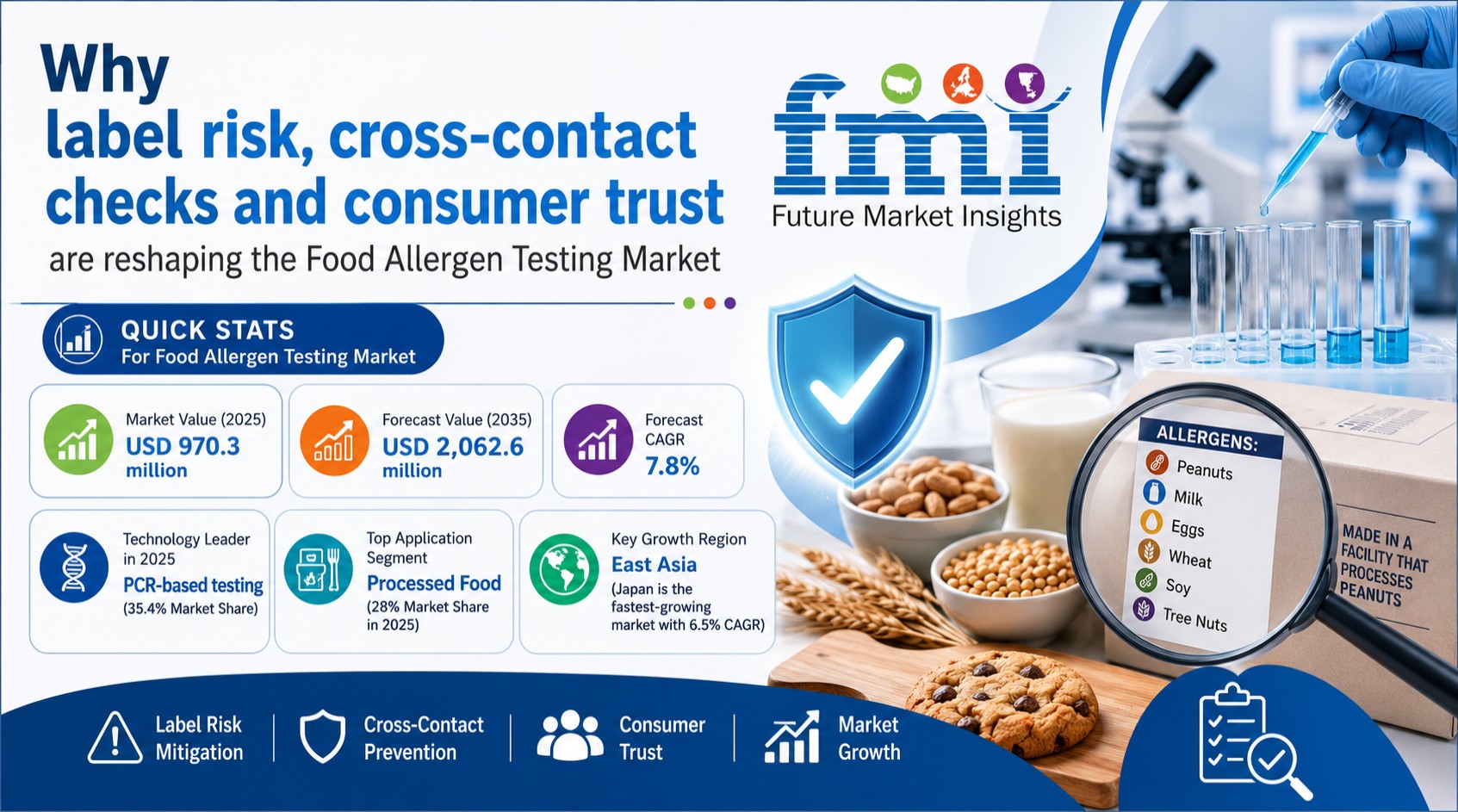
According to industry analysis, the food allergen testing market is valued at USD 970.3 million in 2025 and is projected to reach USD 2,062.6 million by 2035, expanding at a CAGR of 7.8%. The market’s growth reflects stricter regulatory requirements, rising food allergy prevalence, increasing consumer awareness, and growing pressure on manufacturers to demonstrate effective allergen control throughout production.
As allergen-related recalls continue to impact brand reputation and retailer confidence, food manufacturers are investing in advanced testing technologies, integrated data platforms, and automated compliance systems to strengthen consumer trust and reduce operational risk.
Featured Snippet: Key Market Answer
Q: What is driving growth in the food allergen testing market?
A: Growth is being driven by stricter food allergen labeling regulations, increasing prevalence of food allergies, rising recall risks, growing consumer demand for transparency, and greater adoption of advanced testing technologies such as PCR, ELISA, and rapid detection systems that help manufacturers prevent cross-contact and ensure label accuracy.
Quick Stats of Food Allergen Testing Market
- Market Size (2025): USD 970.3 Million
- Forecast Market Value (2035): USD 2,062.6 Million
- CAGR (2025–2035):8%
- Leading Technology: PCR-Based Testing (35.4%)
- Leading Application: Processed Food (28.0%)
- Fastest Emerging Trend: Proof-of-Control Manufacturing Systems
Market Overview: The Shift Toward Proof-of-Control Manufacturing
The food allergen testing market encompasses laboratory testing, process verification, ingredient screening, environmental monitoring, and quality assurance systems designed to detect allergenic substances throughout food production.
Historically, allergen management focused primarily on packaging labels and ingredient declarations. Today, manufacturers are expected to provide evidence that allergens are effectively controlled across the entire production process.
The industry is being reshaped by three major forces:
- Increasing regulatory scrutiny of allergen labeling
- Growing prevalence of food allergies among consumers
- Rising demand for documented proof of allergen control
As a result, allergen testing is evolving from a laboratory activity into a strategic component of food safety governance.
Key Growth Drivers
Rising Food Allergy Prevalence
Food allergies continue to affect millions of consumers worldwide.
Recent health data indicates that a significant percentage of both adults and children have diagnosed food allergies, increasing pressure on manufacturers to ensure accurate labeling and effective allergen control measures.
Stricter Labeling Regulations
Regulatory agencies continue to strengthen allergen disclosure requirements.
The inclusion of sesame as a major allergen under recent legislation and updated allergen labeling guidance has heightened compliance requirements for packaged food manufacturers.
Growth in Processed Food Production
Processed foods remain the largest application segment due to the complexity of ingredient sourcing and manufacturing processes.
Shared production lines, multiple ingredients, and supplier variability increase the need for comprehensive allergen testing programs.
Increased Recall and Brand Protection Concerns
Undeclared allergens remain one of the leading causes of food recalls globally.
Manufacturers are investing in testing systems that help identify risks before products reach consumers, reducing financial and reputational exposure.
Market Trends Shaping the Industry
Integrated Allergen Governance Platforms
Organizations are increasingly connecting allergen testing data with supplier management, quality control, and labeling systems.
This creates a unified allergen proof layer across the production process.
Cross-Contact Risk Mapping
Manufacturers are moving beyond end-product testing toward predictive risk assessment.
Advanced software platforms can identify high-risk production routes, changeover sequences, and sanitation gaps before contamination occurs.
Automated Label Validation
Food companies are adopting systems that link ingredient declarations directly to labeling workflows.
This reduces the risk of inaccurate allergen statements reaching packaging and retail shelves.
Cleaning Verification Digitization
Sanitation records, swab testing, and allergen detection results are increasingly being integrated into digital quality management platforms.
This allows manufacturers to demonstrate proof of control during audits and retailer reviews.
Retailer-Driven Transparency
Retailers are demanding greater visibility into allergen management practices.
Testing records are increasingly being used as part of supplier qualification and performance evaluation processes.
Segment Insights
Technology Leadership: PCR-Based Testing (35.4%)
PCR-based testing continues to lead the market due to its sensitivity, accuracy, and ability to detect trace allergen residues.
Key advantages include:
- High detection sensitivity
- Strong validation performance
- Broad regulatory acceptance
- Compatibility with complex food matrices
- Reliable detection of processed allergens
PCR technology is increasingly being combined with automated data management systems to support plant-wide allergen governance.
Application Leadership: Processed Food (28.0%)
Processed food remains the largest application segment because of:
- Complex ingredient formulations
- Shared manufacturing equipment
- Frequent product changeovers
- Increased cross-contact risks
- Extensive labeling requirements
Manufacturers within this segment face heightened pressure to demonstrate allergen control throughout production.
Related Food Safety Testing Markets
Food Diagnostics Services Market
- Market Value (2025): USD 15.6 Billion
- Forecast Value (2036): USD 49.2 Billion
- CAGR: 11.0%
Growth is driven by increasing demand for integrated food safety and quality assurance systems.
Food Pathogen Testing Market
- Market Value (2025): USD 23.5 Billion
- Forecast Value (2035): USD 55.8 Billion
- CAGR: 8.7%
Demand is supported by heightened concerns regarding foodborne pathogens and contamination control.
Food Authenticity Testing Services Market
- Market Value (2025): USD 6.62 Billion
- Forecast Value (2035): USD 11.31 Billion
- CAGR: 5.5%
Expansion is driven by increasing requirements for label accuracy, ingredient verification, and anti-adulteration programs.
Regional Insights
North America
North America remains a leading market due to:
- Strong allergen labeling regulations
- High consumer awareness
- Advanced testing infrastructure
- Significant investments in food safety technologies
The region continues to drive adoption of integrated allergen management platforms.
Europe
Europe maintains strong growth supported by:
- Stringent food safety standards
- Comprehensive allergen disclosure requirements
- Retailer-driven quality assurance programs
- Growing demand for transparency
Asia-Pacific
Asia-Pacific is expected to experience the fastest long-term growth owing to:
- Expanding processed food production
- Increasing food exports
- Rising regulatory oversight
- Growing consumer awareness of food allergies
Emerging Markets
Countries across Latin America, Southeast Asia, and the Middle East are strengthening allergen management programs as food manufacturing capacity expands.
Competitive Landscape
The food allergen testing market is evolving toward integrated testing and compliance ecosystems that combine laboratory diagnostics, quality management, supplier governance, and labeling control.
Key Players
- Thermo Fisher Scientific
- Hygiena
- Romer Labs
- Neogen Corporation
- Eurofins Scientific
- SGS SA
- Bureau Veritas
- Mérieux NutriSciences
- Intertek Group plc
- ALS Limited
Competitive Differentiation Factors
- PCR testing capabilities
- ELISA assay performance
- Rapid testing technologies
- Digital compliance integration
- Supplier management systems
- Label governance functionality
- Data traceability and audit readiness
Recent Developments
- Expansion of PCR-based allergen detection technologies
- Increased adoption of integrated allergen management software
- Growth of supplier allergen verification programs
- Development of automated label review systems
- Enhanced digital sanitation and cleaning verification workflows
- Greater focus on retailer-ready compliance documentation
Expert Insight
The food allergen testing market is entering what can be described as the “Proof-of-Control Era.”
Manufacturers are no longer evaluated solely on whether allergen labels are present. They are increasingly judged on their ability to demonstrate that allergens are actively managed throughout ingredient sourcing, production, sanitation, testing, and packaging processes.
Organizations that connect testing results, supplier records, cleaning verification, and label governance into a single operational framework will be better positioned to reduce recall risks, strengthen retailer relationships, and build lasting consumer trust.
FAQs
What is the future outlook for the food allergen testing market?
The market is projected to reach USD 2,062.6 million by 2035, growing at a CAGR of 7.8% as food manufacturers strengthen allergen control programs and regulatory compliance initiatives.
Which technology dominates the market?
PCR-based testing leads the market with a 35.4% share due to its high sensitivity, reliability, and effectiveness across diverse food applications.
Why are packaged food manufacturers increasing allergen testing investments?
Manufacturers seek to reduce recall risks, comply with labeling regulations, improve consumer trust, and strengthen retailer confidence through documented allergen control.
What are the key challenges facing the industry?
- Cross-contact management
- Supplier allergen verification
- Label accuracy
- Cleaning validation
- Data integration across multiple systems
Which application segment leads the market?
Processed food is expected to lead the market with a 28.0% share due to complex manufacturing environments and extensive allergen control requirements.
Which regions offer the strongest growth opportunities?
Asia-Pacific offers the highest long-term growth potential, while North America and Europe continue to lead in regulatory adoption and food safety innovation.
Conclusion
The food allergen testing market stands at the center of the packaged food industry’s transformation toward evidence-based food safety management. As regulations become more stringent and consumers demand greater transparency, allergen testing will become increasingly integrated into manufacturing, compliance, and brand protection strategies.
Organizations that embrace proof-of-control manufacturing, digital allergen governance, and advanced testing technologies will be better positioned to reduce operational risks, protect brand reputation, and strengthen consumer confidence.
Over the coming decade, allergen testing is expected to evolve from a compliance requirement into a strategic business capability, making it a foundational pillar of modern food manufacturing.
Related Research Reports
Food Diagnostics Services Market is projected to reach USD 49.2 billion by 2036, driven by growing demand for integrated food safety and quality assurance solutions.
Food Pathogen Testing Market is forecast to expand from USD 23.5 billion in 2025 to USD 55.8 billion by 2035, supported by increasing food safety concerns and regulatory oversight.
FMI Custom Research: Strategic Intelligence for Confident Decision-Making
In today’s rapidly evolving business environment, leadership teams need more than market data they need clear, actionable intelligence tailored to their strategic objectives. FMI’s Custom Research solutions are designed around the specific business questions organizations need answered, enabling executives to evaluate growth opportunities, validate investments, assess competitive dynamics, and reduce uncertainty before making critical decisions. By combining deep industry expertise, primary research, and proprietary market intelligence, FMI delivers insights that help organizations move from assumptions to evidence-based strategies with greater speed and confidence.
Key Executive Benefits
- Decision-Ready Insights: Research tailored to your specific business challenges, growth plans, and investment priorities.
- Reduced Strategic Risk: Validate market opportunities, customer demand, and competitive positioning before committing resources.
- Market Entry Confidence: Assess opportunity size, regulatory barriers, channel dynamics, and competitive landscapes with precision.
- Competitive Advantage: Gain proprietary intelligence unavailable through syndicated reports or internal datasets.
- Faster Growth Decisions: Accelerate expansion, product development, portfolio optimization, and investment planning.
- Primary Market Validation: Access real-world customer, buyer, and stakeholder insights that support high-confidence decision-making.
- Global Industry Expertise: Powered by 100+ analysts, 20,000+ published reports, and 1.6 million+ hours of research experience.
- Proven Track Record: Over 7,000 market-entry engagements completed across six regions and 14 industry sectors with strong client retention.
Business Impact
FMI helps organizations transform market complexity into strategic clarity, enabling leadership teams to identify growth opportunities faster, optimize resource allocation, strengthen competitive positioning, and make high-stakes business decisions with confidence.
To explore how FMI Custom Research can support your strategic priorities, please connect with our team at – sales@futuremarketinsights.com
About Future Market Insights (FMI)
Future Market Insights is a leading provider of market intelligence, consulting services, and syndicated research reports. FMI delivers actionable insights across food and beverage, healthcare, consumer goods, biotechnology, chemicals, industrial products, and emerging technologies, helping organizations identify growth opportunities and make informed strategic decisions in evolving global markets.
Contact Us:
Future Market Insights Inc.
Christiana Corporate, 200 Continental Drive,
Suite 401, Newark, Delaware – 19713, USA
T: +1-347-918-3531
Why FMI: https://www.futuremarketinsights.com/why-fmi
For Sales Enquiries: sales@futuremarketinsights.com
Website: https://www.futuremarketinsights.com