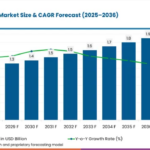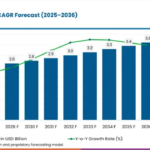


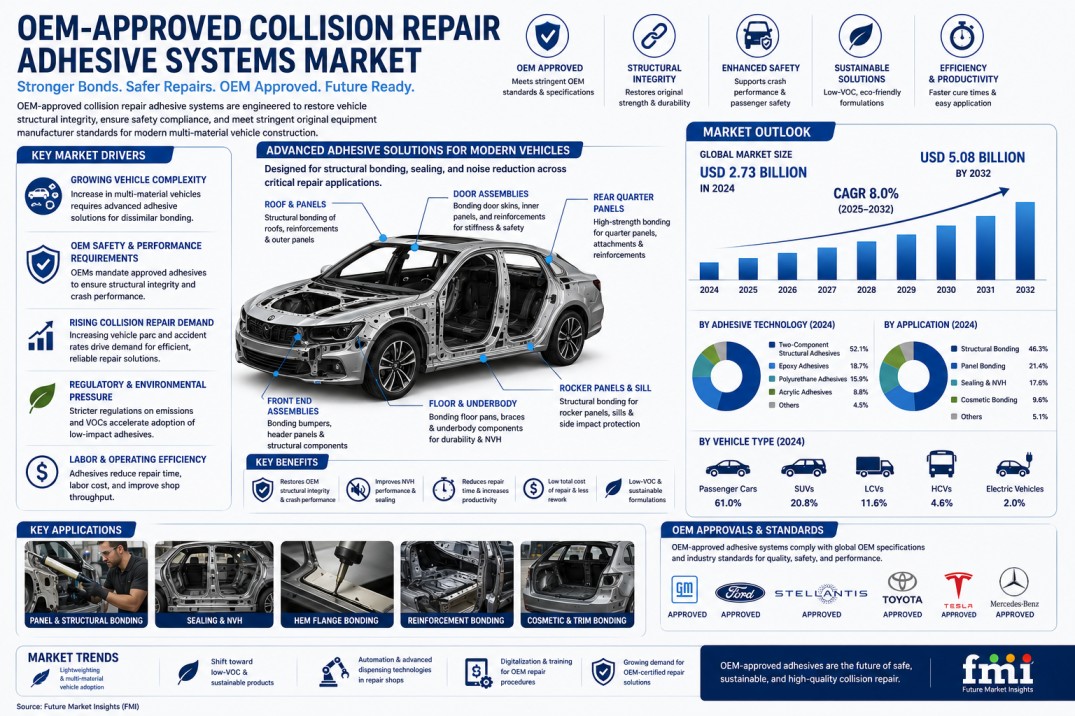
The global OEM-approved collision repair adhesive systems market is projected to grow from USD 1.4 billion in 2026 to USD 2.4 billion by 2036, expanding at a CAGR of 5.4% during the forecast period. Growth is being fueled by increasing adoption of certified repair procedures, rising use of mixed-material vehicle structures, and stricter insurer and OEM requirements for documented repair quality. Two-part epoxy systems are expected to dominate the market with a 44.8% share in 2026, while passenger cars will account for 66.3% of overall demand.
Collision Repair Industry Shifts Toward OEM-Compliant Bonding Solutions
Modern vehicle designs increasingly incorporate aluminum, high-strength steel, composites, and lightweight materials to improve safety and fuel efficiency. These advanced structures require specialized repair methods that go beyond traditional welding and mechanical fastening.
As a result, collision repair centers are adopting OEM-approved adhesive systems that meet manufacturer specifications and preserve vehicle structural integrity. Repair procedures now frequently require body shops to use designated adhesives listed in OEM repair manuals, ensuring that repaired vehicles meet original safety and performance standards.
The growing emphasis on repair quality, technician accountability, and vehicle certification is making adhesive selection a critical part of the collision repair process.
Certified Body Shops Drive Demand for Approved Adhesive Systems
Certified repair facilities are becoming major consumers of OEM-approved adhesives. These shops must follow strict repair protocols established by vehicle manufacturers, particularly when repairing structural panels and safety-critical components.
Adhesives used in collision repairs are increasingly required to have documented performance characteristics, approved application procedures, and traceable usage records. Failure to comply with OEM repair specifications can impact warranty eligibility and vehicle safety certifications.
As repair complexity rises, body shops are investing in adhesive systems that provide reliable bonding performance while simplifying compliance with manufacturer requirements.
Two-Part Epoxy Systems Remain the Preferred Adhesive Technology
Two-part epoxy systems are projected to account for 44.8% of market demand in 2026, making them the leading adhesive category.
These systems offer excellent structural strength, corrosion resistance, and long-term durability, making them suitable for bonding steel, aluminum, and composite vehicle panels. Their ability to withstand mechanical loads while maintaining dimensional stability has made them a preferred choice for collision repair applications.
Epoxy adhesives are particularly valuable in structural repairs where maintaining vehicle crashworthiness is essential. Their widespread acceptance across OEM repair programs continues to support strong market demand.
Mixed-Material Vehicle Bodies Increase Repair Complexity
Automakers are increasingly using multiple materials within a single vehicle platform to achieve weight reduction and improve efficiency. While these materials deliver performance benefits, they also create new challenges for repair professionals.
Traditional repair techniques may not be suitable for joining dissimilar materials, making adhesive bonding a critical solution. Adhesives help prevent galvanic corrosion between metals, distribute loads more evenly, and preserve material properties that could be compromised by welding.
As mixed-material construction becomes more common across passenger vehicles and electric vehicles, demand for advanced adhesive systems is expected to increase significantly.
Panel Bonding Applications Continue to Lead Market Demand
Panel bonding remains one of the most important applications for collision repair adhesives. Damaged exterior panels, roof sections, quarter panels, and structural reinforcements often require approved bonding solutions to restore vehicle integrity.
OEMs increasingly specify adhesive bonding procedures to improve durability and corrosion protection while reducing repair-related distortion. Body shops are therefore prioritizing products that deliver consistent bond strength and comply with manufacturer repair guidelines.
The growing number of bonded vehicle components across modern vehicle platforms will continue supporting demand for panel bonding adhesives throughout the forecast period.
Cartridge Systems Improve Accuracy and Repair Documentation
Cartridge-based adhesive systems are expected to capture 62.7% of package format demand in 2026.
These systems simplify adhesive dispensing and mixing, helping technicians achieve accurate ratios while minimizing material waste. Cartridge systems also support repair documentation requirements by allowing easier tracking of product usage, batch numbers, and application records.
As insurers and OEMs place greater emphasis on repair traceability, cartridge-based solutions are becoming increasingly attractive for professional collision repair facilities.
Insurer Oversight Strengthens the Need for Repair Documentation
Insurance companies are becoming more involved in reviewing repair procedures and validating repair quality. This trend is encouraging body shops to maintain detailed records of materials, repair methods, and curing processes.
OEM-approved adhesive systems support this requirement by providing documented performance data, standardized application procedures, and traceable product information. Repair facilities using approved materials can more easily demonstrate compliance with insurer and manufacturer expectations.
This growing focus on documentation and accountability is creating long-term opportunities for suppliers offering certified adhesive solutions.
Electric Vehicles Create New Opportunities for Adhesive Suppliers
Electric vehicle adoption is generating additional demand for collision repair adhesives. EV structures frequently utilize lightweight materials and bonded assemblies that require specialized repair methods.
Battery enclosures, aluminum body panels, and composite components often depend on adhesive bonding technologies to maintain structural performance and thermal management characteristics. Repairing these systems requires adhesives specifically approved for EV applications.
As EV production expands globally, adhesive manufacturers are developing products and training programs tailored to the unique requirements of electric vehicle repair.
Asia-Pacific Emerges as a Key Growth Region
India is expected to record the fastest growth rate through 2036, with a CAGR of 6.9%, driven by increasing vehicle ownership, expanding professional repair networks, and rising adoption of certified repair practices.
China is also witnessing strong demand as EV production growth and advanced vehicle construction techniques increase the need for specialized repair adhesives. The country’s expanding collision repair infrastructure is creating opportunities for both domestic and international adhesive suppliers.
Across Asia-Pacific, growing vehicle parc size and increasing awareness of OEM repair standards are expected to support sustained market expansion.
Competitive Landscape Focuses on Training and OEM Coverage
Competition within the OEM-approved collision repair adhesive systems market is increasingly centered on technical support, training programs, and OEM approval coverage.
Leading suppliers are investing in technician education, certification initiatives, and application support services to help repair facilities adopt proper bonding procedures. Companies that can demonstrate verified bond performance, broad vehicle coverage, and compliance with manufacturer repair standards are likely to strengthen their position in certified repair networks.
As vehicle designs continue to evolve and repair requirements become more stringent, OEM-approved adhesive systems are expected to play an increasingly important role in ensuring safe, efficient, and compliant collision repairs worldwide.
Browse More Industry Reports
Machine Condition Monitoring Market – https://www.openpr.com/news/4535416/machine-condition-monitoring-market-to-reach-usd-7-2-billion
Lightweight Automotive Body Panels Market – https://www.openpr.com/news/4535430/lightweight-automotive-body-panels-market-to-reach-usd-234-3
EV Driveline NVH Couplings Market – https://www.openpr.com/news/4535443/ev-driveline-nvh-couplings-market-to-reach-usd-3-2-billion