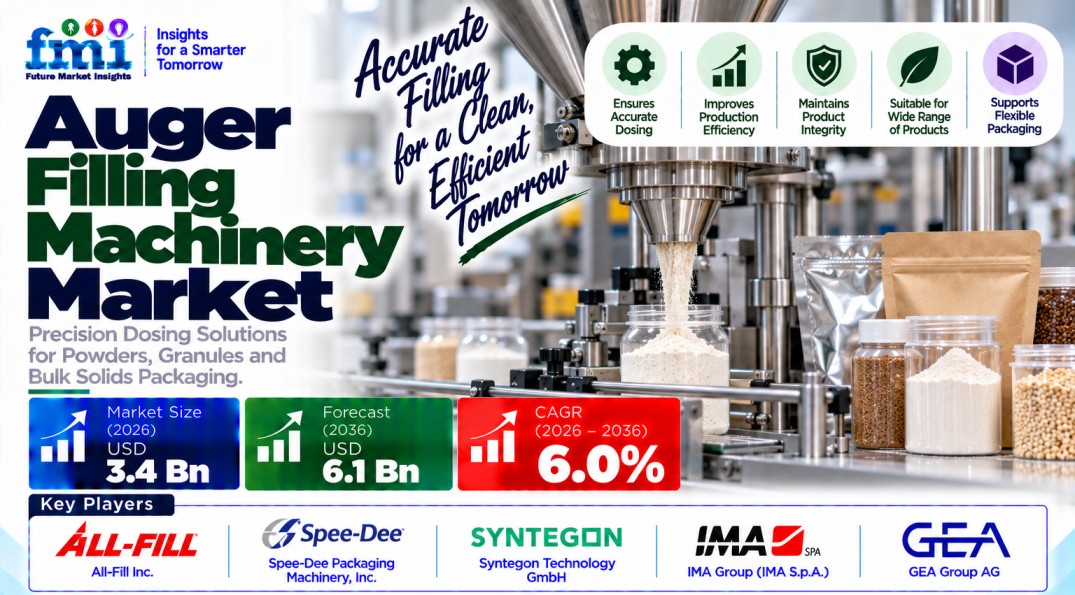
According to the latest market intelligence report published by Future Market Insights (FMI), the global auger filling machinery market is estimated to reach USD 3.4 billion in 2026, up from USD 3.2 billion in 2025, and is projected to grow to USD 6.1 billion by 2036. The market is forecast to expand at a compound annual growth rate (CAGR) of 6.0% from 2026 to 2036, creating an incremental revenue opportunity of USD 2.7 billion.
Rising ingredient costs, the need for accurate powder dosing and growing emphasis on hygienic packaging operations are supporting demand for advanced auger filling systems. FMI highlights the role of direct-drive servo technology, automated inline configurations and closed-loop checkweigher feedback in helping manufacturers improve fill consistency and reduce product giveaway across food, nutrition and pharmaceutical packaging lines.
Market Size & Growth Forecasts
- 2025 Baseline Market Value: USD 3.2 billion
- 2026 Estimated Market Size: USD 3.4 billion
- 2036 Projected Market Value: USD 6.1 billion
- Forecast CAGR: 6.0% from 2026 to 2036
- Incremental Revenue Opportunity: USD 2.7 billion
The report assesses machinery revenue across machine configuration, product type, container type, end use and region. Its scope includes standalone, inline, rotary, semi-automatic and benchtop auger filling machines, servo dosing heads and replacement auger tooling. Downstream secondary case packers, liquid piston fillers and bulk agricultural grain conveyors are excluded.
>> Get Detailed Market Forecasts, Competitive Benchmarking, and Pricing Trends: https://www.futuremarketinsights.com/reports/sample/rep-gb-35890
Key Market Segments
By Machine Configuration
Automatic inline equipment is projected to account for 39.2% of machine configuration sales in 2026. These systems integrate with linear conveyors and support automated container indexing. Closed-loop checkweigher feedback and servo-driven dosing help maintain fill consistency while reducing interruptions during production.
Other configurations include rotary, semi-automatic and benchtop equipment.
By Product Type
Free-flowing powders are expected to represent 39.3% of the product-type segment in 2026. Granulated sugars, crystalline beverage mixes and similar materials can be dosed efficiently when their flow characteristics remain consistent. Non-free-flowing powders, granules and fine dusty products also form part of the market.
By Container Type and End Use
- Bottles and jars: Projected to account for 42.9% of container-type demand in 2026, supported by applications involving protein powders, supplements and dry formulations.
- Food and beverage: Expected to represent 40.3% of end-use demand in 2026, reflecting demand from commercial food processors, dairy powder manufacturers and nutrition producers.
Other container formats include pouches and sachets, cans and cartons. Additional end-use industries include pharmaceuticals, chemicals and cosmetics.
By Country / Region
FMI projects the following country-level growth rates for 2026–2036:
- United Kingdom: 6.2% CAGR, supported by sports nutrition contract packaging and demand for faster allergen changeovers.
- United States: 6.1%, reflecting demand for automated nutraceutical packaging and infant formula production.
- Italy: 6.0%, supported by packaging machinery capabilities and pharmaceutical powder-dosing applications.
- France: 5.9%, driven by specialty dairy formulations and cosmetic powder processing.
- Japan: 5.7%, with opportunities in compact, multi-lane dosing and single-serve packaging.
- Germany: 5.6%, supported by pharmaceutical containment requirements and upgrades to existing production lines.
The report covers North America, Latin America, Western Europe, Eastern Europe, East Asia, South Asia and Pacific, and the Middle East and Africa.
Major Market Trends & Drivers
Precision dosing and reduced product giveaway: Direct-drive servo motors and closed-loop weighing feedback can help manufacturers respond to changes in powder flow and hopper pressure, improving fill accuracy and reducing unnecessary ingredient consumption.
Hygienic design and faster changeovers: Tool-free split hoppers and quick-release auger shafts can simplify cleaning between product batches. These features are particularly relevant to contract packagers handling multiple formulations and allergen-sensitive products.
Broader automation across powder packaging: Food, nutritional supplement, chemical and pharmaceutical manufacturers are integrating auger fillers with conveyors, checkweighers and packaging lines to improve throughput and maintain consistent filling performance.
>> Access Detailed Market Insights: https://www.futuremarketinsights.com/reports/auger-filling-machinery-market
Competitive Landscape
The market includes specialist dosing-equipment manufacturers and suppliers of integrated packaging systems. Competitive differentiation centers on servo accuracy, hygienic equipment design, changeover efficiency, dust containment and integration with downstream packaging operations.
Key Companies Profiled Include: All-Fill Inc., Spee-Dee Packaging Machinery, Inc., Syntegon Technology GmbH, IMA Group (IMA S.p.A.), GEA Group AG, Optima Packaging Group GmbH, Rovema GmbH and ProMach, Inc.
Analyst Perspective / Insight
“Dry powder packagers no longer judge auger fillers solely by mechanical cycle speed. Suppliers combining direct-drive servo pitch accuracy with tool-free split hoppers are winning multi-line replacement contracts across nutrition and pharmaceutical plants.”
— Nandini Roy Choudhury, Principal Consultant, Future Market Insights