

According to the latest analysis by Future Market Insights, the global 3D Printed Hip and Knee Implants Market is entering a new phase of expansion as healthcare providers increasingly embrace personalized orthopedic solutions designed to improve patient outcomes and surgical precision. The rapid advancement of additive manufacturing technologies, combined with growing demand for customized implants and minimally invasive procedures, is transforming the landscape of joint replacement surgeries worldwide.
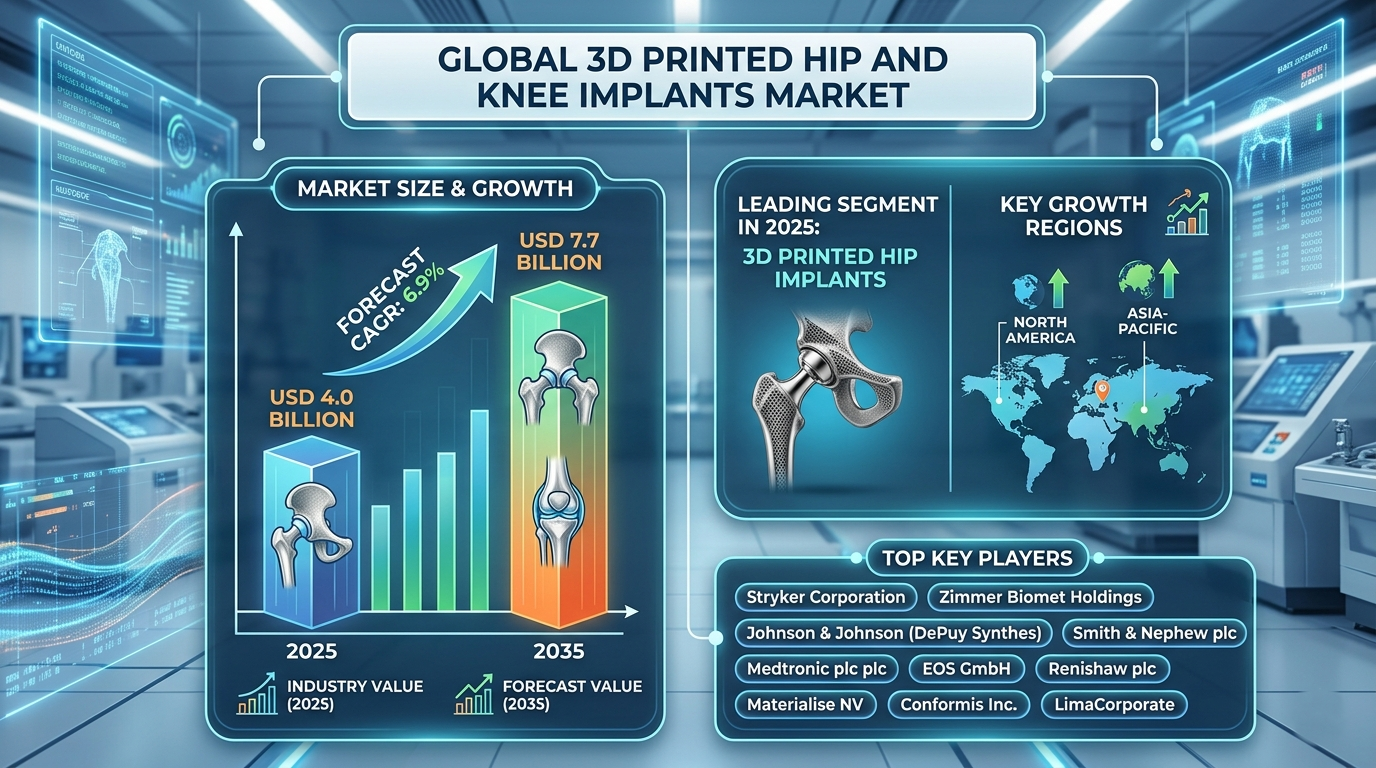
The market is projected to grow from USD 4.0 billion in 2025 to USD 7.7 billion by 2035, registering a CAGR of 6.9% during the forecast period. Increasing prevalence of osteoarthritis, degenerative joint disorders, and age-related musculoskeletal conditions continues to drive demand for innovative implant technologies capable of delivering superior anatomical fit and long-term functionality.
Healthcare systems worldwide are increasingly prioritizing patient-centric treatment approaches, creating favorable conditions for the adoption of advanced 3D printed orthopedic implants that offer enhanced osseointegration, reduced revision rates, and improved post-operative recovery.
Quick Market Highlights
- Global market projected to grow from USD 4.0 billion in 2025 to USD 7.7 billion by 2035
- Rising adoption of patient-specific orthopedic implants across major healthcare markets
- Strong demand driven by increasing incidence of osteoarthritis and joint degeneration
- Growing integration of AI-powered implant design and advanced additive manufacturing technologies
- Expansion of minimally invasive surgical procedures supporting implant adoption
- Titanium and titanium alloys remain the preferred material segment for orthopedic applications
Personalized Orthopedic Care Emerges as a Major Growth Catalyst
The orthopedic industry is undergoing a significant transformation as personalized medicine principles become increasingly integrated into surgical planning and implant development. Unlike traditional implants that require surgeons to adapt procedures to standardized components, 3D printed implants are designed using patient-specific anatomical data derived from advanced imaging technologies.
This customized approach has demonstrated significant benefits in terms of implant fit, alignment accuracy, and overall patient satisfaction. Healthcare providers are recognizing that personalized implants can help reduce complications, improve mobility outcomes, and enhance long-term implant performance.
As patient expectations continue to rise, demand for individualized orthopedic solutions is expected to accelerate across both developed and emerging healthcare markets.
3D Printed Hip Implants Lead Market Expansion
Among implant categories, 3D Printed Hip Implants are expected to dominate the market in 2025, accounting for 54.4% of total revenue.
The segment’s leadership is supported by growing demand for total hip arthroplasty procedures, particularly among aging populations experiencing mobility limitations and degenerative joint conditions. Customized hip implants provide superior anatomical matching, allowing surgeons to optimize implant positioning while minimizing surgical complexity.
The increasing availability of regulatory-approved 3D printed acetabular cups and femoral components has further strengthened commercial adoption. Additionally, advanced porous structures enabled through additive manufacturing are improving osseointegration, supporting long-term implant stability and clinical success.
Industry analysts anticipate continued investment in patient-specific hip implant technologies as healthcare providers seek to improve surgical outcomes while reducing revision procedures.
Advanced Materials Accelerate Implant Performance
Material innovation remains a critical factor influencing market growth and product development strategies.
Titanium and titanium alloys are projected to capture 63.2% of total market revenue in 2025, making them the most widely utilized materials within the 3D printed hip and knee implant ecosystem. Their exceptional strength-to-weight ratio, corrosion resistance, and biocompatibility make them highly suitable for load-bearing orthopedic applications.
Advancements in additive manufacturing techniques such as Laser Powder Bed Fusion (LPBF) and Electron Beam Melting (EBM) are enabling manufacturers to create highly complex implant structures with optimized surface textures that promote bone ingrowth and long-term fixation.
The growing adoption of cementless implant procedures, particularly in revision surgeries and complex joint reconstructions, continues to reinforce the preference for titanium-based implant designs.
Hospitals Remain the Primary Adoption Channel
Hospitals accounted for approximately 65% of market revenue in 2025, supported by their advanced surgical infrastructure and ability to perform high volumes of joint replacement procedures.
The successful implementation of 3D printed implants often requires sophisticated imaging capabilities, digital surgical planning systems, and highly trained orthopedic specialists. Hospitals are uniquely positioned to provide these resources while maintaining comprehensive post-operative care programs.
In addition, many leading healthcare institutions are forming strategic partnerships with implant manufacturers to gain access to next-generation orthopedic technologies. The integration of surgical robotics, digital workflow platforms, and additive manufacturing capabilities is further strengthening hospitals’ leadership position within the market.
As healthcare systems increasingly prioritize precision medicine initiatives, hospitals are expected to remain the dominant end-user segment throughout the forecast period.
Artificial Intelligence and Digital Manufacturing Enhance Innovation
Technological innovation continues to reshape the competitive landscape of the 3D printed orthopedic implant industry.
Artificial intelligence is playing an increasingly important role in implant design optimization, enabling manufacturers to create highly customized devices that account for patient-specific anatomical and biomechanical characteristics. Advanced simulation tools are improving implant performance predictions while supporting more efficient product development cycles.
Manufacturers are also leveraging digital twin technologies, automated quality control systems, and advanced manufacturing software to improve production efficiency and consistency.
The combination of AI-driven design and additive manufacturing is creating new opportunities for customized orthopedic solutions that were previously unattainable through conventional manufacturing methods.
Regulatory Advancements Support Commercial Expansion
The regulatory environment for medical 3D printing continues to evolve in favor of innovation and commercialization.
Healthcare authorities across major markets are actively developing frameworks that support the approval and adoption of patient-specific medical devices. Improved regulatory clarity is encouraging manufacturers to accelerate investments in customized implant development while expanding commercial availability.
A notable milestone occurred in April 2025 when restor3d secured FDA 510(k) clearance for its iTotal Identity CR 3DP Porous Total Knee Replacement System. The approval marked the company’s first cementless offering following the acquisition of Conformis and highlighted the growing acceptance of advanced patient-specific orthopedic solutions.
As regulatory pathways become more streamlined, market participants are expected to introduce increasingly sophisticated implant designs and treatment options.
Challenges Continue to Influence Market Development
Despite strong growth prospects, several challenges continue to impact broader market adoption.
The production of customized implants often involves higher manufacturing costs compared to conventional alternatives, creating reimbursement and affordability considerations in certain healthcare systems. Regulatory requirements for patient-specific devices can also increase development timelines and compliance costs.
Additional challenges include ensuring long-term implant durability, expanding access to advanced manufacturing capabilities, and training orthopedic surgeons on emerging technologies and surgical workflows.
Nevertheless, ongoing innovation and increasing clinical validation are expected to gradually overcome many of these barriers throughout the forecast period.
Competitive Landscape Focuses on Innovation and Customization
Competition within the 3D printed hip and knee implants market remains intense as manufacturers invest heavily in personalized medicine strategies and advanced manufacturing technologies.
Leading companies are focusing on:
- Patient-specific implant development
- AI-powered design optimization
- Advanced titanium manufacturing capabilities
- Smart implant technologies
- Robotic surgery integration
- Strategic partnerships with healthcare providers
- Regulatory expansion initiatives
Major industry participants include Stryker Corporation, Zimmer Biomet Holdings, Johnson & Johnson (DePuy Synthes), Smith & Nephew plc, Medtronic plc, EOS GmbH, Renishaw plc, Materialise NV, Conformis Inc., LimaCorporate, Exactech Inc., DJO Global Inc., Additive Orthopaedics, and Arthrex Inc.
Organizations capable of combining clinical expertise, digital innovation, and manufacturing excellence are expected to strengthen their competitive positions over the coming decade.
Outlook: Personalized Joint Replacement Set to Transform Orthopedic Care
Looking ahead to 2035, 3D printed hip and knee implants are expected to become an increasingly important component of modern orthopedic treatment strategies.
The convergence of additive manufacturing, artificial intelligence, advanced biomaterials, and robotic-assisted surgery is creating a new generation of highly personalized orthopedic solutions designed to improve patient outcomes and healthcare efficiency.
As healthcare providers continue to prioritize precision medicine and long-term value-based care, the market is well-positioned to benefit from sustained investment, regulatory support, and technological advancement. The next decade is likely to favor manufacturers capable of delivering customized implants that combine clinical performance, cost-effectiveness, and superior patient experiences.
Related Reports:
3D Printed Medical Devices Market
3D Printed Surgical Models Market
Have a specific Requirements and Need Assistant on Report Pricing or Limited Budget please contact us – sales@futuremarketinsights.com
About Future Market Insights (FMI)
Future Market Insights, Inc. (FMI) is an ESOMAR-certified, ISO 9001:2015 market research and consulting organization, trusted by Fortune 500 clients and global enterprises. With operations in the U.S., UK, India, and Dubai, FMI provides data-backed insights and strategic intelligence across 30+ industries and 1200 markets worldwide.
Contact Us:
Future Market Insights Inc.
Christiana Corporate, 200 Continental Drive,
Suite 401, Newark, Delaware – 19713, USA
T: +1-347-918-3531
Why FMI: https://www.futuremarketinsights.com/why-fmi
For Sales Enquiries: sales@futuremarketinsights.com
Website: https://www.futuremarketinsights.com