

The China food-grade alcohol market is undergoing a period of structural transformation as domestic supply controls, feedstock competition, and import dependence increasingly shape pricing power across the value chain. Food-grade alcohol remains a critical ingredient for spirits, vinegar, food extracts, nutraceuticals, pharmaceuticals, cosmetics, and specialty food processing applications. However, unlike many food ingredients, its supply is heavily influenced by government policy decisions, fuel ethanol mandates, grain security measures, and international trade conditions.
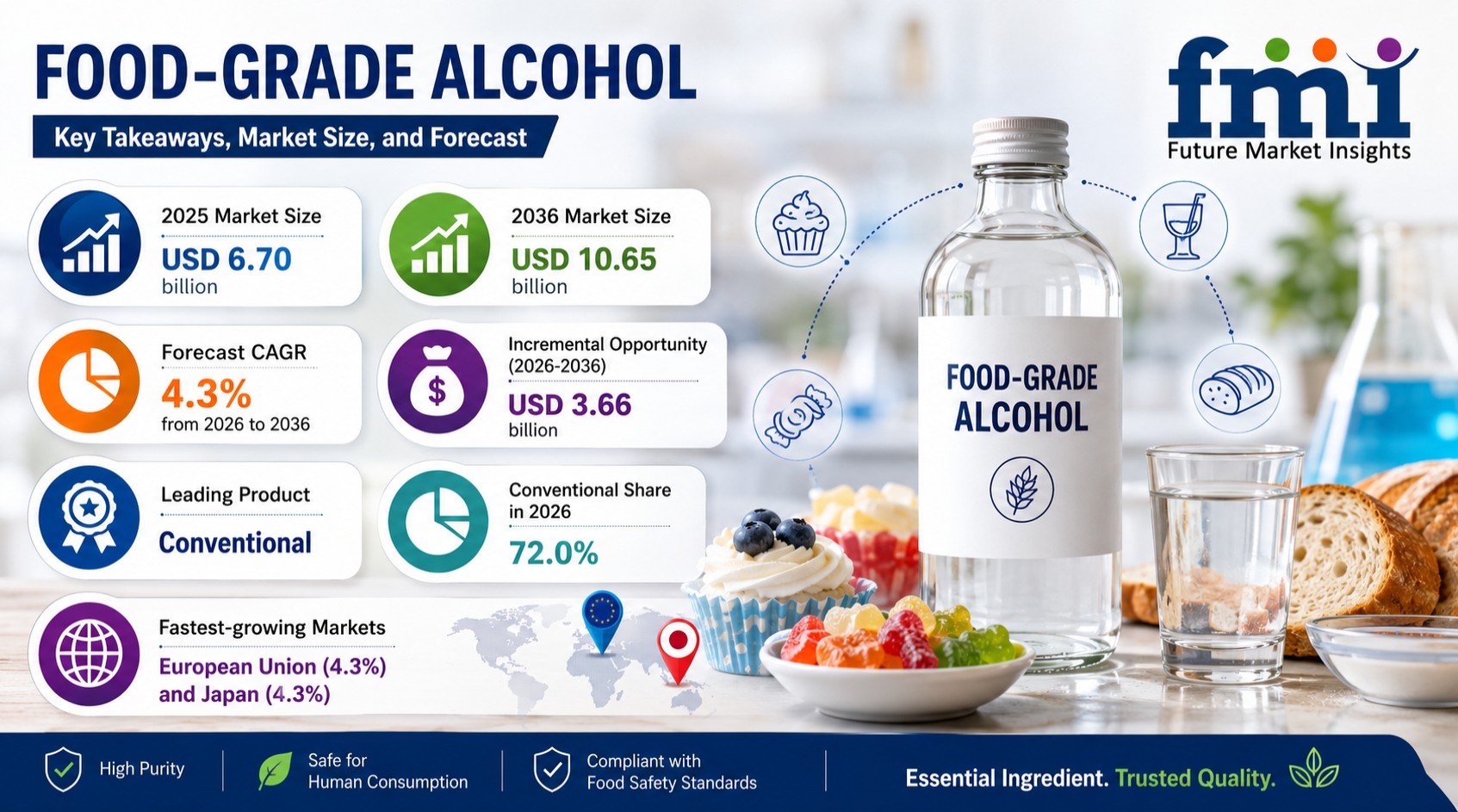
According to industry estimates, the global food-grade alcohol market is projected to witness steady growth through 2036, supported by rising demand from beverage, pharmaceutical, and food processing industries. In China, pricing dynamics are becoming increasingly complex as producers balance food-grade demand against fuel ethanol requirements and industrial applications.
The market’s future will be defined by the interaction between domestic production controls and import reliance, creating a pricing environment where policy decisions can be as influential as traditional supply-and-demand fundamentals.
Featured Snippet: Key Market Answer
Q: How do domestic supply controls and import reliance affect pricing power in food-grade alcohol in China?
A: Domestic supply controls influence pricing power by determining how much ethanol capacity is allocated to food-grade, fuel, and industrial applications. When government policies prioritize fuel ethanol production or grain security, food-grade supply tightens and domestic prices rise. At the same time, China’s reliance on imported high-purity alcohol establishes a pricing ceiling because buyers can switch to imports when domestic prices exceed landed foreign costs.
Quick Stats of China Food-Grade Alcohol Market
- Coverage: 7 Regions, 30 Countries
- Forecast Period: 2026–2036
- Primary Feedstock: Corn-Based Ethanol
- Secondary Feedstock: Molasses-Based Ethanol
- Key Demand Segment: Spirits and Beverage Applications
- Emerging Trend: Supply Chain Diversification and Import Risk Management
- Major Pricing Driver: Domestic Ethanol Allocation Policies
- Critical Risk Factor: Feedstock Competition with Fuel Ethanol Programs
Market Overview: Pricing Power in a Policy-Driven Market
Food-grade alcohol pricing in China is shaped by factors extending far beyond traditional commodity market fundamentals.
The country’s ethanol industry operates within a framework where food-grade, industrial, and fuel ethanol applications compete for the same feedstocks and production assets. As a result, policy interventions related to energy security, grain management, and environmental targets can significantly influence supply availability.
Food-grade alcohol producers increasingly face competition from fuel ethanol programs that redirect production capacity toward transportation fuels. At the same time, beverage manufacturers, food processors, and pharmaceutical companies require consistent access to high-purity alcohol grades.
This dynamic has created a market where pricing power depends on a producer’s ability to secure feedstocks, maintain regulatory compliance, manage logistics networks, and navigate import competition.
Key Growth Drivers
Expansion of Beverage and Food Processing Industries
China’s growing premium beverage, flavoring, and food ingredient sectors continue to drive demand for food-grade alcohol.
Manufacturers increasingly require consistent quality and purity standards to support premium product positioning and export-oriented production.
Rising Demand for High-Purity Grades
Pharmaceutical, nutraceutical, and specialty food applications are increasing demand for extra-neutral alcohol grades above 96% purity.
These applications often rely on imports when domestic supply is insufficient.
Modernization of Food Manufacturing
Food producers are investing in advanced extraction, preservation, and ingredient processing technologies that require reliable access to food-grade ethanol.
This trend supports long-term demand growth despite periodic supply disruptions.
Supply Chain Resilience Initiatives
Manufacturers are diversifying sourcing strategies and increasing inventory planning to reduce exposure to policy-driven supply fluctuations.
Market Trends Shaping the Industry
Fuel Ethanol Competition Intensifies
Government fuel blending programs continue to influence ethanol allocation decisions.
When blending mandates expand, producers often redirect capacity toward fuel applications, reducing food-grade availability and strengthening seller pricing power.
Multi-Feedstock Production Strategies
Distilleries are increasingly investing in flexible production systems capable of processing both corn and molasses feedstocks.
This flexibility helps mitigate raw material price volatility and improves supply resilience.
Import Reliance for Premium Grades
High-purity food-grade alcohol imports are becoming an increasingly important component of China’s supply balance.
Imported products help stabilize markets during periods of domestic tightness while limiting excessive price increases.
Supply Chain Localization
Food and beverage manufacturers are seeking closer proximity to alcohol suppliers to reduce logistics costs and improve procurement reliability.
Risk-Based Procurement Strategies
Large buyers increasingly utilize forward contracts, strategic inventories, and multi-supplier sourcing programs to manage pricing volatility.
Key Factors Influencing Pricing Power
Domestic Supply Controls
China’s ethanol industry operates under policy frameworks that can influence production allocation.
Key controls include:
- Fuel ethanol blending mandates
- Grain reserve policies
- Production licensing systems
- Environmental compliance requirements
- Provincial development priorities
These controls determine the volume available for food-grade applications.
Feedstock Competition
Corn remains the dominant feedstock for food-grade alcohol production.
Pricing is heavily influenced by:
- Domestic grain harvest conditions
- Government grain reserve operations
- Livestock feed demand
- Feedstock transportation costs
Molasses-based production offers diversification but remains concentrated in specific sugar-producing regions.
Import Dependence
China relies on imported alcohol for certain high-purity applications.
Imports serve as a balancing mechanism when domestic availability declines.
This dependence creates a natural pricing ceiling because buyers can switch to foreign suppliers when domestic prices become uncompetitive.
Currency Movements
Exchange rate fluctuations directly influence imported alcohol costs.
A weaker RMB increases import costs and strengthens domestic producer pricing power.
A stronger RMB improves import competitiveness and limits domestic pricing flexibility.
Segment Insights
Product Leadership: Conventional Food-Grade Alcohol
Conventional food-grade alcohol continues to dominate market demand due to:
- Large-scale beverage production
- Broad industrial application
- Established supply chains
- Competitive pricing
Application Leadership: Spirits Industry
The spirits segment remains the largest consumer of food-grade alcohol because of:
- Large production volumes
- Consistent quality requirements
- Regulatory compliance standards
- Growing premiumization trends
Functional Leadership: Solvents and Preservatives
Food-grade alcohol remains widely utilized as:
- Processing solvents
- Flavor extraction agents
- Preservation ingredients
- Sanitization solutions
Regional Insights
Northeast China
Northeastern provinces including Heilongjiang, Jilin, and Inner Mongolia dominate corn-based ethanol production.
Advantages include:
- Proximity to grain production
- Lower feedstock transportation costs
- Integrated agricultural processing infrastructure
Central China
Henan and Anhui maintain diversified production networks serving regional food and beverage manufacturers.
These regions benefit from balanced access to both feedstocks and consumption markets.
Southern China
Guangdong and Guangxi represent important centers for molasses-based production linked to sugar processing industries.
Coastal Consumption Hubs
Shanghai, Guangdong, and other coastal markets represent major demand centers where imported food-grade alcohol competes directly with domestic supply.
Competitive Landscape
The China food-grade alcohol market consists of state-linked enterprises, integrated grain processors, private distilleries, and international suppliers.
Competition increasingly focuses on:
- Feedstock security
- Production flexibility
- Purity specifications
- Logistics efficiency
- Regulatory compliance
- Import sourcing capabilities
Key Industry Participants
- State-owned grain processing groups
- Integrated ethanol producers
- Regional food-grade alcohol manufacturers
- Sugar industry ethanol producers
- International alcohol suppliers
- Specialty high-purity alcohol exporters
Recent Developments
- Expansion of food-grade alcohol applications in pharmaceutical manufacturing
- Increasing focus on ethanol supply chain resilience
- Greater investment in flexible feedstock processing systems
- Enhanced monitoring of grain utilization policies
- Growing use of imported premium-grade alcohol
- Development of regional storage and distribution infrastructure
Expert Insight
The China food-grade alcohol market demonstrates how regulatory frameworks can fundamentally alter commodity pricing dynamics.
Unlike many food ingredients where pricing is primarily determined by supply and demand, food-grade alcohol pricing reflects a complex interaction between agricultural policy, energy security objectives, industrial strategy, and international trade conditions.
Organizations capable of managing feedstock risk, import exposure, and regulatory uncertainty will be best positioned to maintain margins and secure long-term supply stability.
FAQs
Why do domestic policy decisions have a strong impact on food-grade alcohol prices?
Government policies influence how ethanol production is allocated between fuel, industrial, and food-grade applications. Changes in fuel ethanol mandates or grain availability can rapidly alter supply conditions and pricing.
Which feedstock dominates food-grade alcohol production in China?
Corn remains the dominant feedstock, particularly in northeastern provinces where grain production is concentrated.
Why does China import food-grade alcohol?
Imports are primarily used to meet demand for high-purity alcohol grades and to supplement domestic supply during periods of market tightness.
How do exchange rates affect pricing?
A weaker RMB increases the cost of imported alcohol and strengthens domestic producer pricing power, while a stronger RMB improves import competitiveness.
Which regions have the strongest pricing influence?
Northeastern production centers influence supply availability, while coastal consumption markets shape demand and import competitiveness.
How can buyers manage pricing volatility?
Buyers can utilize long-term contracts, supplier diversification, strategic inventories, and import sourcing programs to reduce exposure to supply disruptions.
Conclusion
The China food-grade alcohol market is increasingly characterized by policy-driven supply allocation, feedstock competition, and strategic import dependence. As fuel ethanol programs, grain security priorities, and international trade conditions continue to evolve, pricing power will remain highly sensitive to both domestic and global developments.
Organizations that understand the interaction between regulatory controls, feedstock economics, logistics costs, and import competitiveness will be better positioned to navigate market volatility and secure reliable access to food-grade alcohol.
Over the coming decade, successful market participants will increasingly rely on diversified sourcing strategies, flexible production systems, and sophisticated risk management approaches to maintain competitiveness in an increasingly complex pricing environment.
Related Research Reports
Industrial Alcohol Market is projected to benefit from expanding chemical processing, pharmaceutical manufacturing, and industrial solvent demand.
Alcoholic Flavors Market is projected to benefit from rising premium spirits consumption, expanding ready-to-drink cocktail innovation, and growing demand for natural flavor formulations.
Alcohol Ingredients Market is projected to benefit from rising craft brewing activity, increasing adoption of clean-label ingredient formulations, and advancements in fermentation technology.
About Future Market Insights (FMI)
Future Market Insights is a leading provider of market intelligence, consulting services, and syndicated research reports. FMI delivers actionable insights across food and beverage, consumer products, healthcare, chemicals, biotechnology, industrial products, and emerging technologies, helping organizations identify growth opportunities and make informed strategic decisions in rapidly evolving markets.
Contact Us:
Future Market Insights Inc.
Christiana Corporate, 200 Continental Drive,
Suite 401, Newark, Delaware – 19713, USA
T: +1-347-918-3531
Why FMI: https://www.futuremarketinsights.com/why-fmi
For Sales Enquiries: sales@futuremarketinsights.com
Website: https://www.futuremarketinsights.com