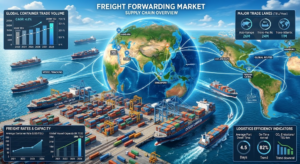


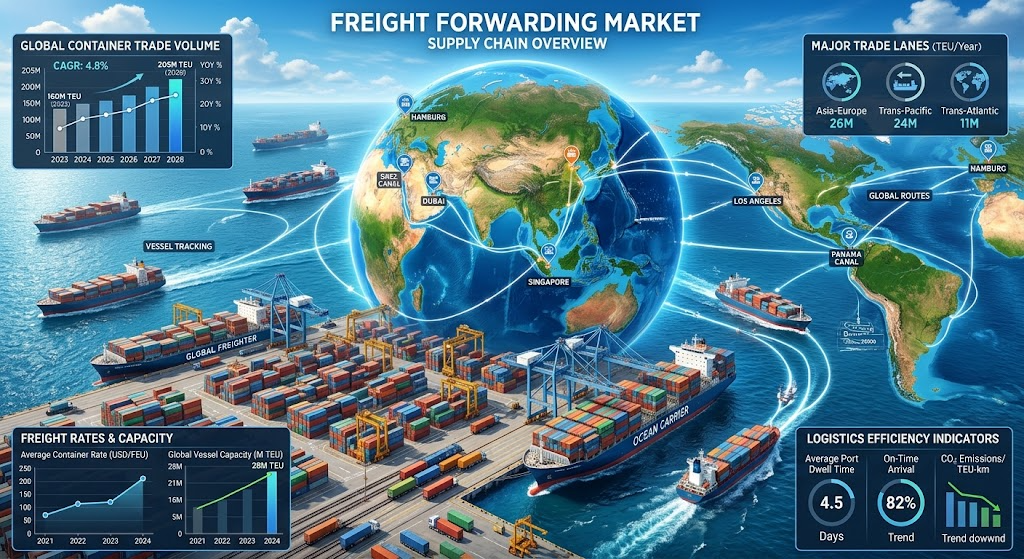
The global ocean freight forwarding market is projected to grow from USD 81.6 billion in 2025 to USD 120.7 billion by 2035, registering a compound annual growth rate (CAGR) of 4.0% during the forecast period, according to Future Market Insights (FMI). Expanding international trade, rising containerized cargo volumes, and growing demand for integrated logistics services are supporting market development.
Ocean freight forwarders coordinate the movement of goods across international shipping routes, managing transportation arrangements, documentation, customs processes, warehousing, and related logistics services. As global supply chains become increasingly interconnected, businesses are relying on freight forwarding providers to improve shipment visibility, manage transportation costs, and coordinate cross-border cargo movements.
Digital freight platforms, automated documentation, predictive analytics, and real-time shipment tracking are transforming service delivery. These capabilities are helping logistics providers respond to changing trade patterns, port congestion, capacity constraints, and customer expectations for more transparent shipping operations.
👉 Get Detailed Market Forecasts, Competitive Benchmarking, and Pricing Trends:
https://www.futuremarketinsights.com/reports/sample/rep-gb-22980
Ocean Freight Forwarding Market Forecast and Key Highlights
- Market valuation: USD 81.6 billion in 2025.
- Forecast value: USD 120.7 billion by 2035.
- Growth rate: 4.0% CAGR from 2025 to 2035.
- Incremental market opportunity: USD 39.1 billion over the forecast period.
- Leading shipment type: Full Container Load (FCL), projected to account for 54.3% of the market in 2025.
- Leading service segment: Transportation and warehousing, expected to represent 47.8% of the market in 2025.
- Leading end-user segment: Electronics, projected to account for 35.6% of the market in 2025.
Full Container Load Services Lead Shipment Demand
Full Container Load (FCL) services are projected to account for 54.3% of the ocean freight forwarding market by shipment type in 2025. FCL shipments are commonly preferred by businesses transporting large cargo volumes that can fill an entire container. Dedicated container capacity can reduce cargo handling and simplify shipment coordination for manufacturers, exporters, and distributors.
Less-than-Container Load (LCL) services provide an alternative for businesses that do not require a full container. By consolidating cargo from multiple shippers, LCL providers help smaller exporters and importers access international ocean transportation without booking an entire container.
Transportation and warehousing services are expected to hold a 47.8% share in 2025. These services connect maritime shipping with inland distribution networks, storage facilities, and inventory management operations. Integrated logistics offerings are becoming increasingly important as businesses seek coordinated transportation from origin to destination.
Electronics Industry Supports Ocean Freight Demand
The electronics end-user segment is projected to account for 35.6% of the market in 2025. International supply chains for semiconductors, consumer electronics, electrical components, and industrial equipment generate substantial cargo movement between manufacturing centers and global consumption markets.
Electronics shipments often require secure handling, shipment visibility, and reliable delivery coordination. Freight forwarders are responding through container tracking, digital documentation, cargo insurance support, and specialized logistics arrangements.
Agriculture, automotive, beverages, and other industries also contribute to market demand. Agricultural exporters require suitable transportation and, in some cases, temperature-controlled container services. Automotive manufacturers depend on coordinated international movement of components and finished products, while beverage companies use ocean freight to support large-volume distribution.
Digitalization and Supply Chain Integration Create New Opportunities
Several factors are shaping the ocean freight forwarding market:
Digital freight platforms: Online booking, automated documentation, shipment dashboards, and electronic data exchange are improving coordination between shippers, carriers, and logistics providers.
Real-time shipment visibility: IoT-enabled tracking and digital monitoring tools help customers follow cargo movements and respond to delays or changes in shipping schedules.
Multimodal logistics integration: Forwarders are combining ocean transportation with road, rail, and warehousing services to offer end-to-end supply chain solutions.
Predictive analytics and AI: Data-driven tools can support route planning, demand forecasting, capacity management, and operational decision-making.
Trade corridor diversification: Nearshoring, regional manufacturing expansion, and changing trade relationships are creating opportunities across established and emerging maritime routes.
However, the industry faces challenges from port congestion, volatile freight rates, changing customs requirements, and capacity constraints. Differences in documentation and regulatory procedures across countries can also increase administrative complexity. Providers investing in technology, compliance expertise, and carrier relationships may be better positioned to manage these challenges.
Regional Outlook: China and India Lead Market Growth
FMI’s country-level projections indicate the following growth rates between 2025 and 2035:
- China: 5.4% CAGR
- India: 5.0% CAGR
- Germany: 4.6% CAGR
- France: 4.2% CAGR
- United Kingdom: 3.8% CAGR
- United States: 3.4% CAGR
- Brazil: 3.0% CAGR
China is projected to lead growth among the listed countries, supported by its major maritime trade gateways, extensive manufacturing base, and established container port infrastructure. Investments in port automation and digital logistics are further influencing the country’s forwarding ecosystem.
India is expected to register a 5.0% CAGR, supported by expanding international trade, port modernization, and improving connections between ports and industrial centers. Infrastructure initiatives and rising exports across textiles, chemicals, agricultural products, and automotive components are creating opportunities for freight forwarding providers.
Germany’s growth reflects its role as a major European logistics hub, while France benefits from maritime connectivity and port modernization. The United Kingdom’s market is influenced by customs digitization and international trade requirements. In the United States, established logistics networks and demand for integrated freight services support continued market development.
Competitive Landscape and Key Companies
The ocean freight forwarding market includes global logistics providers with extensive carrier relationships, international networks, and technology-enabled supply chain services. Competition is increasingly influenced by pricing, shipment visibility, service reliability, customs expertise, and the ability to coordinate multimodal transportation.
Key companies profiled in FMI’s report include:
- Kuehne+Nagel
- DHL
- DB Schenker
- GEODIS
- Sinotrans
- DSV A/S
- Expeditors International
These companies are strengthening their service portfolios through digital platforms, global network expansion, strategic partnerships, and integrated logistics capabilities. Providers with strong carrier relationships and international coverage are positioned to serve multinational customers requiring consistent service across multiple trade corridors.
Key Industry Development
In September 2024, DSV A/S announced its acquisition of DB Schenker in a transaction valued at approximately €14.3 billion. The deal represented a significant development in the global logistics sector, bringing together two major freight forwarding and supply chain service providers.
The consolidation reflects the importance of global scale, network coverage, and operational capabilities in an increasingly competitive freight forwarding environment.
Access the Full Report: https://www.futuremarketinsights.com/reports/ocean-freight-forwarding-market
Analyst Perspective
The ocean freight forwarding market is evolving from a primarily transactional shipping service into a broader supply chain coordination function. As customers seek greater transparency, cost control, and predictable delivery, forwarders with digital capabilities and integrated transportation networks are likely to strengthen their competitive positions.
Investment in automated documentation, real-time tracking, and multimodal connectivity will remain important for providers seeking to improve customer experience and operational efficiency.
About Future Market Insights (FMI)
Future Market Insights (FMI) is a global market intelligence and consulting firm providing comprehensive market research, competitive intelligence, and strategic business insights across industries. The firm delivers detailed forecasts, technology analysis, and data-driven recommendations that support informed decision-making for manufacturers, investors, distributors, and policymakers worldwide.
For Press & Corporate Inquiries
Rahul Singh
AVP – Marketing and Growth Strategy
Future Market Insights, Inc.
+91 8600020075
For Sales – sales@futuremarketinsights.com
For Media – Rahul.singh@futuremarketinsights.com
For Web – https://www.futuremarketinsights.com