

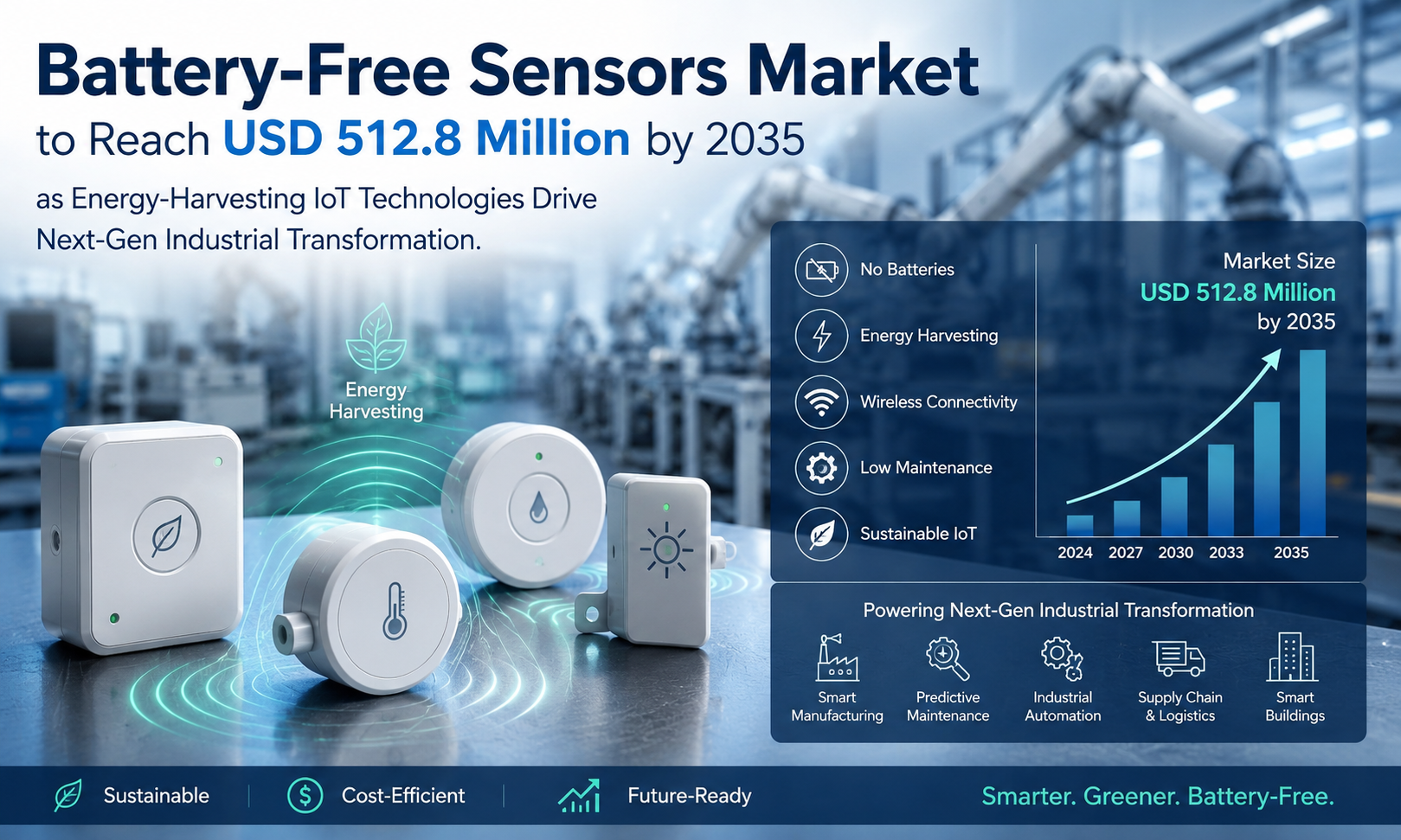
The global Battery-Free Sensors Market is entering a high-growth phase as industries increasingly adopt energy-harvesting technologies to enable maintenance-free, sustainable, and ultra-low-power sensing systems. According to industry analysis, the market is projected to grow from USD 73.2 million in 2025 to USD 512.8 million by 2035, reflecting a robust CAGR of 21.5%.
The rapid expansion of IoT ecosystems, smart cities, industrial automation, and wireless sensor networks is accelerating demand for self-powered sensing solutions. Technologies such as RF energy harvesting, piezoelectric systems, thermoelectric conversion, and solar-assisted micro-sensors are redefining how data is captured and transmitted across industries.
At the same time, advancements in near-field communication (NFC), Bluetooth Low Energy (BLE), and ultra-low-power semiconductors are significantly improving sensor efficiency and deployment scalability across healthcare, automotive, consumer electronics, and industrial applications.
However, challenges such as limited energy storage capacity, signal interference, and high initial deployment costs continue to shape the competitive landscape.
Get detailed market forecasts, competitive benchmarking, and pricing trends:
https://www.futuremarketinsights.com/reports/sample/rep-gb-17873
Market Overview
The Battery-Free Sensors Market is evolving from conventional battery-dependent sensing systems into advanced energy-autonomous architectures powered by ambient energy sources.
By 2035, the industry is expected to reach USD 512.8 million, up from USD 73.2 million in 2025, driven by increasing demand for:
• Maintenance-free IoT devices
• Sustainable industrial monitoring systems
• Smart infrastructure deployments
• Real-time environmental sensing
• Low-cost wireless sensor networks
Battery-free sensors eliminate the need for traditional batteries by leveraging RF, vibration, light, and thermal energy harvesting, enabling long-term deployment in hard-to-access environments.
Key Growth Drivers
The market is being propelled by structural shifts in digital transformation and sustainability-focused engineering.
Key growth drivers include:
• Rising adoption of IoT-enabled smart systems
• Expansion of smart cities and connected infrastructure
• Increasing demand for maintenance-free industrial sensors
• Sustainability initiatives reducing electronic waste
• Growth of wireless sensor networks (WSNs)
• Advancements in ultra-low-power electronics
Industries such as healthcare, automotive, logistics, and industrial automation are rapidly integrating battery-free sensors to improve operational efficiency and reduce lifecycle costs.
Technology and Innovation Trends
Innovation in energy harvesting is the backbone of market expansion.
Key technological advancements include:
• RF energy harvesting systems
• Piezoelectric and thermoelectric conversion technologies
• Ultra-low-power semiconductor design
• NFC and BLE-based communication systems
• AI-driven energy optimization algorithms
• Miniaturized sensor architectures
Emerging innovations are enabling sensors to operate continuously without battery replacement, even in remote and industrial environments.
These developments are expanding applications across:
• Smart healthcare monitoring
• Predictive industrial maintenance
• Smart logistics and supply chain tracking
• Environmental and agricultural monitoring
• Smart home automation systems
Market Challenges and Restraints
Despite strong growth momentum, several constraints remain:
• Limited energy harvesting efficiency under variable conditions
• Signal reliability and interference issues
• High upfront deployment and integration costs
• Constraints in continuous real-time data transmission
• Standardization challenges across IoT ecosystems
Smaller manufacturers face difficulties scaling production due to the complexity of advanced semiconductor integration and energy harvesting optimization.
Segment Analysis
Ultra High Frequency (UHF) Sensors Dominate the Market
The UHF segment leads the market due to its long-range communication and suitability for large-scale IoT deployments.
Key advantages include:
• Extended communication range
• High data transfer efficiency
• Strong compatibility with RF energy harvesting
• Scalability for industrial IoT systems
UHF sensors are widely used in:
• Asset tracking
• Supply chain monitoring
• Smart city infrastructure
• Industrial automation systems
Temperature and Humidity Sensors Lead by Type
Temperature and humidity sensors account for the largest share due to their widespread use in:
• Smart buildings and HVAC systems
• Food storage and cold chain logistics
• Pharmaceutical monitoring
• Precision agriculture
Their reliability and compatibility with RF-based energy harvesting make them ideal for long-term deployment in critical environments.
Regional Analysis
North America
North America remains a leading market due to strong IoT adoption and advanced industrial automation. The United States and Canada are heavily investing in smart infrastructure and energy-efficient sensing systems.
Europe
Europe shows strong demand driven by Industry 4.0 initiatives, sustainability regulations, and smart manufacturing adoption. Countries such as Germany, France, and the United Kingdom are leading deployment in automotive and healthcare sectors.
Asia-Pacific
Asia-Pacific is the fastest-growing region, fueled by smart city initiatives, industrial expansion, and 5G deployment in China, India, Japan, and South Korea. Large-scale IoT integration is accelerating adoption across industries.
Japan
Japan’s market is driven by robotics, automation, and healthcare applications for aging populations, with strong R&D in miniaturized sensor technologies.
South Korea
South Korea benefits from its advanced electronics ecosystem and rapid adoption of IoT-enabled logistics and smart factory systems.
Unlock high-growth opportunities with FMI’s industry analysis:
https://www.futuremarketinsights.com/industry-analysis
Competitive Landscape
The market is moderately consolidated, with strong participation from semiconductor and IoT solution providers.
The competitive structure is divided into:
• Global semiconductor leaders
• Energy harvesting innovators
• IoT platform integrators
Competition is intensifying as companies invest in AI-enabled sensing, ultra-low-power chip design, and wireless energy transfer technologies.
Leading Companies Analysis
Major market participants include:
ON Semiconductor
Texas Instruments
STMicroelectronics
Infineon Technologies
EnOcean GmbH
Powercast Corporation
Everactive
BehrTech
Lord MicroStrain
BatteroTech
These companies are focusing on:
• Energy harvesting innovation
• Ultra-low-power sensor development
• IoT ecosystem integration
• Wireless communication enhancement
• AI-based predictive analytics
Investment and Strategic Developments
Recent developments highlight increasing investment momentum:
2025 — STMicroelectronics expanded its IoT edge computing sensor portfolio for industrial automation applications.
2025 — Texas Instruments advanced ultra-low-power RF energy harvesting chipsets for smart infrastructure.
2024 — EnOcean GmbH strengthened its self-powered wireless sensor offerings for smart buildings.
Ongoing R&D investments are focused on graphene-based materials, AI-powered power optimization, and 6G-enabled sensor networks.
Future Outlook
By 2035, the Battery-Free Sensors Market is expected to evolve into a fully autonomous sensing ecosystem powered by ambient energy and intelligent computing.
Future trends include:
• Integration with 6G networks
• AI-driven predictive sensing systems
• Edge computing-enabled real-time analytics
• Advanced nanomaterial-based energy harvesting
• Fully autonomous industrial IoT ecosystems
Asia-Pacific will continue to lead volume growth, while North America and Europe will focus on advanced applications and technological innovation.
Companies that combine energy efficiency, AI integration, and scalable IoT architectures will define the next phase of market leadership.
FMI Custom Research: Strategic Intelligence for Confident Decision-Making
FMI Custom Research provides tailored intelligence solutions designed to support strategic business decisions in rapidly evolving industries.
Key executive benefits include:
• Decision-ready insights
• Reduced investment risk
• Market entry validation
• Competitive benchmarking
• Faster growth strategy execution
• Primary research-driven intelligence
For inquiries:
sales@futuremarketinsights.com
Conclusion
The global Battery-Free Sensors Market is undergoing a transformative shift driven by sustainability mandates, IoT expansion, and breakthroughs in energy-harvesting technologies.
With the market projected to rise from USD 73.2 million in 2025 to USD 512.8 million by 2035, the industry is poised for exponential growth. As innovation in ultra-low-power electronics and wireless connectivity accelerates, battery-free sensors are expected to become a foundational technology in next-generation smart infrastructure and industrial ecosystems.
Related Reports
Battery-Free IoT Devices Market
Energy Harvesting Sensor Market
Smart Sensor Market
Wireless Sensor Network Market
Industrial IoT Market
About Future Market Insights (FMI)
Future Market Insights (FMI) delivers actionable, decision-focused market intelligence backed by robust primary research and industry expertise.
For Press & Corporate Inquiries
Future Market Insights Inc.
Sales: sales@futuremarketinsights.com
Website: https://www.futuremarketinsights.com/