

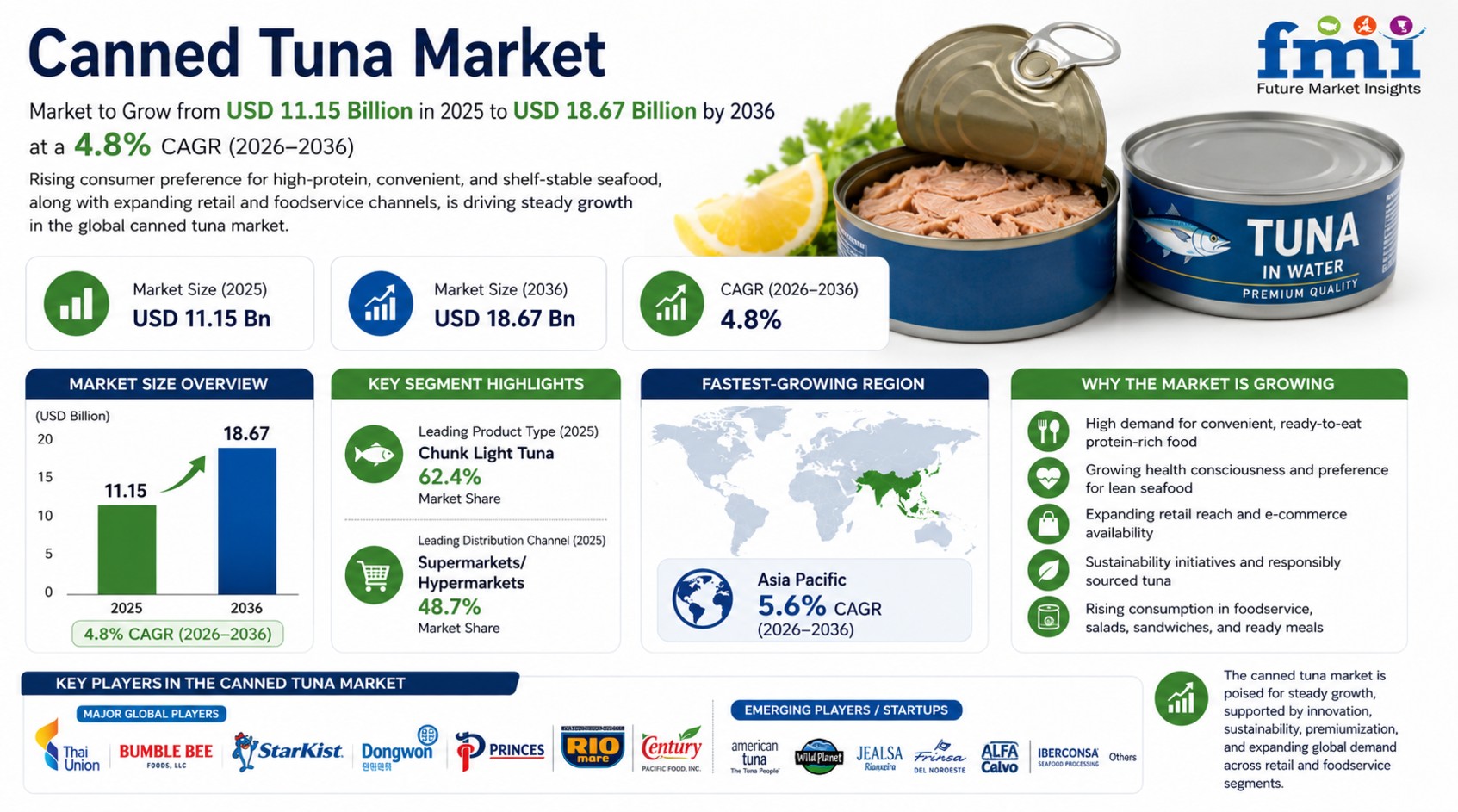
The global canned tuna market is increasingly becoming a retailer-driven category where private-label products compete directly with established seafood brands. As canned tuna remains one of the most frequently purchased shelf-stable protein sources, supermarkets are leveraging their control over pricing, shelf placement, and merchandising to expand own-brand offerings across value and premium segments. Rather than relying solely on brand recognition, manufacturers must now compete on sourcing transparency, convenience, product innovation, and nutritional differentiation.
While branded canned tuna continues to benefit from consumer trust and established quality perceptions, purchasing decisions are increasingly influenced by price-per-can comparisons, multipack value, and prominent in-store placement. This shift is transforming canned tuna from a brand-led category into a value-driven pantry staple where commercial success depends on delivering measurable product advantages beyond simple name recognition.
Featured Snippet: Key Market Answer
Q: Why is private label becoming a major competitive threat in the canned tuna market?
A: Private-label canned tuna competes effectively because it delivers comparable shelf-stable protein at lower prices while benefiting from retailer-controlled shelf placement and promotional support. Basic products such as canned light tuna, chunk tuna, tuna in water, and multipacks are particularly vulnerable because consumers often prioritize price, pack size, and convenience over brand loyalty. Branded manufacturers maintain stronger pricing power when they differentiate through sustainability certifications, traceability, superior quality, innovative flavors, premium packaging, and value-added nutrition.
Quick Stats of the Canned Tuna Market
- Core Growth Theme: Retailer Expansion Through Private-Label Pantry Protein
- Dominant Product Type: Canned Light Tuna (approximately 50.0% product share)
- Leading Product Form: Chunk Tuna (approximately 40.0% form share)
- Primary Consumer Applications: Sandwiches, salads, pasta, rice bowls, meal preparation, and pantry storage
- Critical Competitive Variable: Price-per-can combined with shelf positioning and retailer visibility
Market Overview: Retailers Are Increasingly Defining Category Competition
The canned tuna market has evolved beyond a traditional seafood category into one of the most competitive shelf-stable protein segments within packaged food retail.
Consumers purchase canned tuna as an everyday pantry essential because it offers convenience, long shelf life, affordability, and versatile meal preparation. These characteristics also make it one of the easiest categories for supermarkets to introduce successful private-label alternatives.
As retailer-owned brands continue improving product quality and packaging while maintaining attractive pricing, competition increasingly centers on value perception rather than historical brand recognition.
Key Growth Drivers Behind Private-Label Expansion
Pantry Staple Purchasing Behavior
Canned tuna is routinely purchased for household replenishment rather than occasional indulgence. Since consumers frequently buy it alongside other grocery staples, many compare products primarily on price, serving size, and perceived value.
Shelf-Stable Convenience
Long shelf life eliminates many of the logistical challenges associated with refrigerated proteins. Consumers appreciate canned tuna because it requires no refrigeration before opening, supports meal preparation, and serves as an emergency pantry ingredient.
Retailer Control of Shelf Space
Supermarkets increasingly use shelf positioning, promotional displays, category management, and multipack merchandising to improve visibility for their own-brand canned tuna while placing pricing pressure on national brands.
Growing Demand for Affordable Protein
As consumers seek economical protein options, canned tuna continues attracting value-conscious shoppers. Retailer brands capitalize on this demand by offering comparable nutrition at lower prices across core pantry formats.
Technical & Commercial Economics Behind Private-Label Competition
Competition in canned tuna extends well beyond branding.
- Price-Per-Serving Economics: Consumers frequently evaluate canned tuna based on protein value per serving rather than brand image, making pricing highly transparent.
- Multipack Value Strategy: Retailers encourage larger basket sizes by offering multipack discounts that reduce the perceived cost per can while increasing customer loyalty.
- Packaging Optimization: Easy-open lids, pouches, resealable packaging, and convenient multipacks provide additional differentiation opportunities for both branded and private-label products.
- Supply Chain Efficiency: Retailers leverage large purchasing volumes and streamlined procurement to maintain competitive pricing while expanding private-label portfolios.
Segment Deep Dive: Where Private Label Competes Most Aggressively
Canned Light Tuna: The Primary Battleground
Canned light tuna represents the largest volume opportunity within the category because it combines affordability with widespread consumer familiarity.
Its broad household appeal makes it particularly vulnerable to retailer substitution, as shoppers often perceive store brands as acceptable alternatives for routine purchases.
Chunk Tuna: Everyday Meal Versatility
Chunk tuna remains one of the most versatile canned seafood formats, supporting sandwiches, salads, pasta dishes, casseroles, rice bowls, and quick family meals.
Because functionality is similar across brands, retailers can compete effectively through pricing and promotional positioning.
Value Multipacks: High-Volume Competition
Multipack formats strengthen retailer competitiveness by emphasizing household savings and reducing the effective cost per serving.
These products perform especially well among families, bulk shoppers, and consumers focused on pantry stocking.
Premium and Specialty Products: Brand Protection Zones
Premium branded products maintain stronger competitive positions through differentiation.
Pole-and-line caught tuna, MSC-certified seafood, tuna packed in olive oil, flavored varieties, premium white tuna, low-sodium products, high-protein positioning, and ready-to-eat meal solutions create advantages that are more difficult for private-label products to replicate immediately.
Regional Market Dynamics
North America
North American supermarkets continue expanding private-label portfolios as consumers increasingly accept retailer-owned packaged food products. Strong supermarket concentration further strengthens retailer influence over shelf allocation and category pricing.
Europe
European private-label penetration remains among the highest globally. Retailers increasingly compete through sustainable sourcing, premium store-brand ranges, and environmentally responsible seafood positioning alongside competitive pricing.
Asia-Pacific
Growing urbanization and rising demand for affordable convenience foods continue supporting canned tuna consumption. While branded products remain important in many markets, modern retail expansion creates additional opportunities for supermarket-owned brands.
Competitive Differentiation Strategies
Leading branded manufacturers increasingly defend market share through measurable product advantages rather than promotional pricing alone.
- Responsible Sourcing & Traceability: Sustainability certifications, responsible fishing practices, and transparent supply chains strengthen consumer trust.
- Product Innovation: Flavored tuna, premium oils, low-sodium recipes, ready-to-eat meal kits, and nutritional enhancements create additional value beyond commodity products.
- Packaging Innovation: Easy-open cans, convenient pouches, resealable packaging, and portable meal formats improve everyday usability.
- Nutritional Positioning: High-protein messaging, clean ingredients, and health-focused formulations appeal to wellness-oriented consumers.
- Recipe & Meal Solutions: Positioning canned tuna as a complete meal ingredient rather than a basic pantry commodity strengthens premium differentiation.
Industry FAQs
Why is private label particularly strong in canned tuna?
Canned tuna is a shelf-stable pantry staple with standardized product characteristics, allowing consumers to compare products primarily on price, pack size, convenience, and retailer availability.
Which canned tuna products face the greatest private-label competition?
Basic canned light tuna, chunk tuna, tuna packed in water or brine, and multipack formats experience the strongest competition because purchasing decisions are often value driven.
How can branded tuna manufacturers defend market share?
Brands strengthen competitiveness through sustainability certifications, traceability, premium quality, innovative flavors, convenient packaging, nutritional differentiation, and value-added product formats.
Why do supermarkets have a competitive advantage?
Retailers control shelf positioning, promotional activity, pricing architecture, category management, and private-label merchandising, giving them significant influence over consumer purchasing decisions.
Will private label replace branded canned tuna?
Private label is expected to increase competitive pressure, particularly within mainstream pantry products. However, branded manufacturers can maintain premium positioning by offering superior quality, sourcing transparency, product innovation, and stronger consumer trust.
Conclusion
The future structure of the canned tuna market will increasingly reflect retailer influence rather than traditional brand dominance. Private-label products continue gaining share by combining competitive pricing, convenient packaging, and strong retail visibility across core pantry protein categories.
Branded manufacturers are unlikely to lose relevance, but long-term success will depend on moving beyond legacy brand recognition. Companies that invest in sustainability, traceability, product innovation, premium nutrition, and convenient meal solutions will be better positioned to protect margins as supermarket brands continue expanding their presence.
Ultimately, the canned tuna market is evolving into a category where commercial leadership depends not on shelf familiarity alone, but on delivering meaningful value that justifies a premium beyond price.
Related Research Reports
- Ready-to-Eat Food Market – Market intelligence covering convenient meal solutions, portable foods, and consumer lifestyle trends.
- Canned Food Market – Industry outlook covering shelf-stable food consumption, retail distribution, and evolving consumer demand.
FMI Custom Research: Strategic Intelligence for Confident Decision-Making
In today’s rapidly evolving business environment, leadership teams need more than market data they need clear, actionable intelligence tailored to their strategic objectives. FMI’s Custom Research solutions are designed around the specific business questions organizations need answered, enabling executives to evaluate growth opportunities, validate investments, assess competitive dynamics, and reduce uncertainty before making critical decisions. By combining deep industry expertise, primary research, and proprietary market intelligence, FMI delivers insights that help organizations move from assumptions to evidence-based strategies with greater speed and confidence.
Key Executive Benefits
- Decision-Ready Insights: Research tailored to your specific business challenges, growth plans, and investment priorities.
- Reduced Strategic Risk: Validate market opportunities, customer demand, and competitive positioning before committing resources.
- Market Entry Confidence: Assess opportunity size, regulatory barriers, channel dynamics, and competitive landscapes with precision.
- Competitive Advantage: Gain proprietary intelligence unavailable through syndicated reports or internal datasets.
- Faster Growth Decisions: Accelerate expansion, product development, portfolio optimization, and investment planning.
- Primary Market Validation: Access real-world customer, buyer, and stakeholder insights that support high-confidence decision-making.
- Global Industry Expertise: Powered by 100+ analysts, 20,000+ published reports, and 1.6 million+ hours of research experience.
- Proven Track Record: Over 7,000 market-entry engagements completed across six regions and 14 industry sectors with strong client retention.
Business Impact
FMI helps organizations transform market complexity into strategic clarity, enabling leadership teams to identify growth opportunities faster, optimize resource allocation, strengthen competitive positioning, and make high-stakes business decisions with confidence.
To explore how FMI Custom Research can support your strategic priorities, please connect with our team at – sales@futuremarketinsights.com
About Future Market Insights (FMI)
Future Market Insights is a leading provider of market intelligence, consulting services, and syndicated research reports. FMI delivers actionable insights across food and beverage, healthcare, consumer goods, biotechnology, chemicals, industrial products, and emerging technologies, helping organizations identify growth opportunities and make informed strategic decisions in evolving global markets.
Contact Us:
Future Market Insights Inc.
Christiana Corporate, 200 Continental Drive,
Suite 401, Newark, Delaware – 19713, USA
T: +1-347-918-3531
Why FMI: https://www.futuremarketinsights.com/why-fmi
For Sales Enquiries: sales@futuremarketinsights.com
Website: https://www.futuremarketinsights.com