

The global airport passenger-service robots market is expanding as airports increasingly adopt autonomous technologies to improve passenger assistance, reduce terminal congestion, and support service continuity. Rising passenger volumes, labor shortages, long waiting times, and growing demand for automated wayfinding, baggage assistance, cleaning, and delivery services are accelerating adoption across airport environments.
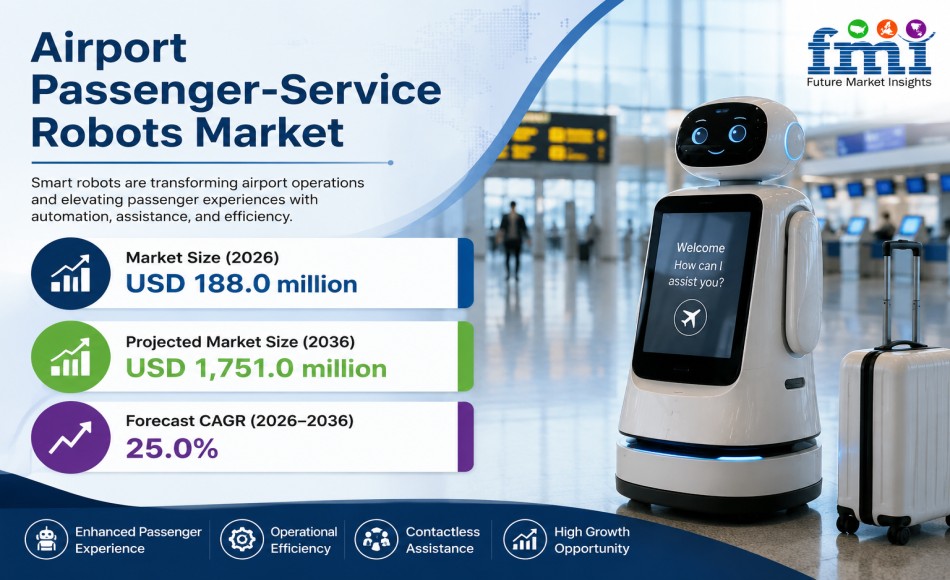
According to Future Market Insights (FMI), the global airport passenger-service robots market is valued at USD 188.0 million in 2026 and is projected to reach USD 1,751.0 million by 2036, expanding at a 25.0% CAGR during the forecast period.
Key Market Highlights
- Market Size (2026): USD 188.0 million
- Projected Market Size (2036): USD 1,751.0 million
- Forecast CAGR (2026–2036): 25.0%
- Leading Function: Guidance & concierge robots with a 38.0% share
- Leading Application: Terminals with a 56.0% share
- Leading Component: Hardware with a 52.0% share
- Leading End User: Airport operators with a 52.0% share
- Leading Business Model: RaaS with a 40.0% share
- Fastest-Growing Market: South Korea at a 27.0% CAGR
Rising Passenger Volumes Accelerate Demand for Airport Service Robots
Growing passenger traffic is placing increasing pressure on airport infrastructure and frontline service teams. Airports Council International data released in July 2025 recorded global passenger traffic surpassing 9.4 billion travelers in 2024, an 8.4% increase from 2023.
As terminal crowds grow, airport authorities are deploying autonomous robots to provide wayfinding, answer routine questions, assist with baggage movement, support cleaning operations, and improve passenger access to information. Long security and check-in queues are also strengthening demand for automated assistance. A SITA report published in September 2024 found that 64.0% of passengers favored shorter airport waiting lines.
Guidance and Concierge Robots Lead Function Demand
Guidance and concierge robots are projected to account for 38.0% of the function segment in 2026. These systems help passengers navigate complex terminals, answer routine questions, provide multilingual assistance, and escalate issues when human support is required.
Airport teams assess these robots based on navigation accuracy, terminal mapping, service response, and safe operation around travelers. Cleaning and disinfection, baggage assist, and food and beverage delivery robots also support airport automation. However, guidance systems remain central as airports seek to reduce pressure on information desks and improve passenger movement.
Terminals Dominate Application Demand
Terminals are projected to represent 56.0% of application demand in 2026. High passenger density across check-in halls, security zones, transfer routes, and gates makes terminals the primary deployment environment for service robots.
Airports Council International reported that the top 20 airports processed 1.54 billion passengers in 2024, reinforcing the need for automated assistance across high-traffic facilities. Airport operators evaluate robots based on safe movement, obstacle avoidance, passenger interaction, and uptime. Lounges and curbside and parking areas provide additional opportunities for delivery, guidance, and accessibility support.
Hardware and Airport Operators Drive Market Demand
Hardware is expected to hold a 52.0% share of the component segment in 2026 as initial investment focuses on mobile robotic platforms, sensors, navigation systems, batteries, and passenger-facing interfaces. Software and services support fleet monitoring, scheduling, analytics, upgrades, and maintenance.
Airport operators are projected to account for 52.0% of end-user demand. As facility managers, they control terminal service quality, accessibility, passenger flow, and public-space operations. Airlines and ground handlers also create demand for baggage assistance and mobility solutions.
RaaS Models Support Wider Adoption
Robots-as-a-Service is forecast to capture a 40.0% share of the business model segment in 2026. Subscription-based deployment allows airports to test robotic systems without significant upfront ownership costs while providing flexibility to adjust fleet size according to passenger traffic.
Direct purchases and service contracts remain important for airports seeking asset ownership or dedicated technical support. However, RaaS is gaining momentum as airports transition from pilot programs to scalable deployments.
South Korea Leads Global Market Growth
South Korea is projected to expand at a 27.0% CAGR through 2036, supported by advanced airport service models and strong automation readiness. The United States is expected to grow at a 26.0% CAGR, driven by airport pilots and high passenger flows.
Japan and the European Union are each forecast to expand at a 24.0% CAGR, supported by service quality expectations, labor support needs, and rising passenger traffic.
Competitive Landscape and Future Outlook
The market remains competitive, with companies focusing on autonomous navigation, multilingual interaction, cleaning automation, baggage assistance, accessibility, and fleet management. Leading companies include LG Electronics, IntBot, Aurrigo International plc, Ottonomy Inc., Cyberdyne Inc., WHILL Inc., SoftBank Robotics Group Corp., SITA, Avidbots Corp., and Bear Robotics, Inc.
In January 2025, LG Electronics secured management control of Bear Robotics after acquiring an additional 30.0% stake. In April 2025, Aurrigo International and Aviation Solutions partnered to commercialize autonomous baggage handling at airports. In March 2026, San José Mineta International Airport launched IntBot’s José humanoid robot in Terminal B, offering real-time information in more than 50 languages.
The airport passenger-service robots market is expected to maintain strong growth through 2036 as airports prioritize passenger flow, service continuity, labor efficiency, and automated assistance. Vendors combining safe navigation, multilingual interfaces, fleet management, airport-tested systems, and local maintenance support will be best positioned to capture emerging opportunities
Explore More Insights from the Consumer Product Industry Analysis
https://www.openpr.com/news/4534677/educational-tourism-market-to-reach-usd-432-4-billion-by-2036
https://www.openpr.com/news/4534689/restaurants-and-mobile-food-services-market-to-reach-usd-3-2
FMI Custom Research: Strategic Intelligence for Confident Decision-Making
In today’s rapidly evolving business environment, leadership teams need more than market data—they need clear, actionable intelligence tailored to their strategic objectives. FMI’s Custom Research solutions are designed around the specific business questions organizations need answered, enabling executives to evaluate growth opportunities, validate investments, assess competitive dynamics, and reduce uncertainty before making critical decisions. By combining deep industry expertise, primary research, and proprietary market intelligence, FMI delivers insights that help organizations move from assumptions to evidence-based strategies with greater speed and confidence.
Key Executive Benefits
- Decision-Ready Insights: Research tailored to your specific business challenges, growth plans, and investment priorities.
- Reduced Strategic Risk: Validate market opportunities, customer demand, and competitive positioning before committing resources.
- Market Entry Confidence: Assess opportunity size, regulatory barriers, channel dynamics, and competitive landscapes with precision.
- Competitive Advantage: Gain proprietary intelligence unavailable through syndicated reports or internal datasets.
- Faster Growth Decisions: Accelerate expansion, product development, portfolio optimization, and investment planning.
- Primary Market Validation: Access real-world customer, buyer, and stakeholder insights that support high-confidence decision-making.
- Global Industry Expertise: Powered by 100+ analysts, 20,000+ published reports, and 1.6 million+ hours of research experience.
- Proven Track Record: Over 7,000 market-entry engagements completed across six regions and 14 industry sectors with strong client retention.
Business Impact
FMI helps organizations transform market complexity into strategic clarity, enabling leadership teams to identify growth opportunities faster, optimize resource allocation, strengthen competitive positioning, and make high-stakes business decisions with confidence.
To explore how FMI Custom Research can support your strategic priorities, please connect with our team at – sales@futuremarketinsights.com
Contact Us:
Future Market Insights Inc.
Christiana Corporate, 200 Continental Drive,
Suite 401, Newark, Delaware – 19713, USA
T: +1-347-918-3531
For Sales Enquiries: sales@futuremarketinsights.com
Website: https://www.futuremarketinsights.com
LinkedIn| Twitter| Blogs | YouTube