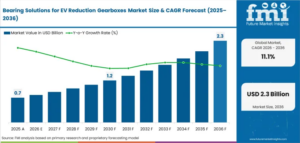


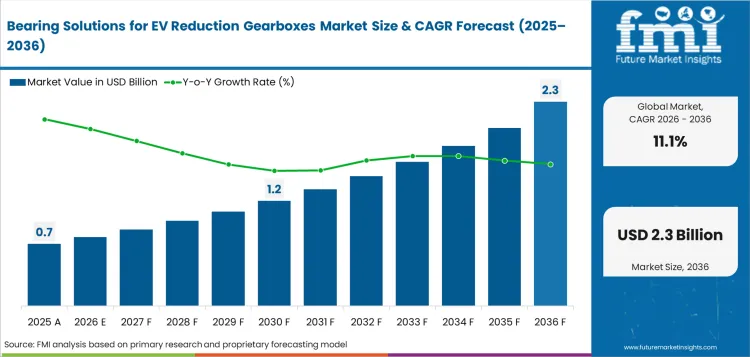
The global bearing solutions for EV reduction gearboxes market was valued at USD 0.7 billion in 2025 and is projected to reach USD 0.8 billion by the end of 2026. Expanding at a robust compound annual growth rate (CAGR) of 11.1% between 2026 and 2036, the market is expected to achieve a global valuation of USD 2.3 billion by 2036. This rapid growth trajectory will create an incremental opportunity of USD 1.5 billion over the ten-year forecast period.
As electric vehicle architectures shift toward higher motor speeds, compact e-axles, and high-voltage battery platforms, traditional drivetrain components are undergoing rapid specialization. The bearing solutions for EV reduction gearboxes market is transitioning from commodity component manufacturing toward highly engineering-validated e-drive assemblies that directly solve critical challenges like electrical pitting, current leakage, high shaft stress, and gearbox noise.
Get detailed market forecasts, competitive benchmarking, and pricing trends:
https://www.futuremarketinsights.com/reports/sample/rep-gb-33183
Key Market Highlights at a Glance
• 2025 Market Value: USD 0.7 billion
• 2026 Forecast Value: USD 0.8 billion
• 2036 Projected Value: USD 2.3 billion
• Forecast CAGR (2026-2036): 11.1%
• Ten-Year Incremental Opportunity: USD 1.5 billion
• Leading Bearing Type Segment (2026): Deep groove ball bearings (38.0% market share)
• Leading Material Segment (2026): Bearing steel (52.0% market share)
• Leading Gearbox Design Segment (2026): Single-speed gearboxes (66.0% market share)
• Leading Vehicle Type Segment (2026): Passenger EVs (61.0% market share)
• Primary Sales Channel Split (2026): OEM fitment (73.0% market share)
• Fastest-Growing Country Markets: China (14.2% CAGR), India (13.5% CAGR)
Why Is the Bearing Solutions for EV Reduction Gearboxes Market Growing?
Growth across the global market is driven by three primary technological and manufacturing shifts within the automotive e-mobility supply chain:
• High-Speed Motor Operating Stress: Modern electric vehicle motors operate at extremely high rotational speeds, generating heightened mechanical stress across compact and heat-sensitive reduction gearbox layouts.
• Electrical Pitting and High-Voltage Insulation Needs: Higher operating voltages, including 800V architectures, increase the risk of electrical current leakage across bearing raceways, accelerating demand for insulated and hybrid ceramic bearing designs.
• Early Platform Validation to Mitigate Noise and Warranty Risks: Vehicle manufacturers are integrating bearing suppliers earlier in platform development to reduce friction losses, control drivetrain noise, and protect long-term warranty budgets.
Electric vehicle production scale serves as the structural foundation for this expanding demand. Global electric car sales exceeded 17 million units in 2024, led by China with over 11 million units, according to International Energy Agency (IEA) data published in May 2025. This volume expansion provides a recurring platform sourcing base for bearing suppliers who offer verified thermal and electrical performance.
“EV gearbox bearings are shifting from standard rotating parts into validated drivetrain components. Vehicle makers need low friction with electrical current control. Higher motor speed and compact e-axles raise pressure while shaft speed proof reduces OEM redesign risk.”
– Nikhil Kaitwade, Principal Consultant for Automotive at Future Market Insights (FMI)
Comprehensive Market Segmentation Analysis
Which Bearing Type Leads the Market?
Deep groove ball bearings are projected to capture a dominant 38.0% share of the bearing type segment in 2026. Compact shaft locations inside modern e-axles require low-friction rolling performance under extreme rotational velocities. Deep groove ball bearings provide an optimal balance of low rotational resistance, radial load capacity, and compact dimensional footprints. Other evaluated bearing types in the market taxonomy include tapered roller bearings, cylindrical roller bearings, needle roller bearings, and angular contact bearings.
Which Material Type Commands the Highest Volume?
Bearing steel is forecast to hold 52.0% of all material usage in 2026. While high-voltage platforms increasingly adopt advanced materials, high-volume passenger EV platforms continue prioritizing durable bearing steel variants that balance mechanical durability with controlled unit production costs. However, advanced material categories-including hybrid ceramic, polymer cages, coated steel, and specialized insulated bearings-are gaining rapid adoption in premium e-drive platforms.
Which Gearbox Design Dominates OEM Fitment?
Single-speed gearboxes are expected to retain a market-leading 66.0% design share in 2026. Passenger EV programs overwhelmingly favor single-speed compact reduction layouts due to their operational efficiency, lower weight, and simpler bearing validation protocols compared to multi-speed or complex transmission arrangements. Additional design configurations analyzed include coaxial gearboxes, offset gearboxes, and fully integrated e-axles.
How Do Vehicle Type and Sales Channel Splits Compare?
• Passenger EVs: Estimated to capture 61.0% of the vehicle type share in 2026, driven by high global platform build volumes that demand lightweight, quiet drive units. Additional vehicle coverage includes light commercial EVs, heavy commercial EVs, electric buses, and off-highway EVs.
• OEM Fitment: Expected to account for 73.0% of total sales channel demand in 2026, as primary bearing validation occurs during initial vehicle program engineering. Other critical channels include OES service, aftermarket replacement, repair kits, and remanufactured units.
Market Dynamics: Drivers, Restraints, and Key Trends
Key Market Drivers
• Escalating global production of new energy vehicles (NEVs).
• Stringent OEM standards regarding NVH (noise, vibration, and harshness) reduction inside EV passenger cabins.
• Rapid transition toward 800V high-voltage battery systems requiring specialized current-leakage control.
Key Market Restraints
• Elevated raw material costs associated with specialized ceramic elements and precision insulation coatings.
• Long, rigorous OEM engineering validation cycles that delay rapid product rollouts for new market entrants.
Prominent Industry Trends
• Insulation Engineering Innovations: In May 2025, NTN introduced a resin mold insulated bearing for e-axles capable of exceeding 1,000 V insulation resistance, specifically tailored for 800 V battery systems.
• Extreme Space and Weight Optimization: In March 2025, NSK unveiled a compact deep groove ball bearing that reduces outer diameter by approximately 10% and overall weight by 51% compared to conventional units, helping automakers reduce drive-unit dimensions.
• OES Serviceability and Repair Kits: In September 2024, Schaeffler released its Hyundai Ioniq E-Axle RepSystem-G featuring six specialized bearings and seals, enabling cost-effective transmission repairs instead of complete e-axle replacements.
• Current Leakage Mitigation: In April 2024, SKF introduced a conductive brush ring solution designed to divert electrical currents away from bearing raceways, eliminating fluting damage and noise.
Regional Outlook: China and India Lead Global Expansion
China is projected to lead overall country-level growth with a 14.2% CAGR through 2036, supported by massive domestic NEV production, mature e-drive manufacturing ecosystems, and aggressive local component localization strategies.
India represents the second fastest-growing regional market, projected to expand at a 13.5% CAGR through 2036. Growth in India is propelled by expanding domestic EV assembly operations, government incentives for localized automotive manufacturing, and rising investment in commercial and two/three-wheeler electric drivetrains.
• China: 14.2% CAGR (2026-2036) – Driven by high-volume NEV manufacturing and local e-drive integration.
• India: 13.5% CAGR (2026-2036) – Fueled by expanding EV assembly lines and local component sourcing depth.
Competitive Landscape
The competitive environment is defined by tier-1 bearing suppliers integrating electrical insulation, weight reduction, and modular repair capabilities directly into their product lines to win long-term OEM platform contracts.
• NTN Corporation: Focuses on resin mold insulated bearings exceeding 1,000 V insulation resistance for high-voltage platforms.
• NSK Ltd.: Differentiates through ultra-compact deep groove ball bearings offering 51% weight reduction.
• Schaeffler AG: Leads in service-channel innovation with comprehensive e-axle repair kit packages like the RepSystem-G.
• SKF Group: Focuses on current diversion technology through conductive brush rings to prevent electrical raceway damage.