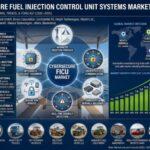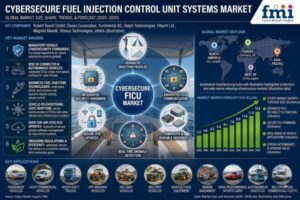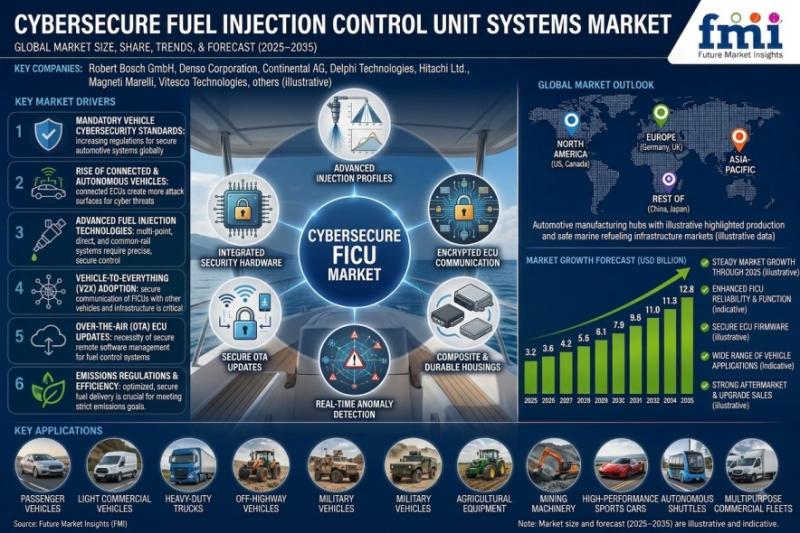
The global cybersecure fuel injection control unit systems market was valued at USD 0.62 billion in 2025 and is projected to reach USD 0.70 billion in 2026. According to market research from Future Market Insights, Inc., total market revenue is forecast to scale to USD 2.39 billion by 2036, expanding at a compound annual growth rate (CAGR) of 13.0% between 2026 and 2036. This growth trajectory will create an absolute incremental opportunity of USD 1.69 billion over the ten-year forecast period. The industry transformation is driven by strict automotive cybersecurity mandates, connected vehicle diagnostics, and the requirement for authenticated over-the-air (OTA) fuel map updates across complex powertrain architectures.
Get detailed market forecasts, competitive benchmarking, and pricing trends:
https://www.futuremarketinsights.com/reports/sample/rep-gb-33192
Key Market Highlights at a Glance
• 2025 Market Valuation: USD 0.62 billion
• 2026 Market Valuation: USD 0.70 billion
• 2036 Market Forecast: USD 2.39 billion
• Forecast Period CAGR (2026-2036): 13.0%
• Absolute Incremental Opportunity: USD 1.69 billion
• Leading Control Architecture Segment: Dedicated Engine ECUs (49.0% market share in 2026)
• Leading Sales Channel Segment: OEM Fitment (78.0% market share in 2026)
• Leading Vehicle Type Segment: Passenger Cars (58.0% market share in 2026)
• Leading Fuel Platform Segment: Gasoline Platforms (42.0% market share in 2026)
• Leading Security Layer Segment: Hardware Security Modules (36.0% market share in 2026)
• Fastest-Growing Country Markets: China (14.8% CAGR) and India (14.2% CAGR)
• Report Scope and Volume: 250-page deep-dive automotive software and powertrain security study
Why Is the Cybersecure Fuel Injection Control Unit Systems Market Growing?
Automotive cybersecurity compliance is transforming powertrain control units from routine engine timing modules into highly protected electronic assets. Modern vehicle platforms rely heavily on connected diagnostics, remote software updates, and multi-fuel flexibility, exposing fuel maps and flash memory to potential tampering or unauthorized remapping.
• Strict Cybersecurity Regulations: UN Regulation No. 155 mandates rigorous audit reviews and risk management for vehicle type approval, forcing vehicle manufacturers to document threat protection across engine ECUs before vehicle launch.
• Connected Diagnostics and OTA Calibration: The rise of remote vehicle maintenance creates a critical need for protected flash memory, secure boot, and authenticated fuel map updates during over-the-air servicing.
• Multi-Fuel Platform Complexity: Expanding compressed natural gas (CNG) and flex-fuel platforms increase software driver channels, making tamper-resistant calibration files essential for emissions compliance.
“I see this market shifting from powertrain cost control to security proof,” says Nikhil Kaitwade, Principal Consultant at Future Market Insights. “Fuel injection control was once judged mainly on timing accuracy and emission calibration. Vehicle makers now ask whether the same unit can protect software and resist tuning misuse. Suppliers that combine injector control know-how with cybersecurity evidence will gain the strongest nomination path.”
Segment Breakdown: What Drives Architecture, Sales Channel, and Fuel Platform Leadership?
Control Architecture: Dedicated Engine ECUs Maintain Primary Share
Dedicated engine ECUs are projected to command 49.0% of total control architecture demand in 2026. Dedicated controllers keep safety-critical injector timing and real-time misfire diagnostics tightly coupled to core engine processing, shielding primary combustion parameters from broader infotainment or body network intrusions.
• Dedicated Engine ECUs: Expected to hold 49.0% share in 2026 due to safety-critical timing and real-time combustion requirements.
• Domain & Zonal Controllers: Expanding as vehicle architectures consolidate electronics into centralized domain processing platforms.
Prose analysis demonstrates that dedicated engine ECUs remain the preferred architecture because OEMs prioritize isolated, safety-validated hardware environments for core engine control.
Sales Channel and Fuel Platform Breakdown
OEM factory fitment is expected to dominate the sales channel, capturing 78.0% of total demand in 2026. Automotive manufacturers lock in cybersecurity validation, encryption key management, and vehicle type approvals well before production release, leaving minimal share for post-launch modifications.
• OEM Fitment: Projected at 78.0% market share in 2026 as factory-installed validation protects type approval integrity.
• Aftermarket & Service Replacement: Representing 22.0% share through authorized service replacements and validated ECU software modules.
Regarding fuel platforms, gasoline systems lead with a 42.0% market share in 2026, driven by high global production volumes of port and direct injection passenger vehicles. Meanwhile, passenger cars account for 58.0% of vehicle type demand in 2026 due to extensive connected vehicle features, while hardware security modules (HSM) represent 36.0% of the security layer segment as microcontrollers incorporate cryptographic protection directly onto silicon.
Speak to Analyst: Customize insights for your business strategy:
https://www.futuremarketinsights.com/customization-available/rep-gb-33192
Market Dynamics: Drivers, Restraints, and Key Trends
Primary Market Drivers
Global vehicle production growth-which expanded from 92.7 million units in 2024 to 96.4 million units in 2025-provides a massive factory floor for secure ECU installation, alongside strict regulatory mandates for secure software updates.
Primary Market Restraints
High software validation costs and long automotive development cycles present recurring implementation barriers for Tier-1 powertrain suppliers.
Emerging Market Trends
Powertrain suppliers are integrating multi-driver architectures, such as Marelli’s multi-injector ECUs supporting up to eight gasoline and four CNG drivers, enabling single-controller management of complex multi-fuel strategies.
Regional Outlook: China and India Accelerate Global Expansion
• China: Forecast to lead global growth with a market-pacing 14.8% CAGR through 2036.
• India: Projected to expand rapidly at a 14.2% CAGR over the ten-year forecast period.
• Europe: Maintains strong baseline demand driven by early enforcement of UN Regulation No. 155 vehicle type approval rules.
• North America: Characterized by robust adoption of connected diagnostics and automated over-the-air powertrain recalibrations.
China leads national expansion with a 14.8% CAGR through 2036, propelled by massive automotive production scale and aggressive localization of automotive microcontrollers and software stacks. India follows closely with a 14.2% CAGR through 2036 as stricter emission standards, flex-fuel adoption, and connected software requirements reach high-volume two-wheeler and passenger car segments. In Europe and North America, growth is anchored by regulatory compliance, where OEM type approval depends on documented vulnerability management and secure boot architectures.
Latest Automotive Industry Analysis Reports:
https://www.futuremarketinsights.com/industry-analysis/automotive
Competitive Landscape: Strategic Positioning Among Industry Leaders
• Robert Bosch GmbH: Leading system-layer integration with deep expertise in engine control units, vehicle architectures, and hardware security.
• Marelli: Innovating advanced multi-fuel ECUs capable of managing flexible gasoline and compressed natural gas injector combinations.
• Continental AG: Delivering scalable engine control platforms featuring integrated software security and secure over-the-air update capabilities.
• Infineon Technologies: Influencing the silicon layer with dedicated automotive microcontrollers equipped with hardware security modules.
• NXP Semiconductors: Providing high-performance automotive processing chips with built-in cryptographic key protection.
• Renesas Electronics: Supporting secure powertrain execution through low-latency microcontrollers designed for functional safety.
• STMicroelectronics: Supplying specialized automotive silicon with embedded secure boot and encrypted memory management.
System-level leaders like Bosch, Marelli, and Continental partner closely with silicon suppliers such as Infineon, NXP, Renesas, and STMicroelectronics to deliver fully validated, tamper-resistant fuel injection systems to global OEMs.