

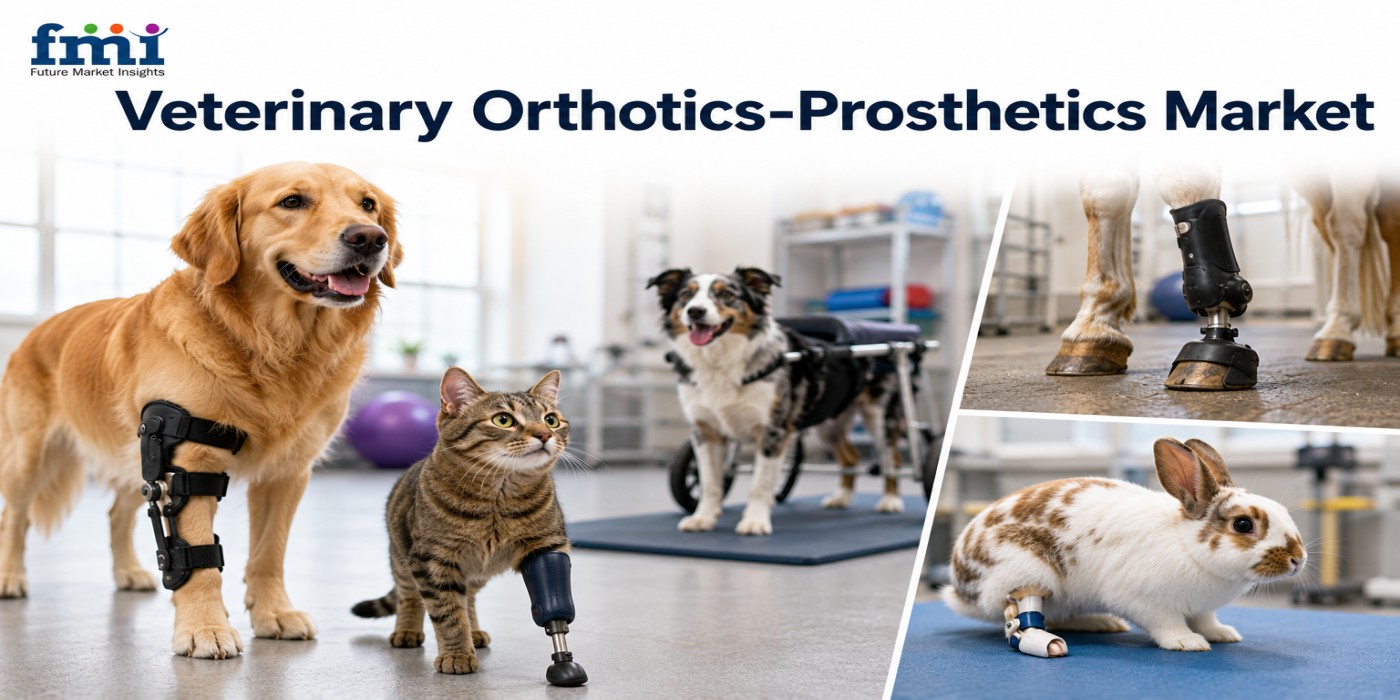
The global veterinary orthotics-prosthetics market is witnessing sustained growth as companion animal ownership continues to rise, veterinary orthopedic care advances, and awareness of animal rehabilitation increases worldwide. Veterinary orthotic and prosthetic devices have become increasingly important for restoring mobility, improving quality of life, and supporting long-term recovery in animals suffering from ligament injuries, fractures, amputations, congenital deformities, neurological disorders, and degenerative joint diseases.
As veterinary hospitals and rehabilitation specialists seek better clinical outcomes, manufacturers are expanding product portfolios that combine advanced materials, precision fitting, customization capabilities, durability, and rehabilitation support. The market is evolving beyond traditional mobility devices toward a patient-centric ecosystem where customized solutions, digital design technologies, and clinical expertise play an increasingly significant role in treatment success.
Market Outlook
The veterinary orthotics-prosthetics market is projected to grow from USD 80.1 million in 2026 to USD 149.0 million by 2036, registering a CAGR of 6.4% during the forecast period.
Unlike earlier stages of market development that were driven primarily by niche rehabilitation providers, future growth is increasingly supported by expanding veterinary infrastructure, rising expenditure on companion animal healthcare, increasing acceptance of rehabilitation therapies, and greater willingness among pet owners to invest in advanced mobility solutions.
Demand is becoming increasingly associated with long-term clinical outcomes, customization, device durability, rehabilitation support, and veterinary expertise, positioning orthotic and prosthetic devices as an essential component of modern veterinary orthopedic care.
China Emerges as a Major Competitive Force
One of the most significant developments shaping the market is China’s rapidly expanding presence in veterinary orthotics and prosthetics manufacturing.
China is expected to remain one of the fastest-growing national markets, expanding at a CAGR of 6.2% between 2026 and 2036, supported by growing veterinary infrastructure, rising disposable income, increasing pet ownership, and higher spending on animal healthcare.
Chinese manufacturers are leveraging lower production costs, expanding supplier ecosystems, and improving precision manufacturing capabilities to increase competitiveness across standardized veterinary braces and mobility-support products.
As domestic production capabilities mature, China is becoming an increasingly influential participant in the global supply chain for veterinary rehabilitation devices.
Veterinary Braces Continue to Lead Product Demand
Veterinary braces remain the largest product category within the market, accounting for approximately 42.0% of global product demand in 2026.
Braces are widely utilized for managing ligament injuries, joint instability, arthritis, post-operative rehabilitation, and musculoskeletal disorders across companion animals.
Compared with highly customized prosthetic limbs, standardized braces are easier to manufacture, allowing suppliers to achieve greater production efficiency while serving a broad range of common orthopedic conditions.
Custom Prosthetics Preserve Competitive Advantages
While standardized braces experience growing price competition, custom veterinary prosthetics continue to represent a specialized segment where precision and clinical expertise remain essential.
Unlike braces, prosthetic devices require individualized limb measurements, gait analysis, material optimization, iterative fitting, and continuous adjustments throughout rehabilitation.
Successful outcomes depend not only on manufacturing quality but also on veterinary collaboration, rehabilitation planning, biomechanical assessment, and long-term patient monitoring.
Veterinary Hospitals Drive Institutional Procurement
Institutional purchasing is becoming an increasingly important driver of market competition.
Veterinary hospitals are expected to account for approximately 38.0% of global market demand by 2026, reflecting the growing role of specialized orthopedic care, surgical procedures, and rehabilitation services.
Large veterinary facilities increasingly seek dependable suppliers capable of delivering consistent product quality, reliable customization, technical support, and predictable turnaround times.
Purchasing Decisions Extend Beyond Price
Competition within the veterinary orthotics-prosthetics market is gradually shifting beyond simple price comparisons.
Veterinary professionals and institutional buyers increasingly evaluate products based on durability, clinical reliability, customization capabilities, material performance, turnaround times, after-sales service, and long-term rehabilitation outcomes.
Quality and Customization Become Key Competitive Differentiators
Manufacturers are increasingly investing in technologies that improve both product quality and patient-specific customization.
Digital scanning, computer-aided design, precision fabrication, lightweight composite materials, and advanced polymers are enabling better anatomical fit while improving comfort and long-term device performance.
Customization capabilities, rapid production cycles, and close collaboration with veterinarians are becoming important competitive advantages as providers seek solutions tailored to individual animals rather than standardized designs alone.
Chinese Manufacturers Continue Closing the Quality Gap
Chinese suppliers are steadily improving manufacturing quality while investing in advanced fabrication technologies and expanding international distribution partnerships.
Rather than competing solely through lower production costs, many manufacturers are focusing on improving consistency, enhancing material quality, and strengthening technical capabilities to meet evolving veterinary expectations.
This transformation is gradually narrowing the historical quality gap between value-oriented manufacturers and premium specialized providers, creating a more balanced competitive landscape across global markets.
Innovation Focuses on Rehabilitation Outcomes
Innovation within the veterinary orthotics-prosthetics market increasingly centers on improving long-term mobility and rehabilitation success.
Manufacturers continue introducing lighter materials, stronger composite structures, improved joint mechanisms, and better-adjustable support systems that enhance animal comfort while facilitating natural movement.
Advances in digital measurement technologies, additive manufacturing, and individualized design processes are further improving precision fitting, reducing production timelines, and enabling more predictable clinical outcomes across a wide range of orthopedic conditions.
Challenges Facing the Market
Despite favorable growth prospects, the veterinary orthotics-prosthetics market continues to face several challenges.
Custom device manufacturing remains labor-intensive and requires specialized veterinary expertise, limiting scalability in many regions. High product costs, reimbursement limitations, and uneven access to advanced rehabilitation services continue to restrict adoption in certain markets.
Segmentation Highlights
Veterinary braces represent approximately 42.0% of total product demand, making them the leading product category within the veterinary orthotics-prosthetics industry.
Veterinary hospitals account for approximately 38.0% of global demand in 2026, highlighting the growing importance of institutional procurement and specialized orthopedic treatment.
Major applications include ligament injuries, joint instability, arthritis management, post-surgical rehabilitation, neurological disorders, congenital limb deformities, traumatic injuries, and limb amputation recovery across companion animals.
Regional Trends
China remains one of the fastest-growing regional markets, driven by expanding veterinary infrastructure, rising pet ownership, increasing disposable incomes, and continuous investment in advanced animal healthcare services.
North America continues to maintain a leading market position due to its well-established veterinary rehabilitation ecosystem, high pet healthcare expenditure, and widespread adoption of advanced orthopedic treatments.
Europe continues to experience steady market expansion supported by growing awareness of animal welfare, increasing rehabilitation services, and demand for customized mobility solutions across companion animal healthcare.
Competitive Landscape and Future Outlook
The veterinary orthotics-prosthetics market remains increasingly competitive, with manufacturers focusing on product innovation, digital customization technologies, veterinary collaboration, and expanded rehabilitation support services.
Leading companies continue investing in precision fabrication, lightweight materials, customized prosthetic design, and improved clinical validation to strengthen market positioning.
Conclusion: Clinical Value and Customization Define the Future of the Veterinary Orthotics-Prosthetics Market
The veterinary orthotics-prosthetics market is entering a new phase of development where clinical outcomes, customization, rehabilitation expertise, and long-term patient mobility are becoming just as important as manufacturing cost.
While standardized veterinary braces continue to dominate product demand through affordability and broad clinical application, customized prosthetic devices remain essential for complex orthopedic cases where precision fitting and veterinary expertise are critical. China’s growing manufacturing capabilities are reshaping global competition by improving both production efficiency and product quality, particularly within standardized mobility-support devices.
Explore More Related Studies Published by FMI Research:
https://www.openpr.com/news/4533262/global-coxsackievirus-infections-treatment-market-led-by-usa
https://www.openpr.com/news/4531346/bartonellosis-therapeutics-market-advances-across-the-united
About Future Market Insights (FMI)
Future Market Insights, Inc. (FMI) is an ESOMAR-certified, ISO 9001:2015 market research and consulting organization trusted by Fortune 500 companies and global enterprises. With operations across the United States, United Kingdom, India, and Dubai, FMI delivers data-driven market intelligence, strategic consulting, and actionable insights across more than 30 industries and 1,200 markets worldwide.