


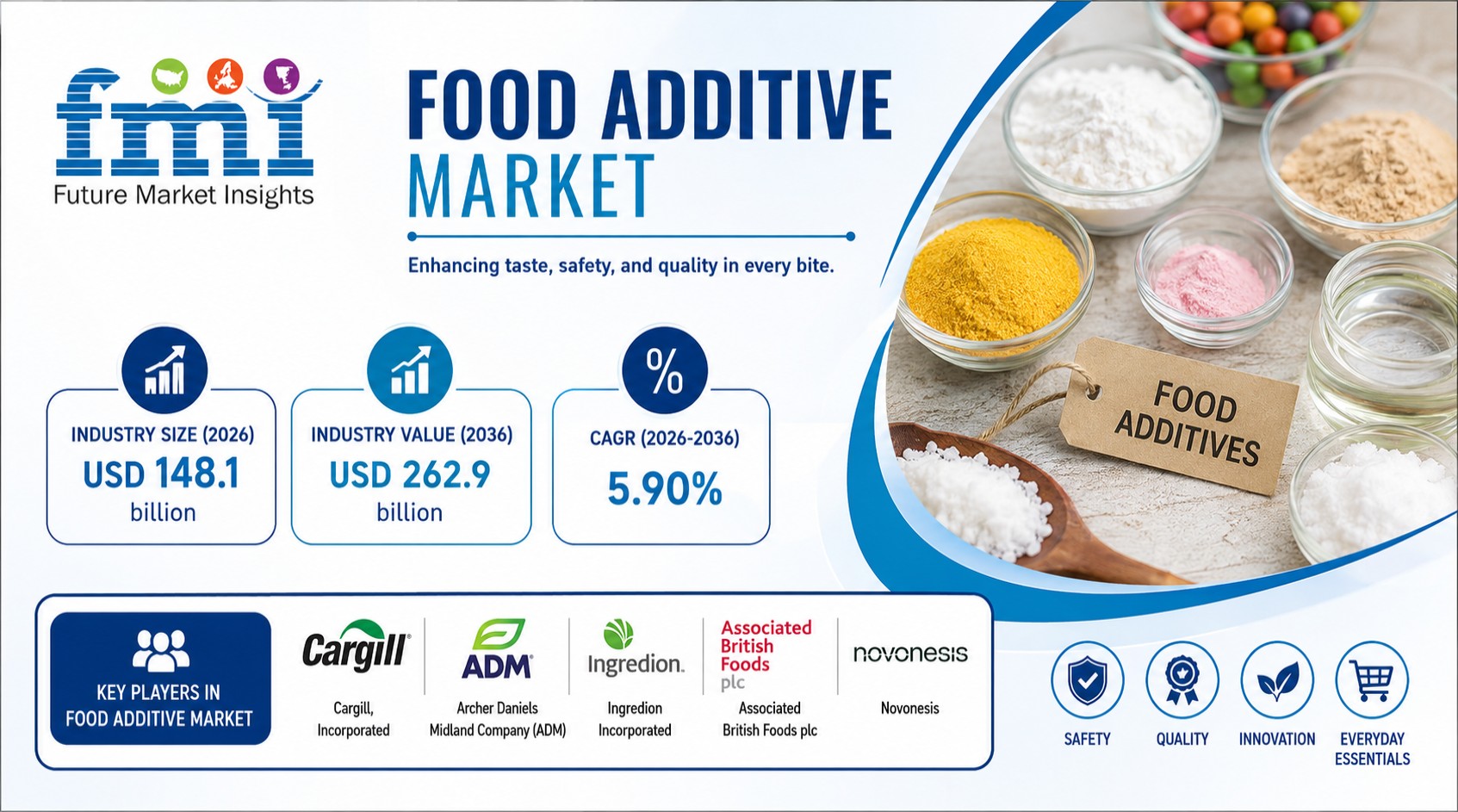
The global food additives market is entering a new phase of transformation as food manufacturers increasingly balance clean-label reformulation with industrial-scale functionality. Growing consumer demand for natural ingredients, combined with evolving food safety regulations and advances in ingredient technologies, is accelerating investments in natural preservatives, plant-derived colorants, fermentation-based additives, enzymes, and hydrocolloids. According to the latest analysis, the market continues to witness strong momentum as manufacturers seek additives capable of delivering consistent performance without compromising product quality or shelf life.
The industry’s evolution demonstrates that food additive capacity extends far beyond production volume. Modern food companies require suppliers capable of delivering standardized functionality, regulatory compliance, batch-to-batch consistency, application support, and resilient supply chains. As natural alternatives replace conventional synthetic additives across multiple applications, scalable functionality has become one of the industry’s most important competitive differentiators.
Featured Snippet: Key Market Answer
Q: Why is food additive capacity becoming a critical issue in the food industry?
A: Food additive capacity now extends beyond manufacturing volume to include consistent functionality, regulatory compliance, supply reliability, formulation validation, and industrial-scale application performance. As clean-label demand accelerates, suppliers must ensure that natural additives perform consistently across processing conditions, storage environments, and global regulatory markets without sacrificing food safety, shelf life, or production efficiency.
Quick Stats of Food Additives Market
- Industry Focus: Natural and Functional Food Additives
- Primary Growth Driver: Clean-Label Reformulation
- Leading Functional Requirement: Shelf-Life Extension and Product Stability
- Fastest Emerging Trend: Fermentation-Based Natural Ingredients
- Key Industry Challenge: Scaling Natural Additives Without Performance Loss
Market Overview: Scaling Natural Functionality
Food additives include preservatives, colors, emulsifiers, stabilizers, sweeteners, enzymes, antioxidants, and texturizers that provide essential technical functions throughout food manufacturing, processing, packaging, and storage.
As consumer preference shifts toward recognizable ingredients and minimally processed foods, manufacturers are reformulating thousands of products. However, replacing synthetic additives involves far greater complexity than ingredient substitution.
Three major forces are redefining food additive capacity:
- Rising demand for natural and clean-label ingredients
- Increasing global regulatory complexity
- Growing need for repeatable industrial-scale functionality
The market is therefore evolving from ingredient supply toward complete application-ready technical solutions.
Key Growth Drivers
Rapid Expansion of Clean-Label Reformulation
Food manufacturers across bakery, dairy, beverages, confectionery, snacks, sauces, and convenience foods are replacing synthetic ingredients with naturally sourced alternatives to meet changing consumer expectations.
This trend is creating sustained demand for natural preservatives, botanical extracts, fermentation-derived ingredients, enzymes, and plant-based stabilizers.
Increasing Need for Functional Consistency
Industrial food production depends on ingredients that behave consistently across every production batch.
Food companies increasingly evaluate suppliers based on repeatable functionality rather than ingredient origin alone.
Regulatory Compliance Across Global Markets
Food additive regulations vary considerably across North America, Europe, Asia-Pacific, Latin America, and the Middle East.
Manufacturers require suppliers capable of providing complete documentation, regulatory support, ingredient traceability, and market-specific compliance.
Growing Importance of Supply Chain Reliability
Natural additives often depend on agricultural production, making them vulnerable to weather events, seasonal variation, crop diseases, and fluctuating extraction yields.
Supply resilience has therefore become an essential purchasing criterion.
Market Trends Shaping the Industry
Fermentation-Based Ingredient Production
Fermentation technologies are expanding rapidly as manufacturers seek alternatives that reduce dependence on seasonal agricultural production while improving ingredient consistency.
Application-Led Product Development
Ingredient suppliers increasingly collaborate with food manufacturers through pilot trials, formulation optimization, and shelf-life validation rather than simply supplying raw materials.
Cost-in-Use Optimization
Food manufacturers are shifting purchasing decisions from ingredient price toward total application economics, considering dosage rates, waste reduction, processing efficiency, and product stability.
Functional Clean Labels
Rather than focusing solely on label-friendly ingredients, companies now prioritize natural additives capable of matching the functionality of conventional synthetic systems.
Digital Quality and Traceability Systems
Advanced quality management platforms, digital documentation, and ingredient traceability systems are strengthening supplier transparency and regulatory readiness.
Segment Insights
Natural Food Colors
Natural food colors require precise standardization for:
- Color intensity
- Heat stability
- Light stability
- pH resistance
- Storage performance
- Solubility
Reliable supplier capability has become essential for beverage, dairy, confectionery, and bakery manufacturers.
Food Preservatives
Preservatives remain indispensable for microbial control, spoilage prevention, and shelf-life extension.
Although demand for naturally derived preservatives continues to grow, synthetic preservatives remain important where pathogen control and extended distribution cycles are critical.
Food Emulsifiers
Emulsifiers continue supporting texture stability, suspension, moisture retention, and processing efficiency across packaged foods.
Successful large-scale adoption depends on maintaining performance during freezing, thawing, heating, mixing, and long-term storage.
Food Enzymes
Modern enzyme systems improve manufacturing efficiency while enhancing texture, yield, and product consistency.
Predictable enzyme activity under varying production conditions remains essential for industrial food processing.
Related Food Additive Segments
Food Additives Market
Growth continues to be supported by increasing demand for multifunctional ingredients that improve product quality, safety, and manufacturing efficiency.
Clean Label Food Additives Market
Manufacturers increasingly invest in naturally derived ingredients that satisfy both regulatory requirements and consumer expectations for transparency.
Food Preservatives Market
Demand remains strong as manufacturers prioritize food safety, microbial control, and extended shelf life across global supply chains.
Natural Food Colors Market
The market continues expanding as beverage, confectionery, dairy, and bakery manufacturers replace artificial colors with plant-based alternatives.
Food Emulsifier Market
Growth is driven by increasing demand for stable texture systems across processed foods, convenience products, sauces, dairy, and bakery applications.
Regional Insights
North America
North America remains a leading market owing to:
- Advanced food manufacturing
- Strong clean-label adoption
- Comprehensive food safety regulations
- Significant investment in ingredient innovation
Europe
Europe continues emphasizing:
- Natural ingredient adoption
- Sustainability
- Regulatory transparency
- Consumer-driven reformulation
Asia-Pacific
Asia-Pacific is expected to experience the strongest long-term expansion driven by:
- Growing processed food production
- Rising middle-class consumption
- Expanding food exports
- Increasing investment in food ingredient manufacturing
Emerging Markets
Countries across Latin America, Southeast Asia, India, and the Middle East are witnessing increasing adoption of natural food additives as packaged food production expands.
Competitive Landscape
The food additives market is evolving toward integrated solution providers capable of delivering ingredient innovation alongside technical application expertise, regulatory guidance, quality assurance, and supply chain resilience.
Suppliers are increasingly differentiating themselves through formulation support, pilot-scale validation, digital documentation, and global manufacturing capabilities.
Competitive Differentiation Factors
- Consistent batch-to-batch quality
- Industrial-scale manufacturing capability
- Regulatory documentation expertise
- Application laboratory support
- Supply chain resilience
- Cost-in-use optimization
- Shelf-life validation
- Global technical service networks
Recent Developments
- Increased investment in fermentation-derived natural additives.
- Expansion of plant-based preservative technologies.
- Growing adoption of natural color stabilization systems.
- Higher investment in application laboratories for product reformulation.
- Stronger integration of digital quality documentation and regulatory compliance systems.
Expert Insight
The food additives market is entering what can be described as the “Industrial Functionality Era,” where ingredient success is measured not simply by clean-label positioning but by its ability to deliver repeatable performance across industrial manufacturing environments.
Future market leaders will be those capable of combining natural ingredient innovation with application expertise, regulatory readiness, resilient sourcing, and scalable production systems. As food manufacturers pursue cleaner formulations without compromising quality or operational efficiency, supplier capability will increasingly define competitive advantage.
FAQs
What is driving demand in the food additives market?
Growing clean-label reformulation, stricter food safety regulations, increasing demand for natural ingredients, and advances in fermentation technologies are driving market expansion.
Why are natural food additives difficult to scale?
Natural additives often face agricultural variability, inconsistent raw materials, processing limitations, regulatory complexity, and formulation challenges during commercial production.
Why do synthetic additives remain relevant?
Synthetic additives continue providing standardized functionality, affordability, long shelf life, and reliable pathogen control in applications where consistent performance is essential.
What factors determine food additive capacity?
Capacity depends on manufacturing scale, functional consistency, regulatory compliance, application validation, supply reliability, documentation quality, and cost-effectiveness.
Which regions offer the strongest opportunities?
Asia-Pacific presents the highest long-term growth potential, while North America and Europe continue leading innovation, regulatory compliance, and clean-label adoption.
Conclusion
The food additives market is evolving beyond ingredient production toward comprehensive functional performance. As food manufacturers accelerate clean-label reformulation, suppliers must demonstrate that natural alternatives can deliver consistent industrial-scale functionality without compromising safety, quality, shelf life, or manufacturing efficiency.
Future success will depend on balancing ingredient innovation with application expertise, resilient sourcing, regulatory compliance, and technical support. Companies capable of providing validated, scalable, and cost-effective food additive systems will be well positioned to lead the industry’s next phase of growth as natural ingredients become central to global food production.
Related Research Reports
Clean Label Food Additives Market: Examines the transition toward naturally derived additives driven by consumer demand for transparency and minimally processed foods.
Clean Label Ingredients Market: Analyzes the growing adoption of recognizable ingredients that enhance product quality while supporting clean-label positioning.
Food Preservatives Market: Evaluates antimicrobial and antioxidant technologies that improve food safety and shelf-life performance.
FMI Custom Research: Strategic Intelligence for Confident Decision-Making
In today’s rapidly evolving business environment, leadership teams need more than market data they need clear, actionable intelligence tailored to their strategic objectives. FMI’s Custom Research solutions are designed around the specific business questions organizations need answered, enabling executives to evaluate growth opportunities, validate investments, assess competitive dynamics, and reduce uncertainty before making critical decisions. By combining deep industry expertise, primary research, and proprietary market intelligence, FMI delivers insights that help organizations move from assumptions to evidence-based strategies with greater speed and confidence.
Key Executive Benefits
- Decision-Ready Insights: Research tailored to your specific business challenges, growth plans, and investment priorities.
- Reduced Strategic Risk: Validate market opportunities, customer demand, and competitive positioning before committing resources.
- Market Entry Confidence: Assess opportunity size, regulatory barriers, channel dynamics, and competitive landscapes with precision.
- Competitive Advantage: Gain proprietary intelligence unavailable through syndicated reports or internal datasets.
- Faster Growth Decisions: Accelerate expansion, product development, portfolio optimization, and investment planning.
- Primary Market Validation: Access real-world customer, buyer, and stakeholder insights that support high-confidence decision-making.
- Global Industry Expertise: Powered by 100+ analysts, 20,000+ published reports, and 1.6 million+ hours of research experience.
- Proven Track Record: Over 7,000 market-entry engagements completed across six regions and 14 industry sectors with strong client retention.
Business Impact
FMI helps organizations transform market complexity into strategic clarity, enabling leadership teams to identify growth opportunities faster, optimize resource allocation, strengthen competitive positioning, and make high-stakes business decisions with confidence.
To explore how FMI Custom Research can support your strategic priorities, please connect with our team at – sales@futuremarketinsights.com
About Future Market Insights (FMI)
Future Market Insights is a leading provider of market intelligence, consulting services, and syndicated research reports. FMI delivers actionable insights across food and beverage, healthcare, consumer goods, biotechnology, chemicals, industrial products, and emerging technologies, helping organizations identify growth opportunities and make informed strategic decisions in evolving global markets.
Contact Us:
Future Market Insights Inc.
Christiana Corporate, 200 Continental Drive,
Suite 401, Newark, Delaware – 19713, USA
T: +1-347-918-3531
Why FMI: https://www.futuremarketinsights.com/why-fmi
For Sales Enquiries: sales@futuremarketinsights.com
Website: https://www.futuremarketinsights.com