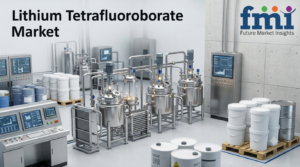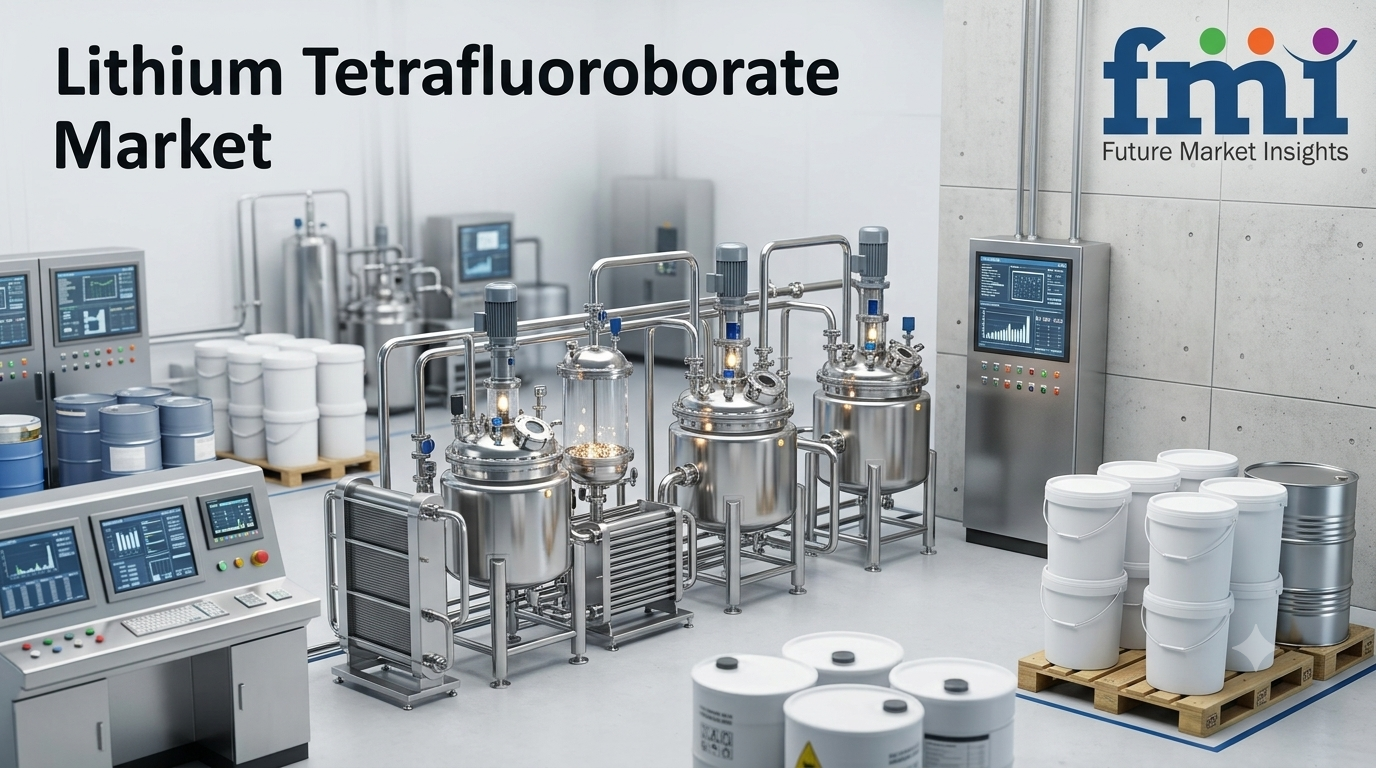
The global lithium tetrafluoroborate market was valued at USD 2.5 billion in 2025 and is estimated to reach USD 2.7 billion in 2026. The market is forecast to grow at a CAGR of 6.5% from 2026 to 2036, reaching USD 5.0 billion by 2036. Rising electric vehicle (EV) battery output, expanding energy storage deployment, and increasing demand for specialized electrolyte formulations are expected to support sales. According to the International Energy Agency, global EV battery deployment reached 1.2 TWh in 2025, nearly 30% above the 2024 level. Lithium tetrafluoroborate (LiBF4) is used as an electrolyte additive to improve battery performance under high- and low-temperature conditions, creating opportunities as battery manufacturers qualify new electrolyte formulations.
Global Segment Leaders
- By Grade: Battery-grade LiBF4 accounts for 42% of market revenue in 2026, supported by repeat purchases from approved battery cell production programs and strict moisture and impurity requirements.
- By Application: Lithium-ion electrolyte additives hold a 47% share in 2026, as formulators use LiBF4 alongside primary electrolyte salts to support temperature performance and stability.
- By Battery Type: EV lithium-ion cells account for 38% of market revenue in 2026, reflecting the scale of electric vehicle battery production and the need to qualify electrolyte formulations for individual vehicle platforms.
- By Purity: The 99.5–99.9% purity range represents 37% of revenue in 2026, balancing battery specifications with purification costs and material pricing.
- By Sales Channel: Electrolyte manufacturers account for 43% of sales in 2026 because they select and source salt ingredients for formulations approved by battery cell makers.
The market is expected to generate an additional USD 2.3 billion in revenue between 2026 and 2036. Demand will depend on battery production volumes, electrolyte qualification schedules, supplier approvals, and the expansion of manufacturing capacity across established and emerging battery markets.
Country-Level Performance
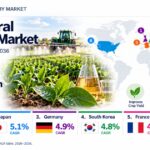
South Korea is projected to record the fastest growth among the profiled countries, with a CAGR of 7.2% from 2026 to 2036. The United States follows at 6.2%, Germany at 5.9%, Japan at 5.6%, and France at 5.3%.
South Korea’s growth outlook is supported by government investment in next-generation battery technology. In November 2025, the government allocated approximately KRW 280 billion through 2029 for battery technology development, according to the supplied report information. The funding is expected to support further development of battery materials and electrolyte formulations.
The United States is forecast to grow at a CAGR of 6.2%. The report identifies domestic battery-material supply as a key growth lever, supported by plans for Orbia’s Louisiana facility to produce 10,000 metric tons of battery-grade electrolyte salts annually with a USD 100 million U.S. Department of Energy grant.
Germany is projected to register a CAGR of 5.9%. PowerCo began cell production in Salzgitter in December 2025, with an initial planned capacity of 20 GWh annually. The expansion creates opportunities for electrolyte suppliers that secure approval for their materials at new production lines.
Japan is expected to record a CAGR of 5.6%. In June 2026, Japan’s Ministry of Economy, Trade and Industry outlined a domestic battery manufacturing target of 150 GWh annually from 2030 to the mid-2030s. Progress toward this target is expected to influence demand for battery materials and approved electrolyte formulations.
France is forecast to record the slowest growth among the profiled countries, at a CAGR of 5.3%. Verkor opened its 16 GWh Bourbourg gigafactory in December 2025 and aims to expand capacity to 50 GWh by 2030. The report identifies electrolyte qualification and production ramp-up at French battery plants as important factors affecting future LiBF4 demand.
Regional Context
South Korea and the United States represent the fastest-growing markets in the country-level forecast, supported by next-generation battery investment, energy storage opportunities, and efforts to develop domestic battery-material supply chains. Germany and Japan are expected to benefit from planned and expanding battery manufacturing capacity, although demand will depend on production ramp-ups and the time required to qualify electrolyte formulations. France is projected to grow more slowly as battery production expands and new electrolyte recipes progress through approval processes.
The full report covers North America, Latin America, Western Europe, Eastern Europe, East Asia, South Asia and the Pacific, and the Middle East and Africa. Detailed country-level growth forecasts are provided for South Korea, the United States, Germany, Japan, and France.
Competitive Landscape
The lithium tetrafluoroborate market includes fluorochemical salt producers, electrolyte formulators, specialty materials companies, and battery-material distributors. Key companies profiled are Morita Chemical Industries Co., Ltd., Stella Chemifa Corporation, Kanto Denka Kogyo Co., Ltd., Foosung Co., Ltd., Soulbrain Co., Ltd., Central Glass Co., Ltd., Mitsubishi Chemical Group Corporation, Solvay S.A., Arkema S.A., and Targray Technology International Inc.
Competition centers on salt purity, moisture control, formulation expertise, supply reliability, and qualification with battery manufacturers. In December 2025, Mitsubishi Chemical agreed to transfer its electrolyte plants in Memphis, United States, and Billingham, United Kingdom, to Green Energy Origin, with completion scheduled for March 2026, subject to approvals. In May 2025, the World Intellectual Property Organization published a Stella Chemifa patent application listing lithium tetrafluoroborate among potential borate salts for battery electrolyte formulations. These developments highlight the importance of electrolyte manufacturing capabilities, material innovation, and supplier relationships in the evolving battery supply chain.
Suppliers that secure early approval at new battery plants may benefit from repeat orders over the life of individual cell programs. However, LiBF4’s relatively low standalone ionic conductivity and limited graphite compatibility restrict its use as the primary electrolyte salt, keeping demand closely linked to its role as an additive.
Related Report:
https://www.openpr.com/news/4659478/mold-powders-and-casting-fluxes-market-to-reach-usd-1-5-billion
https://www.openpr.com/news/4659489/luxury-vinyl-tile-flooring-market-to-reach-usd-97-45-billion
https://www.openpr.com/news/4659500/luxury-wood-doors-for-residential-interiors-market-to-reach-usd
Business Impact
FMI helps organizations transform market complexity into strategic clarity, enabling leadership teams to identify growth opportunities faster, optimize resource allocation, strengthen competitive positioning, and make high-stakes business decisions with confidence.
To explore how FMI Custom Research can support your strategic priorities, please connect with our team at – sales@futuremarketinsights.com
About Future Market Insights (FMI)
Future Market Insights is a leading provider of market intelligence, consulting services, and syndicated research reports. FMI delivers actionable insights across food and beverage, healthcare, consumer goods, biotechnology, chemicals, industrial products, and emerging technologies, helping organizations identify growth opportunities and make informed strategic decisions in evolving global markets.
Contact Us:
Christiana Corporate, 200 Continental Drive,
Suite 401, Newark, Delaware – 19713, USA
T: +1-347-918-3531
Why FMI: https://www.futuremarketinsights.com/why-fmi
For Sales Enquiries: sales@futuremarketinsights.com
Website: https://www.futuremarketinsights.com