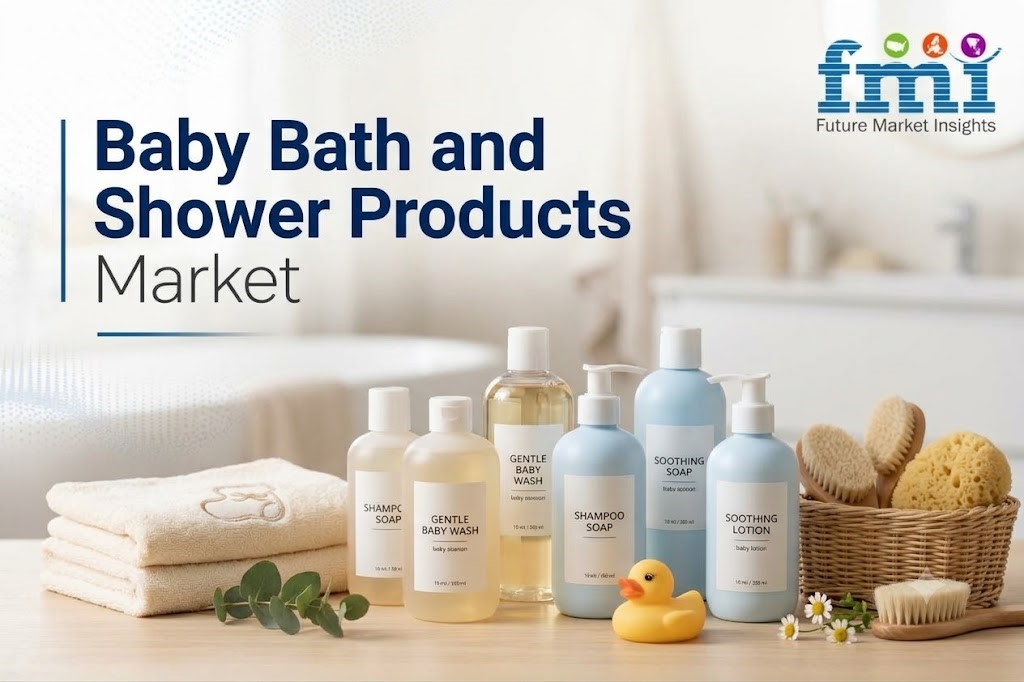
The global baby bath and shower products market is projected to grow from USD 3.6 billion in 2026 to USD 7.8 billion by 2036, registering a compound annual growth rate (CAGR) of 8.0%, according to Future Market Insights (FMI). Valued at USD 3.4 billion in 2025, the market is expected to generate an incremental opportunity of USD 4.2 billion during the forecast period, supported by growing awareness of infant skin health and demand for specialized cleansing products.
Parents are increasingly seeking baby bath products formulated for sensitive skin, with mild cleansing agents, skin-compatible pH levels, and transparent ingredient information. These preferences are encouraging manufacturers to improve formulation testing, expand hypoallergenic product ranges, and develop convenient packaging for everyday infant care routines.
However, manufacturers face challenges from rising clinical evaluation costs, ingredient scrutiny, and competition from multipurpose cleansing products. Maintaining product safety, affordability, and formulation stability remains important for sustained market growth.
Get detailed market forecasts, segment analysis, and competitive insights: https://www.futuremarketinsights.com/reports/sample/rep-gb-4827
Global Segment Leaders
FMI identifies the following leading segments in the baby bath and shower products market for 2026:
- Product Type – Baby Body Wash: 42% share, supported by demand for gentle cleansing products designed for infant skin and daily bathing routines.
- Distribution Channel – Online Retail: 38% share, reflecting convenient purchasing, access to ingredient information, and recurring order options.
Product development is increasingly focused on fragrance-free options, hypoallergenic formulations, and dermatologically evaluated cleansing systems. Pump dispensers and convenient packaging formats also support caregiver needs during routine bathing.
Country-Level Performance
FMI forecasts strong growth across emerging and established markets through 2036.
- India – 9.8% CAGR: Changing infant bathing practices, wider product availability, and increasing adoption of specialized baby care formulations support demand.
- China – 9.2% CAGR: Urban parenting trends and growing acceptance of premium infant care products contribute to market expansion.
- United States – 8.3% CAGR: Demand is supported by interest in naturally derived ingredients, hypoallergenic formulations, and products designed for sensitive infant skin.
- Brazil – 8.1% CAGR: Wider retail availability and rising acceptance of specialized infant care formats support growth.
- Germany – 7.6% CAGR: Consumer interest in organic product credentials, ingredient transparency, and evaluated formulations supports demand.
These forecasts highlight opportunities for manufacturers to adapt product portfolios to local preferences, purchasing power, and distribution structures.
Regional Context
Asia Pacific is identified as the fastest-growing regional market, supported by demand in China and India, a widening consumer base, and greater adoption of specialized infant cleansing products. Manufacturers can pursue growth through accessible price tiers, broader distribution, and formulations suited to local preferences.
North America benefits from awareness of pediatric skin health and demand for hypoallergenic products. In Europe, ingredient compliance, product evaluation, and interest in organic formulations influence product development and positioning.
Across regions, online retail provides opportunities to communicate ingredient details and encourage repeat purchases. Manufacturers must ensure that product safety and performance claims are supported by appropriate evidence.
Competitive Landscape and Key Developments
Key companies profiled by FMI include Johnson & Johnson, Procter & Gamble Co., Unilever PLC, Beiersdorf AG, L’Oréal S.A., Pigeon Corporation, Sebapharma GmbH & Co. KG, Mustela, The Honest Company, Inc., and Burt’s Bees.
Competition centers on formulation quality, ingredient transparency, product safety evaluation, brand credibility, and distribution reach. Established companies benefit from broad portfolios and retail relationships, while specialized infant care brands differentiate through targeted formulations and safety-focused positioning.
Recent developments include:
- In February 2026, Hindustan Unilever Limited announced plans to invest up to ₹2,000 crore in manufacturing capacity expansion across multiple locations over two years, targeting growing premium categories in Beauty & Wellbeing and Home Care liquids.
- In February 2026, Unilever announced a partnership with Google Cloud to advance business transformation through AI, data, and marketing capabilities. The supplied information does not establish a direct impact on the baby bath and shower products market.
For manufacturers, priorities include improving ingredient transparency, investing in product evaluation, and addressing caregiver expectations without making unsupported safety claims.
Baby Bath and Shower Products Market – Report Scope
The FMI report examines the global market from 2026 to 2036, covering revenue forecasts, segment performance, regional trends, and competitive positioning.
The study analyzes four product types: baby body wash, baby shampoo, baby bath oil, and baby bubble bath. Distribution channels include supermarkets and hypermarkets, specialty stores, online retail, and pharmacies. Packaging coverage includes bottles, tubes, pump dispensers, and sachets.
Regional coverage spans North America, Latin America, Europe, East Asia, South Asia, Oceania, and the Middle East and Africa. The report assesses market drivers, formulation trends, distribution strategies, and growth opportunities across established and emerging infant care markets.
Explore More Related Studies Published by FMI Research:
https://www.openpr.com/news/4646979/can-opener-market-to-reach-usd-6-1-billion-by-2036-at-5-8-cagr
https://www.openpr.com/news/4646991/baby-swing-market-to-reach-usd-2-7-billion-by-2036-at-4-3-cagr
https://www.openpr.com/news/4647009/facial-oil-market-to-reach-usd-6-7-billion-by-2036-at-6-1-cagr
Business Impact
FMI helps organizations transform market complexity into strategic clarity, enabling leadership teams to identify growth opportunities faster, optimize resource allocation, strengthen competitive positioning, and make high-stakes business decisions with confidence.
To explore how FMI Custom Research can support your strategic priorities, please connect with our team at – sales@futuremarketinsights.com
About Future Market Insights (FMI)
Future Market Insights, Inc. (FMI) is an ESOMAR-certified, ISO 9001:2015 market research and consulting organization, trusted by Fortune 500 clients and global enterprises. With operations in the U.S., UK, India, and Dubai, FMI provides data-backed insights and strategic intelligence across 30+ industries and 1200 markets worldwide.