

Sustainability Turns Shrimp Certification from a Claim into Pricing Power
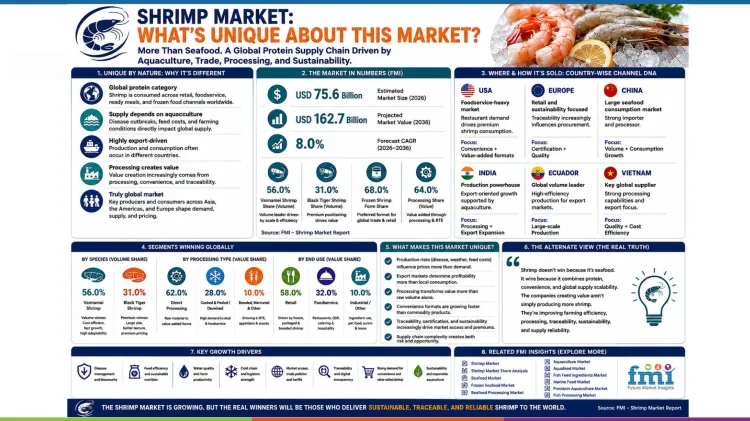
According to the latest insights by Future Market Insights, the global Shrimp Market is witnessing a shift in buyer expectations as sustainability becomes a stronger factor influencing purchasing decisions. However, sustainability certifications alone are no longer enough to justify higher prices. Buyers increasingly expect sustainable shrimp to deliver a complete value proposition combining quality, food safety, traceability, supply reliability, and responsible sourcing.
In 2026, sustainability competition in the shrimp industry is being shaped by changing buyer priorities around:
- Responsible aquaculture practices
• Traceable supply chains
• Food safety assurance
• Environmental compliance
• Certified production systems
• Reliable supply partnerships
Industry analysts highlight that sustainability creates stronger pricing power only when supported by measurable supply chain advantages. Buyers may value certifications such as responsible sourcing, environmental standards, or traceability programs, but long-term purchasing decisions depend on whether shrimp delivers consistent quality, safety, transparency, and supply confidence.
Sustainability Creates Premium Opportunity, But Supply Chain Performance Comes First
The shrimp industry has historically faced challenges related to:
- Limited supply chain visibility
• Environmental concerns
• Quality consistency issues
• Production risks
• Complex global sourcing networks
Although sustainability programs have improved industry practices, perception remains a major factor influencing purchasing decisions.
Sustainability positioning helps producers strengthen buyer confidence through:
- Improved traceability
• Responsible farming practices
• Better compliance standards
• Supply chain transparency
• Reduced procurement risks
However, sustainability cannot replace the core expectations of seafood buyers.
Purchasers continue evaluating shrimp based on:
- Product quality
• Food safety
• Size consistency
• Processing standards
• Supply reliability
• Price competitiveness
A certified shrimp product without strong operational performance may struggle to maintain premium pricing.
Premium Segments Strengthen Sustainability Value
Not all shrimp categories benefit equally from sustainability premiums.
Premium opportunities are strongest in segments where buyers already prioritize quality and responsible sourcing.
Key growth areas include:
- Retail packaged shrimp
• High-quality frozen seafood
• Export-oriented shrimp
• Foodservice supply programs
• Premium seafood categories
These segments create stronger value perception because buyers associate sustainability with:
- Lower sourcing risks
• Better product confidence
• Stronger brand reputation
• Regulatory compliance
• Consumer trust
Examples include:
- Certified frozen shrimp products
• Traceable retail shrimp packs
• Premium restaurant seafood supply
• Responsible aquaculture shrimp
When sustainability aligns with quality and transparency, buyers are more willing to accept higher prices.
Commodity Shrimp Segments Face Stronger Price Pressure
Sustainability pricing power weakens in highly price-driven categories.
The most price-sensitive segments include:
- Commodity wholesale shrimp
• Bulk transactions
• Undifferentiated frozen shrimp
• Price-focused distribution channels
In these categories, buyers focus more on:
- Cost efficiency
• Availability
• Volume supply
• Market pricing
• Supplier flexibility
A sustainability certification may improve perception, but it often does not justify a significant price premium when products are easily replaceable.
The biggest challenge appears when sustainability messaging is stronger than the actual business value delivered.
Supply Chain Complexity Limits Sustainability Execution
Shrimp production involves some of the world’s most complex seafood supply chains.
The process may include:
- Farming in one country
• Processing in another region
• Distribution through multiple intermediaries
• Final consumption in global markets
This complexity makes sustainability implementation challenging.
Producers must manage:
- Traceability systems
• Farming standards
• Feed sourcing
• Processing controls
• Certification requirements
• Environmental monitoring
Common industry challenges include:
- Limited visibility across supply chains
• Certification costs
• Compliance requirements
• Production variability
• Maintaining consistent standards
This makes sustainability a balance between responsible production and commercial feasibility.
Traceability Becomes the Foundation of Premium Value
Traceability has become one of the strongest drivers behind sustainability-based pricing.
Buyers increasingly demand visibility into:
- Origin of shrimp
• Farming practices
• Processing conditions
• Supply chain movement
• Quality assurance systems
Traceability creates value by helping buyers achieve:
- Greater transparency
• Risk reduction
• Procurement confidence
• Regulatory compliance
The strongest sustainability programs are those that transform certification into measurable supply chain benefits.
Food Safety Strengthens Sustainability Premiums
Food safety remains a critical factor influencing shrimp purchasing decisions.
Sustainable shrimp programs gain stronger market acceptance when they support:
- Quality control
• Responsible production
• Better handling practices
• Consistent standards
Buyers are more likely to pay premiums when sustainability reduces uncertainty and protects their supply chain.
The value comes from confidence, not only from certification labels.
Certification Alone Does Not Create Pricing Power
One of the biggest misconceptions in the shrimp industry is believing certification automatically creates premium pricing.
In reality, certification works as a tool to protect and support premium positioning.
Buyers do not pay more simply because shrimp carries a sustainability label.
They pay more because certification represents:
- Lower risk
• Reliable sourcing
• Improved transparency
• Better compliance
• Stronger product assurance
Sustainability becomes commercially valuable when it solves real procurement challenges.
Three Competitive Layers Shape Shrimp Market Economics
The market operates through three major competitive layers.
Product Quality Layer
Driven by:
- Taste and freshness
• Processing quality
• Size consistency
• Product appearance
• Food safety
Products with stronger quality performance maintain greater pricing power.
Sustainability Value Layer
Influenced by:
- Certification
• Traceability
• Responsible farming
• Environmental practices
• Ethical sourcing
Sustainability creates value when buyers recognize meaningful benefits.
Supply Chain Trust Layer
Determined by:
- Supplier reliability
• Transparency
• Compliance strength
• Long-term partnerships
• Brand reputation
Strong suppliers can maintain premium pricing when buyers trust their sourcing systems.
Why Mid-Market Shrimp Suppliers Face Pressure
Mid-sized shrimp producers often compete between premium and value-focused suppliers.
They compete against:
Premium suppliers offering:
- Certified products
• Strong traceability
• Higher quality assurance
• Differentiated sourcing stories
Value suppliers offering:
- Lower prices
• Large-scale supply
• Standardized products
The biggest risk occurs when shrimp products become interchangeable.
If the only message is:
- Sustainable
• Certified
• Responsible
competitors can quickly replicate the positioning.
Future Outlook
The future of the Shrimp Market will depend on how effectively producers combine sustainability with measurable product and supply chain advantages.
Manufacturers and suppliers are expected to focus on:
- Advanced traceability systems
• Responsible aquaculture practices
• Certification improvements
• Supply chain transparency
• Quality consistency
• Food safety innovation
• Sustainable feed solutions
Sustainability will continue creating opportunities, but success will depend on whether companies move beyond certification claims and deliver meaningful buyer value.
The strongest shrimp suppliers will be those that make buyers believe:
Responsible shrimp is not just better for the environment — it is a safer, more reliable, and higher-value product.
FMI Custom Research: Strategic Intelligence for Confident Decision-Making
In today’s rapidly evolving business environment, leadership teams need more than market data—they need clear, actionable intelligence tailored to their strategic objectives.
FMI’s Custom Research solutions are designed around the specific business questions organizations need answered, enabling executives to evaluate growth opportunities, validate investments, assess competitive dynamics, and reduce uncertainty before making critical decisions.
By combining deep industry expertise, primary research, and proprietary market intelligence, FMI delivers insights that help organizations move from assumptions to evidence-based strategies with greater speed and confidence.
Key Executive Benefits
- Decision-Ready Insights
• Reduced Strategic Risk
• Market Entry Confidence
• Competitive Advantage
• Faster Growth Decisions
• Primary Market Validation
• Global Industry Expertise
• Proven Track Record
Business Impact
FMI helps organizations transform market complexity into strategic clarity, enabling leadership teams to identify opportunities faster, strengthen competitive positioning, optimize investments, and make confident business decisions.
To explore how FMI Custom Research can support your strategic priorities, connect with our team at: sales@futuremarketinsights.com
Explore More Related Studies Published by FMI Research:
The Seafood Market is segmented by Product Type, Distribution Channel, End User, and Region. Forecast for 2026 to 2036.
The frozen seafood market is segmented by Nature (Organic, Conventional), Form (Raw, Processed), End Use (Food Processing Industry, Food Service Industry, Retail/Household), Product Type (Fish, Molluscs, Crustaceans, Others), and Distribution Channel (Business to Business, Business to Consumer, Modern Trade, Convenience Stores, Traditional Grocery Stores, Specialist Food Stores, Wholesale Stores, Discount Stores, E-commerce/Online Stores). Forecast for 2025 to 2035.
Fish Feed Market is segmented by Product (Plant Based, Fish and Fish Products, Microorganism), Form (Pellet, Granules, Flakes, Sticks, Powder), End Use Application (Commercial, Household), and Region. Forecast for 2026 to 2036.
The global aquafeed market is segmented by Species (Fish, Crustaceans, Others), Form (Pellets, Extruded, Powder, Liquid), Function (Health, Digestion, Palatability, Special Nutrition), Ingredients (Marine, Land Animal, Veg/Grain, Carotenoid, Nutrients, Others), Sales Channel (Direct, Indirect, Hypermarket, Supermarket, Wholesalers, Specialty Stores, Online, Others), and Region. Forecast for 2025 to 2035.
About Future Market Insights (FMI)
Future Market Insights, Inc. (FMI) is an ESOMAR-certified, ISO 9001:2015 market research and consulting organization, trusted by Fortune 500 clients and global enterprises.
With operations in the U.S., UK, India, and Dubai, FMI provides data-backed insights and strategic intelligence across 30+ industries and 1200 markets worldwide.
Contact Us:
Future Market Insights Inc.
Christiana Corporate, 200 Continental Drive,
Suite 401, Newark, Delaware – 19713, USA
T: +1-347-918-3531
Why FMI: https://www.futuremarketinsights.com/why-fmi
Website: https://www.futuremarketinsights.com
LinkedIn| Twitter| Blogs | YouTube