

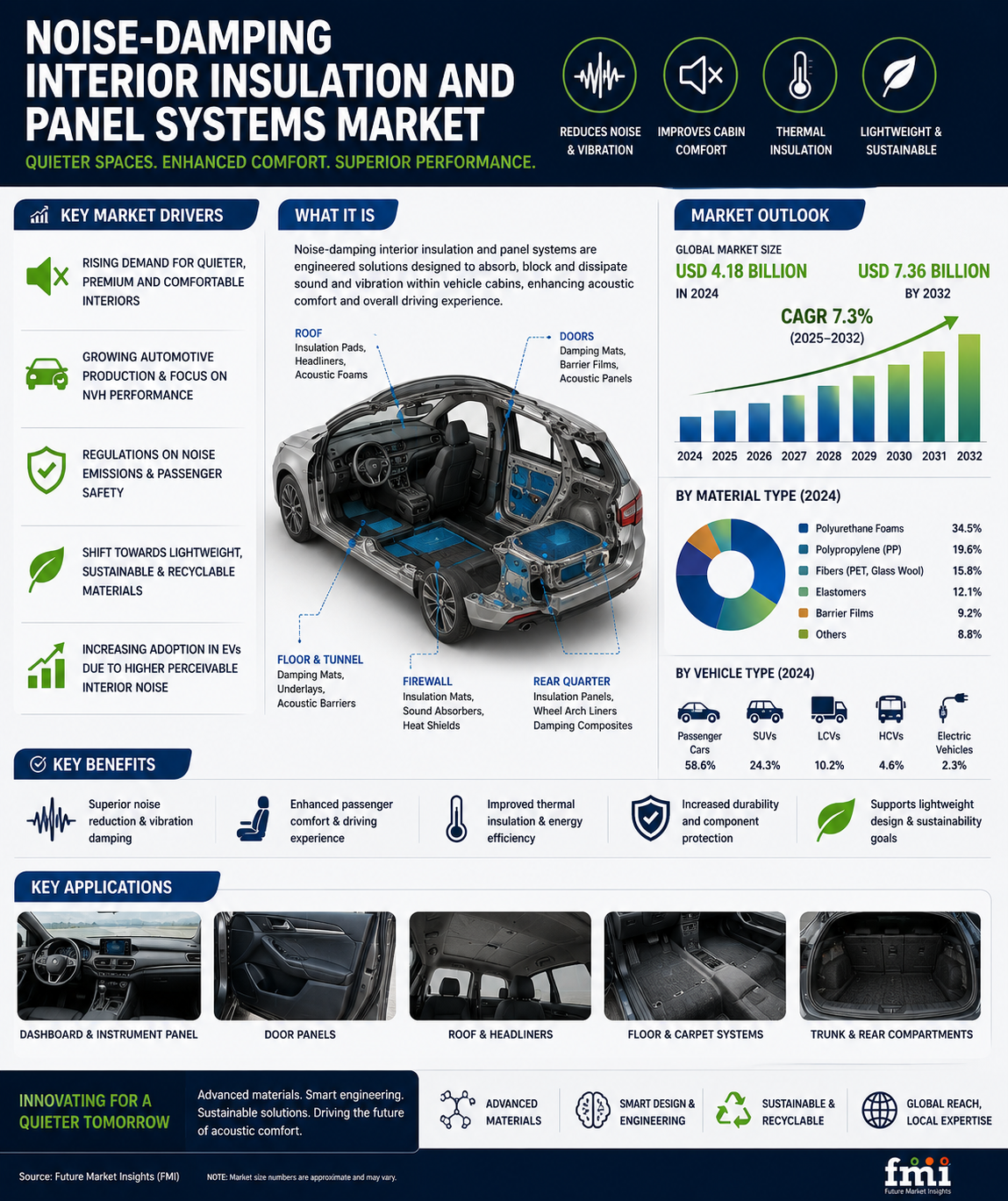
The global Noise-Damping Interior Insulation and Panel Systems Market is entering a period of sustained expansion as automakers place greater emphasis on cabin comfort, acoustic performance, and lightweight interior solutions. Valued at USD 4.7 billion in 2025, the market is projected to reach USD 5.0 billion in 2026 and further expand to USD 8.8 billion by 2036, registering a CAGR of 5.8% during the forecast period.
The market is benefiting from rising consumer expectations for quieter vehicle cabins, growing electric vehicle production, and increasing adoption of advanced acoustic materials that reduce noise while supporting vehicle lightweighting goals. Over the next decade, the industry is expected to generate an incremental opportunity of USD 3.8 billion as manufacturers continue investing in next-generation noise management technologies.
Cabin Quietness Becomes a Key Vehicle Differentiator
Vehicle interiors have evolved from basic transportation spaces into comfort-focused environments where noise control plays a critical role in customer satisfaction. Consumers increasingly associate low cabin noise levels with premium quality, driving automakers to invest heavily in acoustic insulation technologies.
Noise-damping interior insulation and panel systems help reduce road noise, tire noise, wind noise, drivetrain vibration, and structural resonance before they reach vehicle occupants. Components such as floor systems, dash panels, door pads, headliners, and trunk liners work together to create a quieter and more refined driving experience.
The growing importance of vehicle comfort is making acoustic insulation an essential design consideration rather than a secondary engineering feature. Manufacturers are now evaluating interior noise performance earlier in vehicle development cycles to ensure compliance with increasingly demanding consumer expectations.
Electric Vehicles Accelerate Demand for Advanced Acoustic Solutions
The rapid growth of electric and hybrid vehicles is creating new challenges and opportunities for noise-damping system suppliers. Unlike internal combustion engine vehicles, electric vehicles generate significantly less powertrain noise, making road, tire, and aerodynamic sounds more noticeable inside the cabin.
As a result, automakers are strengthening investments in acoustic insulation materials and vibration control systems to maintain premium cabin environments. Vehicle manufacturers are increasingly utilizing vehicle interior NVH (Noise, Vibration, and Harshness) testing programs to evaluate cabin sound quality before final production approval.
Advanced floor systems and dash panels have become particularly important in electric vehicle architectures because they help manage noise transmitted through vehicle structures while maintaining lightweight construction requirements. Suppliers capable of delivering tuned acoustic performance without adding significant vehicle mass are expected to gain competitive advantages in future EV programs.
OEM Line Fit Continues to Dominate Market Demand
Original Equipment Manufacturer (OEM) line fit installations are projected to account for 83.7% of total sales channel demand in 2026, making them the dominant segment within the market.
Automakers increasingly integrate noise-damping solutions during vehicle assembly rather than relying on aftermarket modifications. OEM-installed systems provide better acoustic performance because they are engineered alongside vehicle structures and interior trim components.
As vehicle manufacturers continue focusing on cabin refinement, OEM suppliers are working closely with acoustic material providers to develop customized insulation packages that meet specific noise reduction targets while supporting weight reduction and sustainability objectives.
The strong position of OEM line fit reflects the industry’s shift toward factory-integrated acoustic solutions that improve overall vehicle quality and customer satisfaction.
Passenger Cars Generate Majority of Market Revenue
Passenger cars are expected to represent 62.4% of total vehicle class demand in 2026, making them the largest contributor to market growth.
High production volumes, increasing comfort expectations, and growing adoption of electric passenger vehicles are driving substantial demand for advanced insulation and panel systems. Consumers purchasing passenger vehicles increasingly expect quiet cabin environments regardless of vehicle segment, encouraging manufacturers to incorporate sophisticated acoustic materials even in mid-range models.
The continued expansion of global passenger vehicle production, particularly in emerging markets, is expected to support long-term growth for noise-damping system suppliers.
Lightweight Materials Drive Product Innovation
Automakers face growing pressure to improve fuel efficiency and extend electric vehicle range through weight reduction. This challenge is encouraging the development of lightweight acoustic materials capable of delivering superior sound absorption without adding excessive mass.
Foam fiber composites are emerging as one of the most promising material categories due to their ability to combine acoustic performance, durability, and low weight. These materials help manufacturers reduce cabin noise while supporting vehicle efficiency targets.
Floor systems remain among the most important applications because lower vehicle structures transmit substantial road and tire noise into passenger compartments. Similarly, dash panels play a critical role in reducing sound transmission from front-end components and improving overall cabin refinement.
As sustainability becomes increasingly important, manufacturers are also investing in recyclable acoustic materials that align with circular economy goals.
Sustainability and Low-Emission Materials Gain Importance
Environmental considerations are increasingly influencing material selection across the automotive industry. Acoustic insulation suppliers are responding by introducing recyclable and low-emission products that meet both performance and sustainability requirements.
Autoneum’s Propylat PET interior solution, introduced in 2025, demonstrates this trend by utilizing 100% polyester construction while helping absorb tire and electric motor noise. Such innovations allow automakers to improve cabin acoustics while supporting vehicle recycling objectives.
Interior air quality is also becoming a key consideration. Manufacturers are prioritizing low-emission acoustic materials that reduce volatile organic compound (VOC) emissions and improve passenger comfort. BASF’s Elastoflex® E acoustic foam system, designed to achieve extremely low fogging values, highlights how acoustic performance and cabin air quality are increasingly linked within vehicle interior development programs.
Suppliers that successfully combine recyclability, low emissions, and acoustic effectiveness are expected to secure stronger positions in future vehicle platforms.
Asia-Pacific Leads Global Growth
Asia-Pacific continues to represent the most dynamic region for the noise-damping interior insulation and panel systems market. China is forecast to record the highest growth rate globally at 7.2% CAGR through 2036, supported by robust electric vehicle production and increasing adoption of premium interior technologies.
India follows closely with a projected CAGR of 6.8%, driven by rising passenger vehicle production, expanding middle-class demand, and greater emphasis on vehicle comfort features.
Growing automotive manufacturing activity across the region is creating substantial opportunities for suppliers of acoustic materials, insulation systems, and interior panel solutions.
Future Outlook
The Noise-Damping Interior Insulation and Panel Systems Market is evolving into a critical component of modern vehicle design as automakers seek to balance comfort, sustainability, and efficiency. The transition toward electric mobility, rising consumer expectations for quieter cabins, and increasing use of recyclable lightweight materials will continue to shape market development over the coming decade.
As vehicle manufacturers prioritize acoustic refinement and interior quality, suppliers offering innovative, lightweight, and environmentally responsible noise-damping solutions are expected to capture significant growth opportunities through 2036.
Browse more industry reports
Automotive Radar Sensors Market – https://www.openpr.com/news/4533979/automotive-radar-sensors-market-to-reach-usd-30-8-billion
Automotive Glass Market – https://www.openpr.com/news/4533984/automotive-glass-market-to-reach-usd-40-8-billion-by-2036-driven
Permanent Magnet Motor Market – https://www.openpr.com/news/4533987/permanent-magnet-motor-market-to-reach-usd-161-2-billion-by-2036