

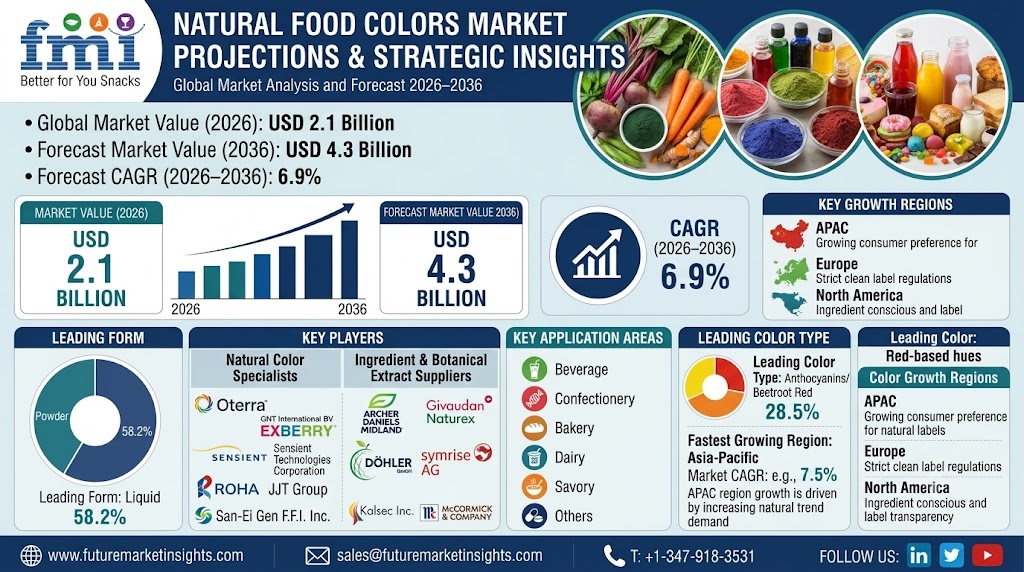
According to the latest insights by Future Market Insights, the global Natural Food Colors market is undergoing major transformation as extraction technology, agricultural supply availability, regulatory compliance, and brand positioning increasingly influence pricing structures across the food and beverage industry.
In 2026, natural food colour pricing is being reshaped by rising demand for clean-label ingredients, advanced processing technologies, supply chain optimization, and manufacturers’ ability to balance premium ingredient costs with consumer expectations for natural alternatives.
Industry analysts highlight that natural food colour economics are no longer determined only by raw material availability but are increasingly influenced by extraction efficiency, stabilization technologies, quality consistency, regulatory requirements, and supplier relationships.
Established manufacturers with integrated sourcing networks and proprietary processing capabilities continue to maintain competitive advantages, while smaller producers face increasing pressure from agricultural volatility, compliance requirements, and technology investments.
Natural Food Colour Economics Drive Premium Pricing
Natural food colour production operates under a significantly different cost structure compared with synthetic colour manufacturing.
Traditional synthetic colours benefit from:
• Predictable production systems
• Stable raw material inputs
• High pigment concentration
• Consistent manufacturing processes
However, natural food colours depend on specialized botanical sources including:
- Turmeric
• Beetroot
• Spirulina
• Annatto
• Other plant-based pigments
These ingredients require extensive agricultural management and advanced extraction processes, increasing production complexity and finished product costs.
Natural colours require multiple stages including:
- Crop cultivation
• Harvest management
• Cleaning and preparation
• Pigment extraction
• Purification
• Stabilization
• Quality testing
The complexity of maintaining colour intensity, stability, and consistency creates supply limitations and supports premium pricing compared with synthetic alternatives.
Agricultural Dependencies Create Cost Volatility
The natural food colour supply chain remains closely linked to agricultural conditions.
Unlike synthetic colours manufactured under controlled industrial environments, natural colours depend on:
- Seasonal crop cycles
• Weather conditions
• Agricultural yields
• Regional production availability
Turmeric production is influenced by:
- Monsoon patterns
• Soil conditions
• Curcumin concentration variations
Beetroot, spirulina, and annatto producers also face supply fluctuations caused by environmental and cultivation challenges.
These agricultural dependencies create pricing uncertainty throughout the value chain.
Extraction Technology Creates Premium Cost Layers
Extraction technology has become one of the biggest competitive factors in natural colour manufacturing.
Modern natural colour production requires advanced processing methods to improve:
- Pigment concentration
• Heat stability
• Shelf life
• Application performance
• Colour consistency
Manufacturers invest in:
- Advanced filtration systems
• Stabilization technologies
• Encapsulation methods
• Purification processes
• Quality control systems
Companies with proprietary extraction technologies can achieve higher yields and improved performance, allowing them to command premium pricing.
Major Manufacturers Maintain Pricing Power Through Scale
Large natural colour manufacturers such as Sensient and Chr. Hansen maintain stronger market positions through several structural advantages.
Integrated Ingredient Procurement
Major suppliers benefit from:
- Long-term agricultural partnerships
• Supplier relationships
• Better sourcing visibility
• Higher production efficiency
These advantages help reduce exposure to raw material price fluctuations.
Smaller producers often experience:
- Higher sourcing costs
• Limited supplier access
• Greater agricultural risk
• Reduced production flexibility
Technology-Based Brand Premiumization
Established companies create value through:
- Superior product consistency
• Technical expertise
• Regulatory support
• Application development
Food manufacturers often prioritize reliability over the lowest ingredient price, allowing premium suppliers to maintain stronger margins.
Processing Complexity Adds Hidden Manufacturing Costs
Replacing synthetic colours with natural alternatives creates technical challenges.
Natural pigments can be affected by:
- Temperature
• pH levels
• Light exposure
• Processing conditions
• Storage environment
Manufacturers must invest in:
- Research and development
• Sensory evaluation
• Stability testing
• Product optimization
• Technical support
These requirements increase manufacturing costs compared with conventional colour systems.
Regulatory Compliance Reshapes Market Economics
Regulatory requirements significantly influence natural colour pricing.
Companies must manage:
- Food safety standards
• Ingredient approvals
• Organic certifications
• Traceability requirements
• Regional compliance frameworks
Manufacturers invest in:
- Documentation systems
• Laboratory testing
• Quality monitoring
• Certification processes
These fixed costs create advantages for larger companies with established regulatory infrastructure.
Supply Chain Control Determines Competitive Advantage
The natural food colour supply chain includes multiple value creation stages.
Stage 1: Agricultural Production
Suppliers manage:
- Crop sourcing
• Cultivation quality
• Harvest timing
• Raw material consistency
Stage 2: Processing and Extraction
Manufacturers manage:
- Extraction technology
• Pigment concentration
• Stabilization
• Quality assurance
Stage 3: Food Industry Application
Brands manage:
- Product formulation
• Consumer positioning
• Distribution
• Retail pricing
Value is captured across each stage, with technology-focused suppliers and strong brands gaining greater pricing power.
Three Pricing Layers Shape Natural Colour Economics
The market operates through three primary pricing layers.
Ingredient Pricing Layer
Driven by:
- Crop availability
• Agricultural conditions
• Extraction efficiency
• Processing requirements
Natural colours maintain higher pricing due to supply limitations and lower pigment concentration.
Manufacturing Cost Layer
Influenced by:
- Processing complexity
• Technology investments
• Energy usage
• Quality requirements
Advanced manufacturing capabilities help improve cost efficiency.
Brand Value Layer
Determined by:
- Consumer trust
• Product positioning
• Technical reliability
• Market reputation
Strong suppliers can achieve premium pricing beyond production costs.
Why Smaller Manufacturers Face Structural Challenges
Smaller natural colour producers face challenges across the value chain.
Key barriers include:
- Limited sourcing power
• Higher processing costs
• Technology investment requirements
• Regulatory expenses
• Lower customer access
Large buyers often receive better supplier terms, making competition difficult for smaller manufacturers.
Future Outlook
The future of the Natural Food Colors market will be shaped by the balance between agricultural supply, technology innovation, and consumer demand for clean-label products.
Manufacturers are expected to focus on:
- Advanced extraction technologies
• Improved stabilization systems
• Supply chain integration
• Sustainable sourcing
• Fermentation-based alternatives
• Cost-efficient processing methods
Growing consumer preference for natural ingredients, transparency, and healthier food choices will continue supporting market expansion.
As competition increases, success will depend on combining agricultural control, technological capabilities, regulatory expertise, and customer-focused solutions.
FMI Custom Research: Strategic Intelligence for Confident Decision-Making
In today’s rapidly evolving business environment, leadership teams need more than market data—they need clear, actionable intelligence tailored to their strategic objectives.
FMI’s Custom Research solutions are designed around the specific business questions organizations need answered, enabling executives to evaluate growth opportunities, validate investments, assess competitive dynamics, and reduce uncertainty before making critical decisions.
By combining deep industry expertise, primary research, and proprietary market intelligence, FMI delivers insights that help organizations move from assumptions to evidence-based strategies with greater speed and confidence.
Key Executive Benefits
- Decision-Ready Insights: Research tailored to specific business challenges, expansion plans, and investment priorities.
• Reduced Strategic Risk: Validate market opportunities, supply risks, and competitive positioning before allocating resources.
• Market Entry Confidence: Assess market size, regulations, supply structures, and competitive landscapes.
• Competitive Advantage: Gain proprietary intelligence beyond traditional syndicated research.
• Faster Growth Decisions: Support product development, geographic expansion, and strategic planning.
• Primary Market Validation: Access real-world buyer and stakeholder insights.
• Global Industry Expertise: Powered by 100+ analysts, 20,000+ published reports, and 1.6 million+ hours of research experience.
• Proven Track Record: Over 7,000 market-entry engagements completed across six regions and 14 industry sectors.
Business Impact
FMI helps organizations transform market complexity into strategic clarity, enabling leadership teams to identify growth opportunities faster, optimize resources, strengthen competitive positioning, and make high-impact business decisions with confidence.
To explore how FMI Custom Research can support your strategic priorities, connect with our team at: sales@futuremarketinsights.com
Explore More Related Studies Published by FMI Research:
Caramel Food Colors Market : Global Industry Analysis and Opportunity Assessment, 2036
Lycopene Food Colors Market is segmented by Product (Natural Lycopene Color, Synthetic Lycopene Color, Blended Lycopene Color), Form (Powder, Liquid, Beadlets), Application (Food and Beverages, Processed Foods, Dietary Supplements), and Region. Forecast for 2026 to 2036.
About Future Market Insights (FMI)
Future Market Insights, Inc. (FMI) is an ESOMAR-certified, ISO 9001:2015 market research and consulting organization, trusted by Fortune 500 clients and global enterprises.
With operations in the U.S., UK, India, and Dubai, FMI provides data-backed insights and strategic intelligence across 30+ industries and 1200 markets worldwide.
Contact Us:
Future Market Insights Inc.
Christiana Corporate, 200 Continental Drive,
Suite 401, Newark, Delaware – 19713, USA
T: +1-347-918-3531
Why FMI: https://www.futuremarketinsights.com/why-fmi
Website: https://www.futuremarketinsights.com
LinkedIn| Twitter| Blogs | YouTube