

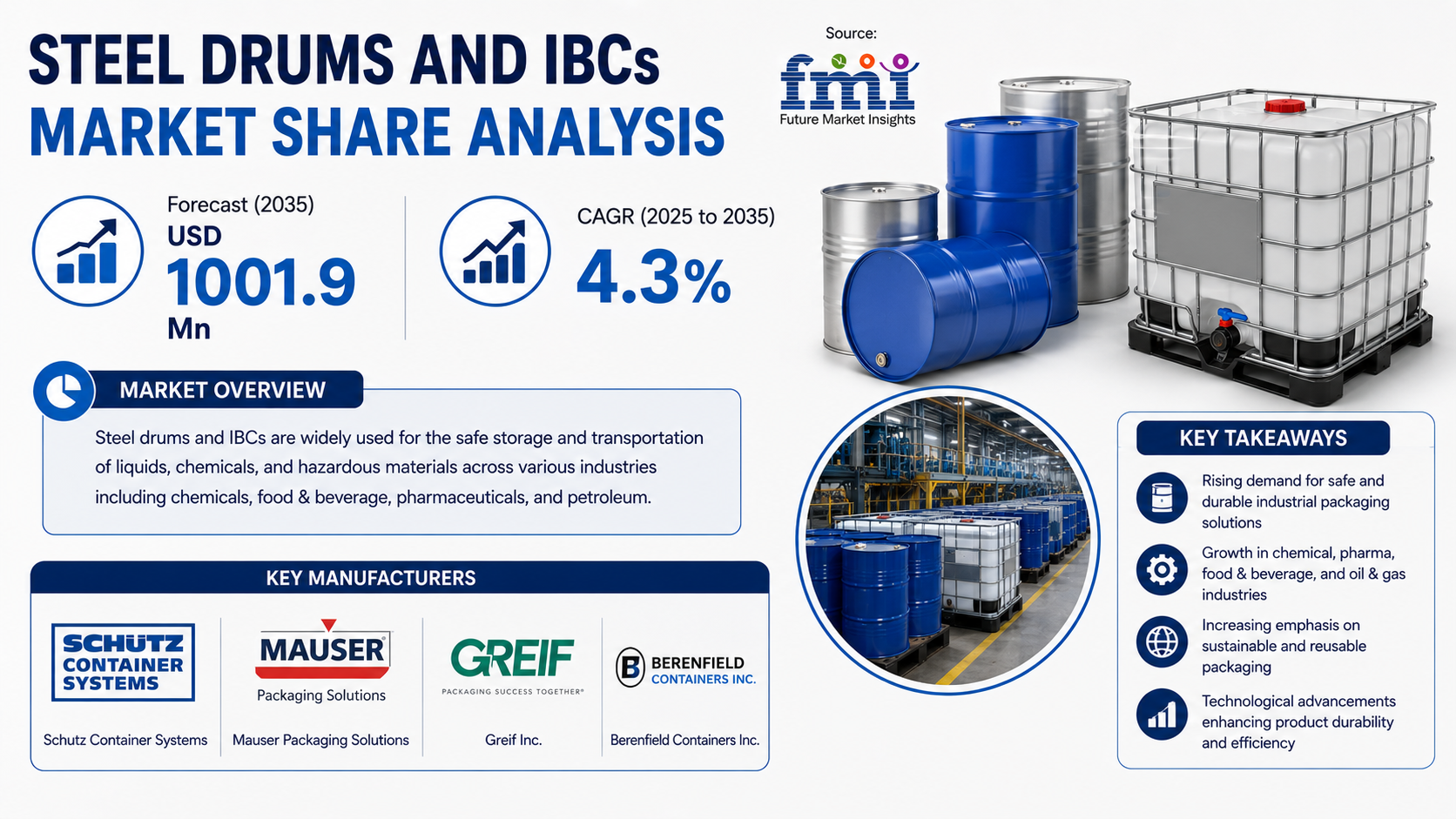
The global steel drums and intermediate bulk containers (IBCs) market is undergoing a significant transformation as industries increasingly prioritize sustainability, operational efficiency, and digital supply chain visibility. According to recent market estimates, the market is expected to reach USD 1,001.9 million by 2035, expanding at a CAGR of 4.3% between 2025 and 2035. Industrial packaging has evolved far beyond its traditional role of merely containing and transporting products. Modern packaging solutions must address a complex set of requirements, including durability, safety, regulatory compliance, logistics efficiency, traceability, and environmental responsibility. As a result, manufacturers of steel drums and IBCs are investing heavily in product innovation, circular economy initiatives, and smart technologies to meet the changing needs of end users.
Featured Snippet: Key Market Answer
Q: What is driving the growth of the steel drums and IBCs market?
A: Growth is being driven by increasing demand for sustainable industrial packaging, expanding global trade activities, growing adoption of reusable containers, advancements in IoT-enabled asset tracking, and rising pressure across industries to reduce packaging waste through recycling and reuse initiatives.
Quick Stats for Steel Drums and IBCs Market
- Forecast Market Value (2035): USD 1,001.9 Million
- Forecast CAGR (2025–2035): 4.3%
- Fastest Emerging Trend: Smart and connected industrial packaging
- Key Sustainability Focus: Reduce, Reuse, and Recycle (3Rs)
- Major Growth Drivers: Circular economy initiatives and logistics optimization
Market Overview: Industrial Packaging Enters a New Era
Steel drums and intermediate bulk containers are widely used for storing and transporting chemicals, food ingredients, pharmaceuticals, petroleum products, agricultural materials, and hazardous substances. Their durability and ability to handle large volumes make them indispensable across industrial supply chains. However, customer expectations are evolving. Businesses now seek packaging solutions that not only protect products but also minimize environmental impact and improve operational efficiency. This shift is encouraging manufacturers to redesign conventional packaging formats through sustainable materials, lightweight structures, and digitally connected systems.
Key Growth Drivers
- Rising Focus on Sustainable Packaging: Environmental concerns continue to reshape industrial packaging decisions worldwide. Governments, businesses, and consumers increasingly favor packaging solutions that support circular economy principles. Steel drums and IBCs naturally align with these objectives due to their ability to be reused, refurbished, and recycled multiple times. Manufacturers are therefore emphasizing sustainability throughout the product lifecycle.
- Adoption of the 3Rs Framework: The principles of Reduce, Reuse, and Recycle have become central to industrial packaging strategies. Companies are introducing initiatives aimed at extending container lifecycles, reducing material consumption, and maximizing resource efficiency. Refurbishment programs and closed-loop collection systems are gaining momentum across several industries.
- Growth in Global Trade: Increasing seaborne trade activities continue to support demand for robust transport packaging. Steel drums and IBCs provide the strength and reliability required for international logistics operations, particularly in sectors handling hazardous or high-value products. As global supply chains expand, the need for secure bulk packaging solutions is expected to rise steadily.
- Demand for Cost Efficiency: Reusable packaging solutions help businesses lower total ownership costs over time. Organizations increasingly recognize that investing in durable industrial containers can reduce replacement expenses, minimize waste management costs, and improve supply chain performance.
Market Trends Shaping the Industry
Product Innovation for Sustainability
Manufacturers are exploring innovative approaches to improve recyclability and reduce environmental impact.
Emerging developments include:
- Foldable container designs
- Lightweight structures
- Enhanced refurbishment capabilities
- Increased use of recycled materials
- Bio-based plastic components in IBC systems
These innovations aim to balance performance with sustainability objectives.
- Lifecycle Extension Initiatives: Extending the usable life of industrial packaging has become a major priority. Refurbishment and reconditioning programs enable steel drums and IBCs to re-enter the supply chain safely, reducing the need for new production and lowering overall environmental footprints. Numerous studies indicate that recycling and reusing industrial containers generate significantly lower emissions compared with manufacturing new units.
- Smart Packaging Technologies: Digital transformation is increasingly influencing industrial packaging. Manufacturers are integrating technology into packaging systems to improve visibility and operational control throughout the supply chain.
- Growing Collaboration Across Value Chains: Packaging companies are collaborating with logistics providers and technology firms to develop solutions that address evolving customer requirements. These partnerships support innovation while accelerating the adoption of intelligent packaging systems.
Technology Integration: The Rise of Connected Containers
The incorporation of the Internet of Things (IoT) is emerging as one of the industry’s most transformative developments.
IoT-enabled steel drums and IBCs provide valuable capabilities, including:
- Real-time asset tracking
- Environmental condition monitoring
- Location visibility
- Improved inventory management
- Reduced manual errors
- Enhanced cargo security
These technologies enable businesses to monitor shipments throughout transit, improving responsiveness and decision-making across increasingly complex supply chains. As digitization accelerates across logistics operations, connected industrial packaging solutions are expected to gain broader adoption.
Regional Outlook
- North America: North America continues to benefit from mature industrial sectors and strong emphasis on sustainability initiatives. Growing investments in smart logistics technologies are further supporting market development.
- Europe: Europe remains at the forefront of circular economy implementation. Stringent environmental regulations and established refurbishment networks continue to encourage the reuse and recycling of industrial packaging solutions.
Competitive Landscape
Competition within the steel drums and IBCs market increasingly revolves around sustainability performance, lifecycle management capabilities, and digital innovation.
Leading manufacturers are investing in:
- Product redesign initiatives
- Recycling and refurbishment programs
- Lightweight engineering solutions
- Smart tracking technologies
- Strategic partnerships
- Enhanced customer support services
Organizations capable of combining durability with sustainability and digital functionality are expected to strengthen their market positions over the coming years.
Future Outlook
The future of the steel drums and IBCs market will be shaped by the convergence of sustainability and technology. Companies are no longer evaluating industrial packaging solely on purchase price but increasingly on lifecycle value, environmental impact, and operational intelligence. Reusable systems, IoT-enabled monitoring, and innovative material solutions will redefine how industrial packaging supports global trade. Businesses that proactively invest in circular economy strategies and connected packaging infrastructure will be better positioned to navigate evolving regulations and customer expectations.
Conclusion
The steel drums and intermediate bulk containers market is evolving from a traditional industrial packaging segment into a strategic enabler of sustainable and intelligent supply chains. Forecast to reach USD 1,001.9 million by 2035, the industry stands to benefit from increasing environmental awareness, expanding global trade, and accelerating digital transformation. As industries seek packaging solutions that deliver durability, efficiency, and accountability, steel drums and IBCs are expected to remain essential components of modern logistics ecosystems, creating long-term value through innovation and responsible resource management.
Related Research Reports
Bulk Liquid Containers Market: Global Industry Analysis 2008 – 2017 and Opportunity Assessment 2018 – 2028
Intermediate Bulk Container (IBC) Market: Industry value is expected to reach USD 9.5 billion by 2036 as chemical and food bulk handling needs expand.
Bulk Container Packaging Market: The bulk container packaging market is projected to grow from USD 31.6 billion by 2035, registering a CAGR of 3.8%.
About Future Market Insights (FMI)
Future Market Insights is a leading provider of market intelligence, consulting services, and syndicated research reports. FMI delivers actionable insights across packaging, logistics, industrial manufacturing, food and beverage, healthcare, chemicals, and emerging technologies, helping organizations identify growth opportunities and make informed strategic decisions in rapidly evolving markets.
Contact
Future Market Insights Inc.
Christiana Corporate
200 Continental Drive, Suite 401
Newark, Delaware 19713, USA
Email: sales@futuremarketinsights.com
Website: www.futuremarketinsights.com