

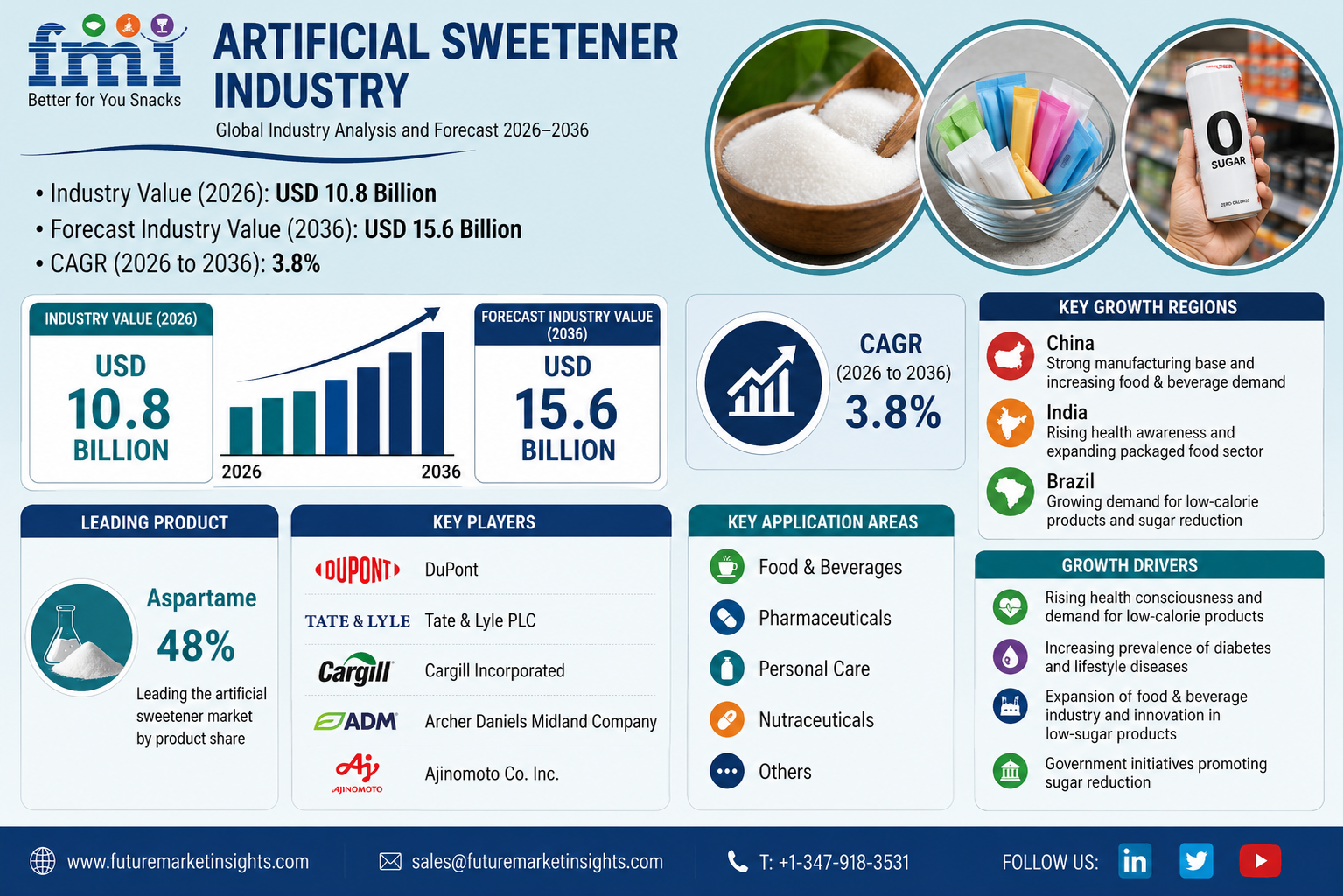
According to the latest insights by Future Market Insights, the global Artificial Sweetener market is experiencing significant transformation as ingredient economics, processing complexity, brand positioning, and supply chain control increasingly influence pricing structures across the low-calorie food industry.
In 2026, the cost dynamics of reduced-calorie products are being reshaped by the growing demand for natural sweeteners, advanced formulation technologies, regulatory compliance requirements, and manufacturers’ ability to balance premium ingredient costs with consumer expectations for healthier alternatives.
Industry analysts highlight that low-calorie food pricing is no longer determined only by basic ingredient costs but is increasingly influenced by sweetener selection, extraction economics, specialized processing, clean-label requirements, regulatory approvals, and brand-driven pricing power.
Established food manufacturers with strong procurement networks and formulation expertise continue to maintain competitive advantages, while smaller producers face increasing pressure from ingredient sourcing challenges, compliance costs, and limited market access.
Alternative Sweetener Economics Drive Low-Calorie Food Pricing
Low-calorie food production operates under a fundamentally different cost structure compared with conventional food manufacturing.
Traditional food categories depend mainly on commodity ingredients such as:
• Sugar
• Flour
• Oils
• Basic fats
However, reduced-calorie products rely heavily on specialized ingredients including:
• Natural sweeteners
• Functional proteins
• Flavor systems
• Texture modifiers
• Preservation technologies
These ingredients require advanced sourcing and processing capabilities, increasing production complexity and finished product costs.
Natural sweeteners such as stevia and monk fruit command premium pricing because they require:
• Agricultural cultivation
• Harvest management
• Extraction processes
• Purification technologies
• Quality control systems
The complexity of producing consistent sweetening solutions creates supply limitations and supports higher pricing compared with conventional synthetic alternatives.
Natural Sweeteners Create Premium Cost Tiers
The sweetener segment has become one of the most important cost drivers in low-calorie food manufacturing.
Natural alternatives provide strong consumer appeal due to:
• Clean-label positioning
• Plant-based origin
• Reduced artificial ingredient perception
• Health-focused marketing advantages
However, production economics remain challenging.
Stevia-based sweeteners require multiple processing stages including:
• Leaf cultivation
• Drying
• Extraction
• Purification
• Crystallization
Lower extraction efficiency and agricultural variability contribute to cost fluctuations.
Similarly, monk fruit sweeteners require specialized processing because the sweet compounds must be isolated from limited agricultural output.
These supply constraints create pricing differences between:
• Premium natural sweeteners
• Blended sweetener systems
• Synthetic sweeteners
Manufacturers increasingly use customized sweetener combinations to balance taste performance, consumer acceptance, and cost efficiency.
Major Food Brands Maintain Pricing Power Through Scale
Large food companies such as Nestlé and Unilever maintain stronger pricing positions through multiple structural advantages.
Their cost control strategies include:
Large-Scale Ingredient Procurement
Major manufacturers benefit from:
• Bulk purchasing agreements
• Long-term supplier relationships
• Better negotiation power
• Stable ingredient availability
These advantages allow them to reduce exposure to raw material volatility.
Smaller producers often face:
• Higher ingredient costs
• Minimum order restrictions
• Limited supplier choices
• Greater supply uncertainty
Brand Premiumization
Strong brands can charge higher prices by leveraging:
• Consumer trust
• Health-focused positioning
• Product credibility
• Marketing strength
Consumers are often willing to pay premium prices for products associated with:
• Reduced sugar
• Natural ingredients
• Better nutrition profiles
This allows established brands to protect margins despite higher formulation costs.
Processing Complexity Adds Hidden Cost Layers
Low-calorie product manufacturing requires specialized technical capabilities because replacing sugar affects:
- Taste
• Texture
• Mouthfeel
• Stability
• Shelf life
Sugar performs multiple functional roles beyond sweetness, making replacement technically challenging.
Manufacturers must invest in:
- Product development
• Sensory testing
• Ingredient combinations
• Stability analysis
• Manufacturing adjustments
These requirements increase operational costs compared with traditional food products.
Regulatory Compliance Reshapes Manufacturing Economics
Regulatory requirements represent another major cost factor.
Low-calorie products often require compliance related to:
- Nutrition claims
• Ingredient approvals
• Health-related statements
• Label transparency
Companies must invest in:
- Testing procedures
• Documentation systems
• Quality monitoring
• Regulatory expertise
These fixed costs create advantages for larger companies with established compliance infrastructure.
Smaller manufacturers often struggle because regulatory expenses represent a larger share of their total operating costs.
Supply Chain Control Determines Competitive Advantage
The artificial sweetener supply chain includes multiple stages:
Stage 1: Ingredient Production
Suppliers manage:
• Agricultural sourcing
• Sweetener extraction
• Ingredient purification
• Quality consistency
Stage 2: Food Manufacturing
Brands manage:
• Formulation
• Processing
• Packaging
• Distribution
This creates multiple pricing points where value is captured.
Ingredient suppliers control specialty sweetener pricing, while major brands capture additional value through product differentiation and consumer loyalty.
Three Pricing Layers Shape Low-Calorie Food Economics
The industry operates through three major pricing layers.
Ingredient Pricing Layer
Driven by:
- Raw material availability
• Extraction efficiency
• Agricultural conditions
• Processing technology
Natural sweeteners generally maintain higher pricing due to limited supply flexibility.
Manufacturing Cost Layer
Influenced by:
- Formulation complexity
• Production efficiency
• Quality requirements
• Energy consumption
Advanced processing capabilities help reduce unit costs.
Brand Value Layer
Determined by:
- Consumer perception
• Marketing strength
• Retail positioning
• Product differentiation
Strong brands can create significant price premiums beyond manufacturing costs.
Why Smaller Manufacturers Face Structural Challenges
Smaller producers face difficulties across the value chain.
Key challenges include:
- Limited purchasing power
• Higher ingredient costs
• Regulatory burdens
• Reduced distribution access
• Lower marketing budgets
Specialty sweetener suppliers often prioritize large-volume buyers, making consistent sourcing more difficult for smaller companies.
Retail access is also challenging because health-focused product categories increasingly favor established brands with proven consumer demand.
Future Outlook
The future of the Artificial Sweetener market will be shaped by the balance between ingredient innovation, cost efficiency, and consumer expectations.
Manufacturers are expected to focus on:
- Advanced sweetener blends
• Improved extraction technologies
• Supply chain diversification
• Clean-label innovation
• Cost-efficient formulation strategies
Growing demand for reduced-sugar foods, functional nutrition products, and healthier alternatives will continue supporting market expansion.
As the industry evolves, competitive advantage will increasingly depend on the ability to combine ingredient efficiency, technological capability, regulatory expertise, and strong brand positioning.
FMI Custom Research: Strategic Intelligence for Confident Decision-Making
In today’s rapidly evolving business environment, leadership teams need more than market data—they need clear, actionable intelligence tailored to their strategic objectives.
FMI’s Custom Research solutions are designed around the specific business questions organizations need answered, enabling executives to evaluate growth opportunities, validate investments, assess competitive dynamics, and reduce uncertainty before making critical decisions.
By combining deep industry expertise, primary research, and proprietary market intelligence, FMI delivers insights that help organizations move from assumptions to evidence-based strategies with greater speed and confidence.
Key Executive Benefits
- Decision-Ready Insights: Research tailored to specific business challenges, expansion plans, and investment priorities.
• Reduced Strategic Risk: Validate market opportunities, supply risks, and competitive positioning before allocating resources.
• Market Entry Confidence: Assess market size, regulations, supply structures, and competitive landscapes.
• Competitive Advantage: Gain proprietary intelligence beyond traditional syndicated research.
• Faster Growth Decisions: Support product development, geographic expansion, and strategic planning.
• Primary Market Validation: Access real-world buyer and stakeholder insights.
• Global Industry Expertise: Powered by 100+ analysts, 20,000+ published reports, and 1.6 million+ hours of research experience.
• Proven Track Record: Over 7,000 market-entry engagements completed across six regions and 14 industry sectors.
Business Impact
FMI helps organizations transform market complexity into strategic clarity, enabling leadership teams to identify growth opportunities faster, optimize resources, strengthen competitive positioning, and make high-impact business decisions with confidence.
To explore how FMI Custom Research can support your strategic priorities, connect with our team at: sales@futuremarketinsights.com
Explore More Related Studies Published by FMI Research:
Functional Food Market: Global Industry Analysis and Opportunity Assessment 2025–2035
Postbiotic Supplements Market Demand & Forecast 2026-2036
About Future Market Insights (FMI)
Future Market Insights, Inc. (FMI) is an ESOMAR-certified, ISO 9001:2015 market research and consulting organization, trusted by Fortune 500 clients and global enterprises.
With operations in the U.S., UK, India, and Dubai, FMI provides data-backed insights and strategic intelligence across 30+ industries and 1200 markets worldwide.
Contact Us:
Future Market Insights Inc.
Christiana Corporate, 200 Continental Drive,
Suite 401, Newark, Delaware – 19713, USA
T: +1-347-918-3531
Why FMI: https://www.futuremarketinsights.com/why-fmi
Website: https://www.futuremarketinsights.com
LinkedIn| Twitter| Blogs | YouTube