

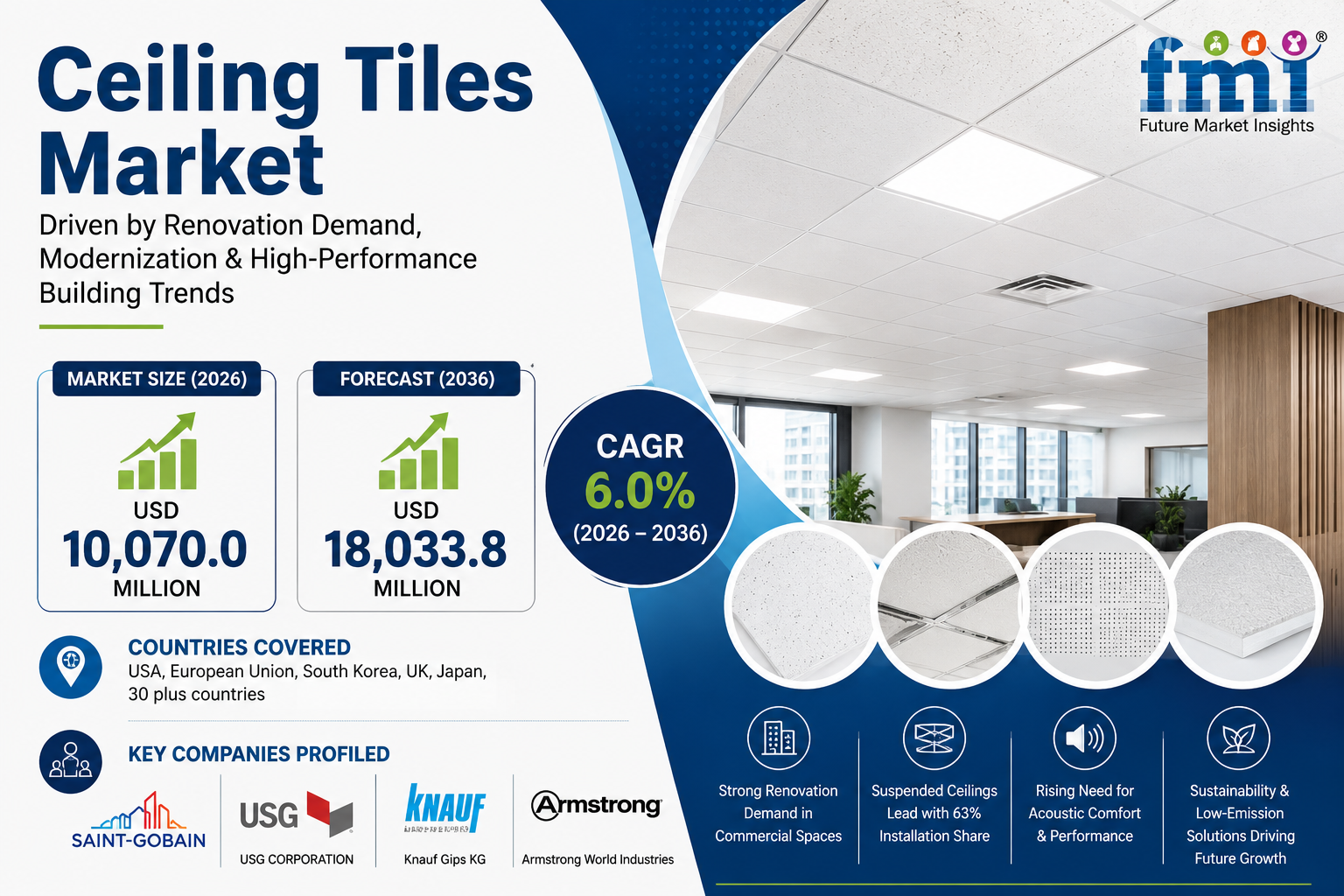
The global ceiling tiles market is entering a sustained growth cycle driven by a combination of renovation-led replacement demand and new construction activity across commercial, institutional, and industrial buildings. According to market estimates, the industry was valued at USD 9,500.0 million in 2025 and is projected to grow from USD 10,070.0 million in 2026 to USD 18,033.8 million by 2036, expanding at a CAGR of 6.0% during the forecast period. This represents an incremental opportunity of USD 7,963.84 million over the next decade.
Unlike many construction materials that generate revenue primarily during initial installation, ceiling tiles benefit from recurring replacement cycles. Commercial buildings, which account for 54.0% of market demand, regularly undergo interior refurbishment to improve aesthetics, acoustics, energy efficiency, and compliance with safety standards. Suspended ceiling systems, representing 63.0% of installation demand, further support replacement demand by enabling easy access to building services and faster panel replacement.
Growth patterns vary geographically. Mature economies such as the United States, European Union, United Kingdom, and Japan are increasingly renovation-driven, while industrially expanding markets such as South Korea continue to generate stronger new-construction demand. Suppliers capable of serving both refurbishment and project-specification channels are expected to capture the most resilient growth opportunities.
Market Overview
The ceiling tiles market occupies a unique position within the global building materials industry because it participates in both initial construction and recurring renovation cycles. A building may be constructed once, but its ceilings can be upgraded multiple times throughout its lifecycle. This dynamic gives ceiling tile manufacturers access to repeat demand from refurbishment, compliance upgrades, and performance-driven retrofits.
Ceiling tiles are widely used across offices, healthcare facilities, schools, retail centers, hospitality spaces, industrial offices, and public buildings. Their importance extends beyond visual appearance. Modern ceiling systems contribute to acoustic management, fire resistance, insulation, hygiene control, and building service accessibility.
The market’s projected expansion to USD 18,033.8 million by 2036 reflects rising investments in infrastructure modernization, workplace redesign, and sustainable building upgrades. As asset owners increasingly seek cost-effective methods to extend building life, ceiling replacement has become one of the most practical interior modernization strategies.
Key Growth Drivers
Renovation remains the strongest structural demand driver for ceiling tiles. Commercial real estate owners frequently replace aging ceiling panels during office reconfigurations, tenant turnovers, and interior upgrades. Ceiling tiles often stain, sag, discolor, crack, or absorb odors over time, making replacement essential for maintaining property value and tenant appeal.
The commercial segment’s 54.0% market share underscores this dependence on refurbishment cycles. Offices, hospitals, educational institutions, and hotels increasingly prioritize interior upgrades that improve occupant comfort while minimizing operational disruption.
Acoustic optimization is another major growth catalyst. Open offices, hybrid workspaces, clinics, classrooms, and collaborative environments require better sound control than legacy building designs. This is creating demand for higher-performance acoustic ceiling solutions with improved Noise Reduction Coefficient (NRC) ratings.
New construction remains a parallel growth engine, particularly in infrastructure-heavy and industrializing economies. Office towers, airports, hospitals, manufacturing facilities, and public institutions continue to generate substantial specification demand for ceiling systems.
Technology & Innovation Trends
Technology innovation in ceiling tiles is shifting from basic functionality toward performance-enhancing solutions. Manufacturers are increasingly developing products with improved acoustic absorption, fire resistance, moisture tolerance, antimicrobial properties, and low-VOC emissions.
Sustainability has become a major innovation theme. Buyers increasingly request recycled-content mineral fiber panels, low-emission materials, and products aligned with green building standards such as LEED and circular construction initiatives.
Digital specification tools are also transforming procurement. Architects and contractors now expect:
- BIM-ready product files
- Fire and acoustic certifications
- Environmental Product Declarations (EPDs)
- Lifecycle sustainability documentation
Smart building integration is creating further innovation opportunities. Ceiling systems increasingly need compatibility with sensors, HVAC systems, sprinklers, smart lighting, and connected building infrastructure.
Mineral fiber remains the leading product category due to its strong balance of acoustic performance, affordability, and compatibility with suspended systems.
Market Challenges & Restraints
Despite strong long-term demand, the ceiling tiles market faces several constraints. Raw material price volatility remains a major challenge, particularly for mineral fiber, gypsum, and metal-based products. Supply chain disruptions can affect manufacturing costs and delivery timelines.
Construction financing pressures also influence demand. High borrowing costs may delay large commercial projects, reducing short-term new construction activity.
Regulatory compliance creates both opportunities and barriers. Stricter building codes related to fire safety, emissions, and sustainability increase product complexity and certification costs for manufacturers.
Replacement demand can also be cyclical. During economic slowdowns, some property owners postpone non-essential interior upgrades, temporarily slowing refurbishment spending.
Competition from alternative ceiling designs—including exposed industrial ceilings and premium architectural finishes—may also pressure traditional tile adoption in certain high-end commercial environments.
Segment Analysis
Suspended ceiling systems dominate the installation landscape with 63.0% market share. Their leadership is primarily driven by flexibility and ease of maintenance. Grid-based suspended systems allow contractors to replace individual tiles without major demolition while providing access to cables, ducts, pipes, and lighting systems.
This makes suspended ceilings particularly attractive for hospitals, offices, and educational facilities where operational downtime must remain minimal.
By product type, mineral fiber leads with 42.0% share in 2026. Mineral fiber ceiling tiles offer a strong combination of cost efficiency, acoustic absorption, fire resistance, and wide specification acceptance across commercial applications.
Other material segments such as metal, gypsum, and specialty panels are gaining traction in premium design-led renovations and specialized environments. Metal ceilings are increasingly preferred in hospitality and modern commercial interiors, while gypsum solutions are favored in healthcare and fire-rated applications.
Sales channel dynamics also reveal important market behavior. Direct sales account for 49.0% of channel demand, indicating the importance of large project contracts and institutional procurement.
Large-scale construction projects typically rely on direct supplier relationships, while renovation-driven replacement demand often flows through regional distributors and contractor networks.
Regional Analysis
The United States remains one of the fastest-growing markets, with projected CAGR of 5.7% through 2036. Growth is supported by infrastructure spending, industrial reshoring, and large-scale public facility modernization. The country’s extensive installed commercial building stock also supports recurring replacement demand.
The European Union is projected to grow at 5.6% CAGR, driven by sustainability regulations, circular economy initiatives, and Green Deal compliance. Renovation-led upgrades across schools, hospitals, and public infrastructure remain particularly significant.
The United Kingdom is expected to expand at 5.5% CAGR. Demand is closely tied to fire safety regulations, healthcare modernization, education facility upgrades, and energy performance standards.
Japan’s 5.3% growth reflects a mature but stable replacement-driven market. Aging infrastructure and strict quality requirements continue to support facility renewal and modernization.
South Korea, growing at 5.6%, presents a distinct demand profile. Semiconductor, display, and EV battery manufacturing expansion is creating substantial new-construction opportunities requiring high-specification ceiling systems for controlled environments.
Competitive Landscape
The ceiling tiles market remains moderately consolidated, with competition centered around product performance, pricing, channel strength, and specification support.
Leading manufacturers increasingly differentiate themselves through:
- Acoustic performance
- Sustainability credentials
- Fire resistance certifications
- Distribution efficiency
- Custom architectural offerings
Suppliers serving both renovation and new-construction channels are better positioned to capture recurring demand while participating in high-volume project opportunities.
Market competition is also intensifying around quick-ship inventory models, especially in renovation-heavy markets where downtime reduction is critical.
Leading Companies Analysis
Major market participants are focusing on portfolio diversification and performance-based product development. Companies with strong mineral fiber offerings retain significant competitive advantages due to broad application compatibility.
Manufacturers are increasingly investing in sustainable production technologies, recycled material sourcing, and certification programs to align with ESG-focused procurement standards.
Leading suppliers are also expanding contractor engagement, digital specification tools, and regional distribution networks to improve responsiveness across fragmented refurbishment markets.
Strategic emphasis has shifted from pure volume sales toward value-added solutions that improve building performance and lifecycle efficiency.
Investment & Strategic Developments
Investment activity across the ceiling tiles market increasingly centers on modernization and sustainability. Capital allocation is flowing toward manufacturing automation, material innovation, and greener production methods.
Public infrastructure programs across North America and Europe continue to stimulate specification demand. Industrial investments in Asia, particularly in semiconductor and battery production, are driving procurement for specialized ceiling solutions.
Mergers, acquisitions, and strategic partnerships are also becoming more common as manufacturers seek stronger geographic reach and channel integration.
Future Outlook
The ceiling tiles market is expected to remain resilient through 2036 as replacement cycles become increasingly important. Renovation-driven demand offers suppliers recurring revenue opportunities independent of new construction cycles.
Mature economies are likely to see faster growth in refurbishment-driven procurement, while emerging industrial markets continue to benefit from new facility construction.
Suppliers capable of balancing specification selling with replacement logistics will likely outperform competitors focused on only one channel.
Sustainability, acoustics, and compliance-led upgrades will increasingly shape buyer preferences over the next decade.
Conclusion
The global ceiling tiles market is evolving from a traditional construction category into a recurring performance-upgrade industry. While new construction continues to generate significant project volumes, renovation demand provides a more durable and predictable revenue base.
Commercial buildings, suspended ceiling systems, and mineral fiber products remain central to market expansion. As buildings age and occupant expectations rise, ceiling upgrades will increasingly serve as a practical pathway for modernization.
Manufacturers that simplify replacement, strengthen channel segmentation, and deliver performance-enhancing products will be best positioned to capture the market’s projected growth to 18033.84 million by 2036.
Explore More Related Studies Published by FMI Research
- The clear floor tiles market is projected to grow from USD 140.0 million in 2026 to USD 265.3 million by 2036, at a CAGR of 6.6%.
- The technical textiles market is projected to reach USD 245.2 billion in 2026 and USD 447.50 billion by 2036, growing at a CAGR of 6.2%.
- The protective textiles market is projected to grow at a CAGR of 5.6%, reaching USD 14.2 billion by 2035.
FMI Custom Research: Strategic Intelligence for Confident Decision-Making
In today’s rapidly evolving business environment, leadership teams need more than market data—they need clear, actionable intelligence tailored to their strategic objectives. FMI’s Custom Research solutions are designed around the specific business questions organizations need answered, enabling executives to evaluate growth opportunities, validate investments, assess competitive dynamics, and reduce uncertainty before making critical decisions. By combining deep industry expertise, primary research, and proprietary market intelligence, FMI delivers insights that help organizations move from assumptions to evidence-based strategies with greater speed and confidence.
Key Executive Benefits
- Decision-Ready Insights: Research tailored to your specific business challenges, growth plans, and investment priorities.
- Reduced Strategic Risk: Validate market opportunities, customer demand, and competitive positioning before committing resources.
- Market Entry Confidence: Assess opportunity size, regulatory barriers, channel dynamics, and competitive landscapes with precision.
- Competitive Advantage: Gain proprietary intelligence unavailable through syndicated reports or internal datasets.
- Faster Growth Decisions: Accelerate expansion, product development, portfolio optimization, and investment planning.
- Primary Market Validation: Access real-world customer, buyer, and stakeholder insights that support high-confidence decision-making.
- Global Industry Expertise: Powered by 100+ analysts, 20,000+ published reports, and 1.6 million+ hours of research experience.
- Proven Track Record: Over 7,000 market-entry engagements completed across six regions and 14 industry sectors with strong client retention.
Business Impact
FMI helps organizations transform market complexity into strategic clarity, enabling leadership teams to identify growth opportunities faster, optimize resource allocation, strengthen competitive positioning, and make high-stakes business decisions with confidence.
To explore how FMI Custom Research can support your strategic priorities, please connect with our team at – sales@futuremarketinsights.com
Contact Us
Future Market Insights Inc.
Christiana Corporate, 200 Continental Drive,
Suite 401, Newark, Delaware – 19713, USA
T: +1-347-918-3531
Why FMI: Future Market Insights – Why FMI
Website: Future Market Insights