

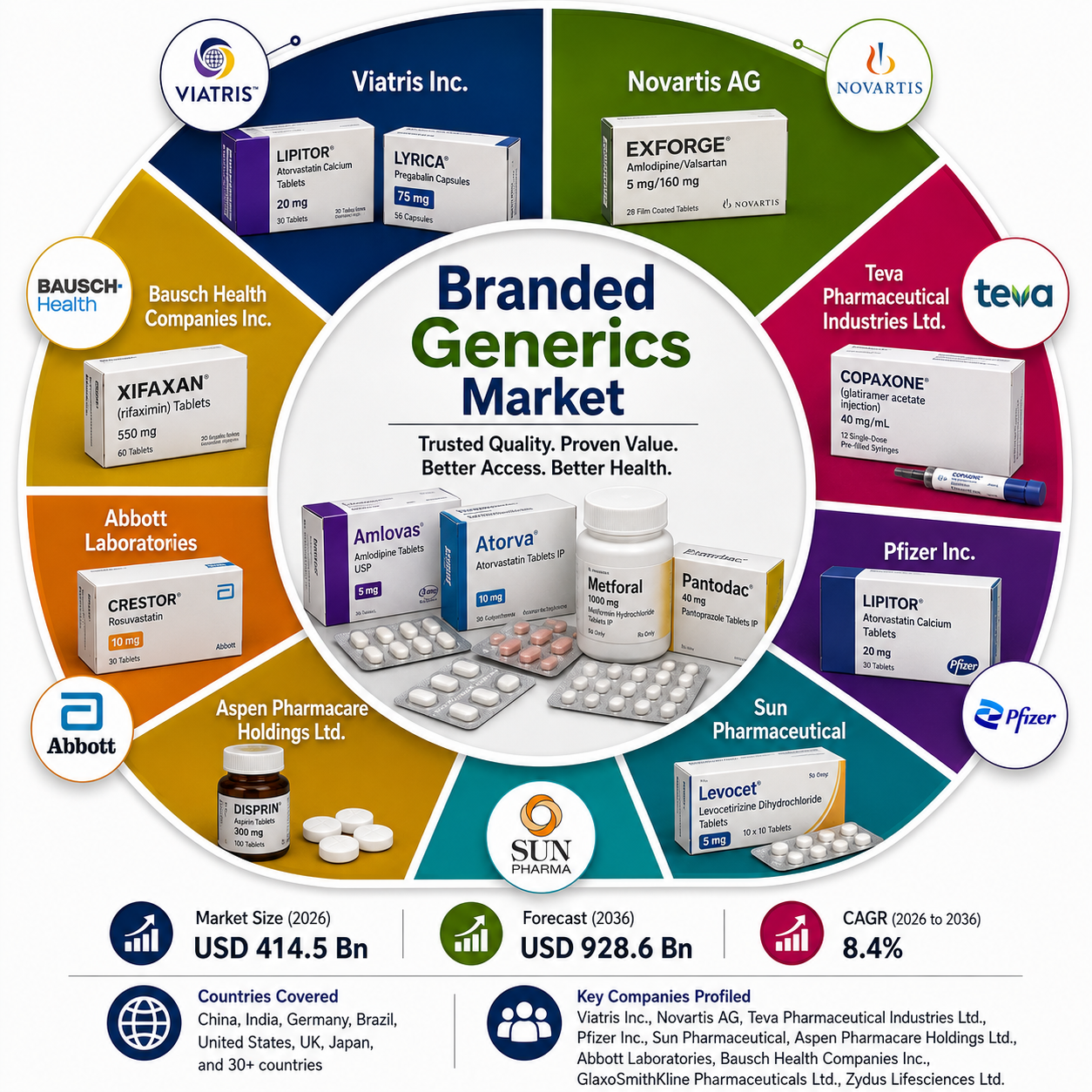
NEWARK, Del., Aug. 10, 2026 — The global Branded Generics Market is expanding as healthcare systems, hospitals, physicians, and patients increasingly seek affordable medicines that combine established therapeutic molecules with recognizable brands and reliable supply. According to Future Market Insights (FMI), the market is projected to grow from USD 414.5 billion in 2026 to USD 928.6 billion by 2036, registering an 8.4% CAGR during the forecast period. Rising chronic disease prevalence, cost pressures across healthcare systems, growing demand for affordable prescription medicines, and continued expansion of hospital and retail pharmacy channels are supporting global market growth.
Branded generics occupy an important position between originator medicines and conventional unbranded generics. They contain established active pharmaceutical ingredients while being marketed under recognizable brand names, allowing manufacturers to compete on physician familiarity, product availability, formulation quality, and supply reliability alongside price.
The market was valued at USD 382.4 billion in 2025 and is expected to create an incremental opportunity of USD 514.1 billion between 2026 and 2036. Oral formulations remain central to demand because tablets and capsules support long-term treatment across chronic conditions such as cardiovascular disease, diabetes, and gastrointestinal disorders.
Get Detailed Market Forecasts, Competitive Benchmarking, and Pricing Trends
Key Branded Generics Market Highlights at a Glance
- Market Size (2025): USD 382.4 Billion
- Market Size (2026): USD 414.5 Billion
- Forecast Market Size (2036): USD 928.6 Billion
- Forecast Period: 2026–2036
- CAGR (2026–2036): 8.4%
- Incremental Opportunity: USD 514.1 Billion
- Leading Formulation Type: Oral Formulations (65.0% Market Share in 2026)
- Leading End User: Hospitals (48.0% Market Share in 2026)
- Key Growth Markets: China and India
- Key Segments Covered: Formulation Type, Therapy Area, Drug Type, End User, Region
Analyst Viewpoint
“Branded generics are increasingly positioned around affordability, physician familiarity, and dependable supply rather than price alone. Chronic disease treatment creates recurring demand for established molecules, while hospitals and pharmacies continue to value manufacturers that can maintain regulatory compliance and consistent product availability. Suppliers with broad portfolios, strong regulatory capabilities, and established distribution networks are likely to remain competitive as healthcare systems balance treatment access with cost containment.”
Why Is the Branded Generics Market Growing?
Growing demand for affordable chronic disease medicines, increasing healthcare expenditure, and expanding access to prescription therapies are supporting sustained demand for branded generics worldwide.
Key Growth Drivers
- Rising prevalence of chronic diseases.
- Increasing demand for affordable prescription medicines.
- Growing use of long-term therapies for cardiovascular and metabolic conditions.
- Expansion of hospital formularies.
- Increasing pharmaceutical access in emerging economies.
- Strong physician and patient familiarity with established brands.
- Growing retail and hospital pharmacy distribution networks.
Cost remains a major consideration in pharmaceutical purchasing, particularly in healthcare systems managing large patient populations. Branded generics allow manufacturers to provide established therapies while maintaining brand recognition and competitive pricing.
Which Formulation Type Leads the Branded Generics Market?
Oral formulations dominate the market, accounting for 65.0% of formulation type demand in 2026.
Tablets and capsules remain widely preferred because they are convenient to administer, suitable for long-term treatment, and commonly prescribed across chronic disease categories.
Formulation Segment Highlights
- Oral formulations remain the largest category.
- Tablets and capsules support recurring prescription demand.
- Chronic therapies generate consistent refill requirements.
- Established oral formulations benefit from broad physician familiarity.
Why Do Hospitals Represent the Largest End User Segment?
Hospitals are forecast to account for 48.0% of end-use revenue in 2026, reflecting their role in managing high patient volumes and maintaining formularies for commonly prescribed medicines.
Hospital purchasing decisions increasingly consider product availability, regulatory compliance, quality consistency, therapeutic familiarity, and overall treatment costs.
End User Highlights
- Hospitals remain the leading end-user category.
- Hospital formularies support recurring branded generic demand.
- Reliable supply remains important for high-volume medicines.
- Pharmacy procurement influences product selection.
- Chronic disease treatment supports continuous hospital demand.
How Are Chronic Diseases Supporting Branded Generic Demand?
Chronic conditions such as cardiovascular disease, diabetes, and gastrointestinal disorders require long-term medication, creating recurring demand for established pharmaceutical products.
Patients undergoing prolonged treatment are more likely to require regular refills, while healthcare providers seek cost-effective therapies that can maintain treatment continuity.
Cardiovascular therapies represent an important demand base because hypertension and lipid-management medicines are frequently used over extended periods. Similarly, diabetes treatment creates sustained demand for established molecules used in blood-glucose management.
Chronic Therapy Highlights
- Cardiovascular disease supports recurring pharmaceutical demand.
- Diabetes treatment creates continuous medication requirements.
- Gastrointestinal therapies contribute to routine prescription volumes.
- Long-term treatment increases refill frequency.
- Affordable medicines improve access to chronic care.
How Does Branded Generics Differ from Conventional Generics?
Branded generics and conventional generics both rely on established active pharmaceutical ingredients, but branded generics are marketed under recognizable trade names.
Conventional generics typically compete primarily on price and availability, while branded generics can differentiate through brand recognition, physician familiarity, formulation characteristics, distribution reach, and manufacturer reputation.
Inactive ingredients such as excipients, coloring agents, preservatives, and binding materials can differ between products, even when the active pharmaceutical ingredient is equivalent. These formulation differences can influence characteristics such as appearance, stability, dissolution, or tolerability in certain circumstances.
For patients and healthcare providers, product selection therefore depends on factors including regulatory approval, clinical appropriateness, physician guidance, formulation requirements, price, and availability.
Market Dynamics
Market Drivers
Increasing chronic disease prevalence, healthcare cost pressures, expanding pharmaceutical access, rising hospital procurement, greater use of long-term therapies, and growing demand for affordable branded medicines continue driving market expansion.
Market Restraints
Intense price competition, regulatory complexity, manufacturing costs, supply-chain disruptions, reimbursement pressures, and competition from conventional generics can restrict margins and create challenges for branded generic manufacturers.
Market Trends
Innovation and competitive positioning continue reshaping the branded generics industry.
Major trends include:
- Expansion of chronic disease portfolios.
- Increasing demand for oral formulations.
- Growth of hospital-based pharmaceutical procurement.
- Expansion of branded generic portfolios in emerging markets.
- Greater emphasis on regulatory compliance.
- Supply-chain and manufacturing optimization.
- Increasing competition on product availability and affordability.
Regional and Country Outlook
China is expected to remain an important growth market as pharmaceutical purchasing reforms, expanding healthcare access, and increasing treatment demand support branded generic adoption. Hospital procurement and volume-based purchasing initiatives are also influencing manufacturer strategies.
India continues to represent a major market due to its large pharmaceutical manufacturing base, extensive retail pharmacy network, physician-led prescribing, and growing demand for affordable medicines.
Germany and the United Kingdom continue to support demand through established healthcare systems, structured pharmaceutical procurement, and continued use of generic medicines to manage healthcare expenditure.
The United States remains an important market because of its large pharmaceutical ecosystem and substantial demand for cost-effective medicines, while Japan continues to present opportunities associated with an aging population and long-term treatment requirements.
Competitive Landscape
Competition remains focused on portfolio breadth, regulatory capabilities, manufacturing reliability, product quality, physician familiarity, pricing strategies, and distribution reach.
Manufacturers are increasingly expanding their branded generic portfolios across high-volume therapeutic areas while strengthening regulatory filings and supply-chain capabilities to maintain availability across hospital and retail pharmacy channels.
Key Companies
- Viatris Inc.
- Novartis AG
- Teva Pharmaceutical Industries Ltd.
- Pfizer Inc.
- Sun Pharmaceutical
- Aspen Pharmacare Holdings Ltd.
- Abbott Laboratories
- Bausch Health Companies Inc.
- GlaxoSmithKline Pharmaceuticals Ltd.
- Zydus Lifesciences Ltd.
Frequently Asked Questions
- What is the projected size of the Branded Generics Market by 2036?
The global Branded Generics Market is projected to reach USD 928.6 billion by 2036, increasing from USD 414.5 billion in 2026. - What is the expected CAGR of the Branded Generics Market?
The market is forecast to expand at an 8.4% CAGR between 2026 and 2036. - Which formulation type dominates the Branded Generics Market?
Oral formulations lead the market, accounting for 65.0% of formulation type demand in 2026. - Which end-user segment holds the largest market share?
Hospitals are expected to account for 48.0% of end-use revenue in 2026. - What factors are driving the Branded Generics Market?
Rising chronic disease prevalence, demand for affordable medicines, recurring treatment requirements, expanding hospital formularies, pharmaceutical access in emerging markets, and strong physician familiarity with established brands continue driving the global Branded Generics Market. - What is the incremental opportunity in the Branded Generics Market?
The market is expected to create an incremental opportunity of USD 514.1 billion between 2026 and 2036.
Related Reports:
- https://sites.google.com/view/healthcarewellnessinsights/oncology-clinical-development-market
- https://sites.google.com/view/healthcarewellnessinsights/brain-pet-mri-systems-market
- https://sites.google.com/view/healthcarewellnessinsights/wearable-medical-device-market_1
- https://sites.google.com/view/healthcarewellnessinsights/liquid-biopsy-market
- https://sites.google.com/view/healthcarewellnessinsights/telehealth-and-telemedicine-market
About Future Market Insights (FMI)
Future Market Insights (FMI) is a global market intelligence and consulting firm providing comprehensive market research, competitive intelligence, and strategic business insights across industries. The firm delivers detailed forecasts, technology analysis, and data-driven recommendations that support informed decision-making for manufacturers, investors, distributors, and policymakers worldwide.
For Press & Corporate Inquiries
Rahul Singh
AVP – Marketing and Growth Strategy
Future Market Insights, Inc.
+91 8600020075
For Sales – sales@futuremarketinsights.com
For Media – Rahul.singh@futuremarketinsights.com
For Web – https://www.futuremarketinsights.com