

According to the latest insights by Future Market Insights, the global Western Blotting Processors industry is witnessing steady expansion as research laboratories, biopharmaceutical companies, and clinical testing facilities increasingly prioritize workflow automation, reproducibility, and compliance-ready protein analysis solutions. In 2025, rising demand for standardized protein detection workflows is driving sustained market growth worldwide.
Industry analysts indicate that while Western blotting remains a foundational technique for protein detection and validation, long-term market growth is increasingly shaped by laboratory automation, digital workflow integration, throughput optimization, and regulatory compliance requirements. Companies capable of delivering highly reproducible, efficient, and audit-ready processing solutions are expected to strengthen their competitive positioning in the evolving life sciences instrumentation landscape.
Rising Demand for Reproducible Protein Analysis Continues to Drive Market Growth
Western blotting remains one of the most widely used protein analysis techniques globally, supporting research, biologics development, and clinical diagnostics.
Growing demand contributes to:
- Increased protein validation workflows
• Higher use in biologics characterization
• Rising laboratory automation investments
• Greater focus on reproducibility across sites
• Increased expenditure on workflow optimization
Protein analysis continues to play a critical role in drug discovery, translational research, and quality control, generating strong demand for standardized Western blotting workflows.
As laboratories scale operations, researchers increasingly prioritize technologies that improve consistency and reduce workflow variability.
Manual Western Blotting Limitations Accelerate Automation Adoption
Manual Western blotting introduces significant variability across laboratories and operators.
Key challenges include:
- Inconsistent incubation timing
• Pipetting and reagent dilution errors
• Uneven membrane washing
• Signal variability and background noise
• Reduced quantitative reliability
Variability in blocking, antibody incubation, and washing steps can substantially affect blot quality, making reproducibility difficult in multi-user or high-volume laboratory settings.
In regulated environments, these inconsistencies create operational risk, delayed workflows, and potential compliance concerns.
As laboratories seek greater process control, demand is rising for automation-driven solutions that minimize human error.
Automated Processors Improve Workflow Standardization
Automated Western blotting processors address reproducibility concerns by standardizing execution across all major workflow stages.
Key automation benefits include:
- Precision-controlled incubation times
• Automated liquid handling
• Uniform reagent distribution
• Temperature-controlled processing
• Consistent washing cycles
These systems improve protocol adherence by ensuring every run follows validated parameters regardless of operator or shift timing.
Integrated shaking and liquid exchange systems reduce edge effects and improve membrane exposure to antibodies, resulting in more consistent signal quality.
Automation is particularly valuable in laboratories with high staff turnover, multiple shifts, or geographically distributed operations.
Throughput Gains Strengthen Value in Biopharma and Core Facilities
Biopharmaceutical development and research core facilities increasingly require higher throughput without compromising assay quality.
Laboratories are prioritizing:
- Parallel blot processing
• Faster turnaround times
• Higher sample capacity
• Improved staff productivity
• Reduced manual labor burden
Automated processors enable multiple blots to be processed simultaneously under identical conditions, significantly increasing operational efficiency.
This parallel processing capability is essential in biologics development, where protein expression validation, post-translational modification analysis, and manufacturing quality control often involve large sample volumes.
By reducing hands-on processing time, automation allows skilled personnel to focus more on experimental design, interpretation, and advanced assay development.
Digital Documentation Strengthens Compliance and Data Integrity
Regulated research and manufacturing environments require strict documentation and process traceability.
Healthcare and research organizations increasingly demand:
- Electronic run records
• Audit-ready documentation
• Reagent traceability
• Timestamped process logs
• Centralized data management
Automated processors generate detailed digital records including protocol parameters, incubation timelines, reagent usage, and temperature histories.
This documentation improves compliance with Good Laboratory Practice and Good Manufacturing Practice standards while reducing transcription errors associated with manual recordkeeping.
Integration with laboratory information management systems further enhances traceability and supports centralized quality oversight.
Audit readiness has become a major driver of automation adoption in regulated laboratories.
Alternative Protein Analysis Technologies Coexist with Western Blotting
Despite advances in alternative protein analysis methods, Western blotting remains indispensable for confirmatory analysis.
Competing technologies include:
- Capillary electrophoresis systems
• Mass spectrometry workflows
• High-throughput immunoassays
• Multiplex protein analysis platforms
• ELISA-based detection systems
While these technologies offer higher throughput or sensitivity, Western blotting remains uniquely valuable for visual confirmation of protein size, isoforms, and expression patterns.
Capillary-based automated Western blotting systems often complement rather than replace traditional blotting workflows.
Many laboratories use capillary systems for screening and quantitative analysis while maintaining traditional processors for confirmatory studies and specialized membrane applications.
Regulatory expectations for confirmatory immunoblot evidence continue reinforcing long-term investment in Western blotting infrastructure.
Balancing Throughput, Cost, and Standardization Remains a Key Challenge
Despite automation benefits, adoption challenges remain for many laboratories.
Key considerations include:
- High capital equipment costs
• Workflow integration complexity
• Training requirements
• Validation of automated protocols
• Budget constraints in smaller labs
• Compatibility with existing assays
Smaller academic laboratories may continue relying on manual workflows due to budget limitations.
However, growing pressure for standardization and reproducibility is expected to accelerate automation adoption over time.
Companies that successfully balance performance, affordability, and workflow flexibility are expected to gain strong competitive advantages.
Instrumentation Innovation Accelerates Market Transformation
R&D investments continue reshaping the Western blotting processors landscape.
Industry stakeholders are investing in:
- AI-assisted workflow optimization
• Smart reagent management
• Advanced digital imaging integration
• Automated quality control tools
• Cloud-enabled documentation systems
• Next-generation blotting platforms
Leading industry players including Bio-Rad Laboratories, Thermo Fisher Scientific, LI-COR Biosciences, GE HealthCare, and Analytik Jena are actively expanding automation-focused product portfolios.
Innovation is increasingly centered around improving reproducibility, throughput, compliance, and digital connectivity.
Future Outlook
The future of the Western Blotting Processors industry will be increasingly shaped by rising laboratory automation, stricter compliance requirements, and growing demand for reproducible protein analysis. Research institutions and biopharmaceutical companies are expected to continue investing in solutions that improve assay reliability while reducing operational risk.
Growing adoption of automated workflow platforms, digital record management, and intelligent laboratory systems is expected to create substantial opportunities across global markets. Manufacturers capable of combining workflow efficiency, reproducibility, and compliance readiness are likely to achieve sustained growth throughout the forecast period.
As life sciences laboratories increasingly focus on operational excellence and data integrity, Western blotting processors are expected to remain a critical component of protein analysis infrastructure.
Key Takeaways
- Manual Western blotting introduces high operator-dependent variability.
• Automated processors improve reproducibility across runs and laboratories.
• Throughput gains are increasingly important in biopharma and core facilities.
• Digital documentation supports audit readiness and data integrity requirements.
• Adoption is driven largely by operational risk reduction rather than assay novelty.
Western Blotting Processors Market Snapshot
| Attributes | Key Insights |
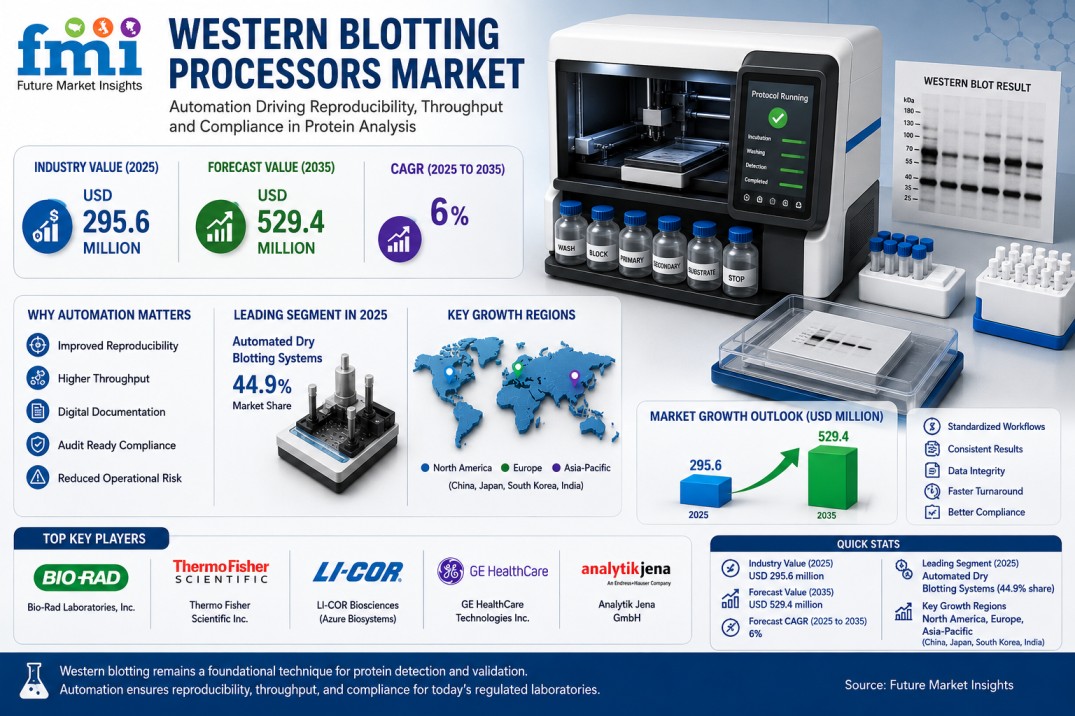
| Estimated Market Size (2025) | USD 295.6 Million |
| Projected Market Value (2035) | USD 529.4 Million |
| CAGR (2025 to 2035) | 6.0% |
Related Reports
The global laboratory automation market is expanding due to increasing adoption of robotic workflow systems and digital process management.
The protein analysis instrumentation market continues to grow with rising demand for precision proteomics and biomarker discovery.
The biopharmaceutical analytical testing market is witnessing strong growth as manufacturers strengthen quality assurance and compliance systems.
Market Summary
The global Western Blotting Processors Market is projected to grow from USD 295.6 million in 2025 to USD 529.4 million by 2035, reflecting sustained demand for automation and reproducible protein analysis workflows.
Segment highlights include:
- Automated Dry Blotting Systems — 44.9% market share in 2025
• Key growth regions — North America, Europe, and Asia-Pacific
• High-growth countries — China, Japan, South Korea, and India
Top Key Players
- Bio-Rad Laboratories
• Thermo Fisher Scientific
• LI-COR Biosciences
• GE HealthCare
• Analytik Jena
Explore More Related Studies Published by FMI Research:
- The Paediatric Oncology Therapeutics Market is anticipated to expand from USD 3.13 Billion in 2025 to USD 6.76 Billion by 2036, registering a CAGR of 8.0%.
- The veno-occlusive hepatic disease therapeutics market is projected to grow from USD 281.3 million in 2025 to USD 553.3 million by 2035, at a CAGR of 7.0%.
- The microbiome therapeutics market is set to reach USD 0.4 billion by 2026-end and grow at a CAGR of 31.1% between 2026-2036 to reach USD 5.9 billion by 2036.
Contact Us:
Future Market Insights Inc.
Christiana Corporate, 200 Continental Drive,
Suite 401, Newark, Delaware – 19713, USA
T: +1-347-918-3531
Why FMI: https://www.futuremarketinsights.com/why-fmi
For Sales Enquiries: sales@futuremarketinsights.com
Website: https://www.futuremarketinsights.com
LinkedIn| Twitter| Blogs | YouTube