

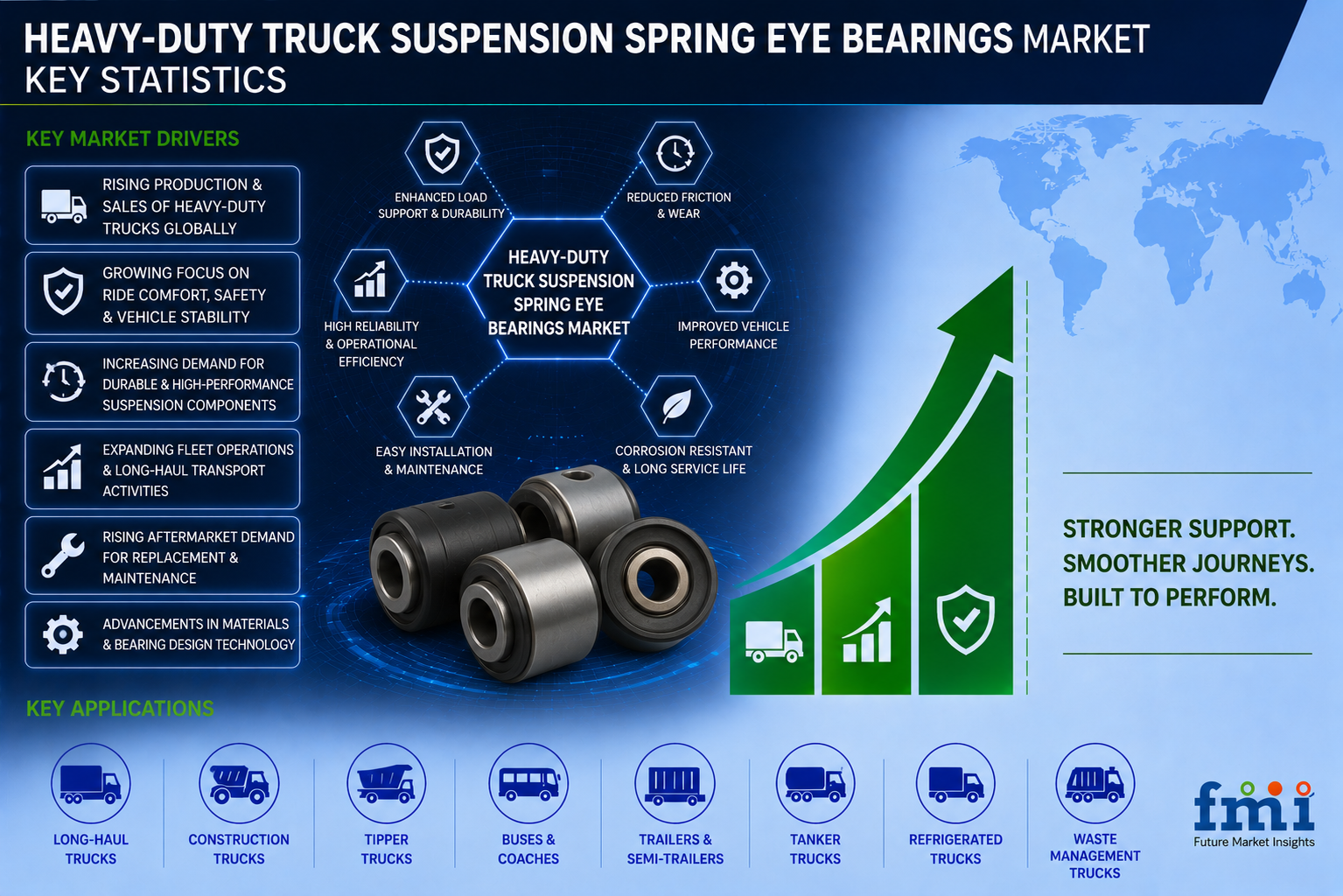
The global Heavy-Duty Truck Suspension Spring Eye Bearings Market is experiencing steady growth as commercial vehicle operators increasingly focus on vehicle uptime, suspension durability, and preventive maintenance. Although spring eye bearings represent a relatively small portion of overall truck component spending, their role in maintaining suspension performance and reducing chassis wear makes them a critical component across heavy-duty truck fleets.
According to Future Market Insights (FMI), the heavy-duty truck suspension spring eye bearings market is projected to grow from USD 616.9 million in 2025 to USD 939.8 million by 2036, expanding at a CAGR of 3.9% during the forecast period. Growth is being supported by increasing truck mileage, expanding freight transportation activity, rising replacement rates, and stronger emphasis on maintenance planning among fleet operators.
As fleets seek to control repair costs while maximizing vehicle availability, suspension service components such as spring eye bearings are becoming increasingly important in maintenance strategies.
Fleet Uptime Priorities Fuel Replacement Demand
Spring eye bearings serve as essential pivot components within leaf spring suspension systems. Positioned between spring eyes, chassis brackets, shackles, and mounting points, these components absorb vibration, accommodate suspension movement, and support load transfer throughout vehicle operation.
Over time, repeated exposure to heavy payloads, road shocks, braking forces, and uneven terrain causes gradual wear. Once bearing looseness develops, trucks can experience increased suspension noise, tire wear, alignment issues, and reduced ride quality.
As a result, fleet operators are replacing spring eye bearings earlier in maintenance cycles to prevent secondary damage and avoid costly downtime. Rather than waiting for major suspension failures, many maintenance teams now treat spring eye bearings as planned replacement components within broader preventive service programs.
This proactive maintenance approach is contributing significantly to market growth.
Aftermarket Segment Dominates Industry Revenue
The replacement market continues to represent the largest source of revenue for spring eye bearing manufacturers.
Aftermarket sales are projected to account for approximately 61.7% of total market demand in 2026, reflecting the ongoing need for suspension repairs across aging truck fleets. Unlike many OEM-installed components that remain untouched for several years, spring eye bearings experience regular replacement due to continuous wear under demanding operating conditions.
Fleet repair facilities, independent service centers, and commercial vehicle workshops increasingly rely on replacement kits that include bushings, sleeves, pins, and associated hardware. These kits simplify repair procedures while ensuring component compatibility and reducing installation time.
The growing importance of distributor networks and parts availability is further strengthening the aftermarket segment’s position within the industry.
Class 8 Trucks Generate the Highest Demand
Among vehicle categories, Class 8 trucks are expected to account for approximately 48.3% of market demand in 2026.
These heavy-duty vehicles operate under some of the industry’s most challenging conditions, transporting substantial payloads across long distances and diverse road environments. The significant axle loads carried by Class 8 trucks place constant stress on suspension pivot points, accelerating wear across spring eye bearings and related components.
Long-haul tractors, construction trucks, vocational vehicles, and regional freight carriers all contribute to replacement demand as suspension systems experience repeated cycles of compression, articulation, and load transfer.
The growing global freight industry is expected to sustain strong demand for suspension maintenance products throughout the forecast period.
Rubber Bush Bearings Lead Product Adoption
Rubber bush bearings are projected to account for approximately 42.6% of the bearing type segment in 2026.
Their popularity stems from their ability to provide effective vibration damping, noise reduction, and load absorption while maintaining relatively low replacement costs. Fleet operators continue to favor rubber bush bearings because they offer an optimal balance between performance, durability, and affordability.
These bearings help minimize harsh vibrations transmitted through the suspension system while supporting smooth articulation during vehicle operation.
Although bronze bearings, polyurethane bearings, spherical bearings, and needle bearings continue to serve specialized applications, rubber bush bearings remain the preferred solution for many heavy-duty truck operators focused on practical fleet maintenance.
Material Innovation Improves Service Life
Material selection is becoming increasingly important as manufacturers seek to extend component life and improve suspension performance.
Steel-backed elastomer designs are expected to account for approximately 39.8% of material demand in 2026. These components combine the structural strength of steel sleeves with the flexibility and vibration-isolation properties of elastomer materials.
The result is improved load management, enhanced durability, and reduced wear under demanding operating conditions.
Polyurethane-based solutions are also gaining attention among repair facilities and fleet operators seeking longer service intervals and improved resistance to environmental factors such as oil exposure, moisture, and temperature fluctuations.
As truck payloads increase and electric commercial vehicles introduce new weight distribution challenges, demand for advanced suspension materials is expected to rise.
Fleet Maintenance Strategies Become More Sophisticated
One of the most important shifts occurring within the market is the growing sophistication of fleet maintenance practices.
Modern fleet operators increasingly use digital maintenance platforms, service records, and predictive repair schedules to manage vehicle health. These systems allow maintenance teams to track suspension wear patterns, identify recurring issues, and schedule component replacement before failures occur.
The adoption of coded repair kits, digital parts catalogs, and vehicle-specific service documentation is helping workshops improve repair accuracy and reduce downtime.
Manufacturers capable of providing comprehensive service solutions, including detailed installation guidance, traceability documentation, and model-specific repair kits, are likely to gain a competitive advantage in the evolving marketplace.
China and India Lead Future Growth
China is expected to record the fastest growth among major markets, expanding at a CAGR of 4.9% through 2036.
The country’s extensive truck manufacturing industry, growing freight transportation sector, and well-developed repair infrastructure continue to create strong demand for suspension service components. Dense parts distribution networks allow repair facilities to access replacement bearings quickly, helping minimize vehicle downtime.
India is projected to follow closely with a CAGR of 4.7% over the forecast period.
Rapid expansion of commercial vehicle sales, increasing freight movement, and improving repair network density are driving stronger demand for suspension maintenance products across the country. As truck ownership grows and vehicle fleets age, replacement opportunities are expected to increase significantly.
Both markets are becoming strategically important for manufacturers seeking long-term growth opportunities in the commercial vehicle aftermarket.
Market Challenges Include Pricing Pressure and Low-Cost Competition
Despite favorable demand conditions, manufacturers continue to face challenges associated with pricing pressure and increasing competition from low-cost suppliers.
Spring eye bearings rely heavily on steel, elastomer compounds, precision bonding techniques, and quality-controlled manufacturing processes. Suppliers that invest in premium materials and advanced engineering often face margin pressure when competing against lower-cost alternatives.
Maintaining quality standards while remaining cost-competitive will remain a critical challenge across both developed and emerging markets.
Companies that differentiate themselves through product durability, service support, catalog accuracy, and distributor relationships are likely to outperform competitors focused solely on pricing.
Future Outlook: Service Life and Availability Will Define Market Leadership
The future of the Heavy-Duty Truck Suspension Spring Eye Bearings Market will be shaped by fleet operators’ growing emphasis on uptime, maintenance efficiency, and total lifecycle cost.
As freight transportation activity increases and trucks remain in service longer, demand for reliable suspension repair components will continue to rise. Manufacturers that offer durable products, comprehensive repair kits, and strong aftermarket support networks will be best positioned to capture market share.
With preventative maintenance becoming increasingly important across commercial vehicle fleets, spring eye bearings are evolving from simple replacement parts into critical components supporting vehicle reliability, safety, and operational performance.
Over the next decade, advancements in material technology, service kit design, and maintenance digitization are expected to create new opportunities for growth while reinforcing the importance of suspension system reliability across the global trucking industry.
Browse More Industry Reports