

The global Ion Exchange Resins Market continues to gain strategic importance as industries worldwide prioritize water purification, wastewater recycling, industrial demineralization, and sustainable resource management. Ion exchange resins, which function by reversibly replacing dissolved ions with similarly charged ions, have become an essential component in modern water treatment systems and numerous industrial separation processes. Their role extends across power generation, chemical manufacturing, fertilizers, pharmaceuticals, paper and pulp production, and municipal wastewater treatment, making them a critical material for industrial infrastructure.
Growing concerns over freshwater scarcity, stricter environmental regulations, and the need for high-purity process water are reshaping demand patterns across developed and emerging economies. Water treatment applications remain the strongest growth contributor, while innovations in mixed-bed demineralization systems and advanced resin technologies continue to improve operational efficiency. At the same time, research initiatives targeting mine wastewater treatment and heavy metal removal are creating new opportunities for specialized ion exchange solutions.
Market Overview
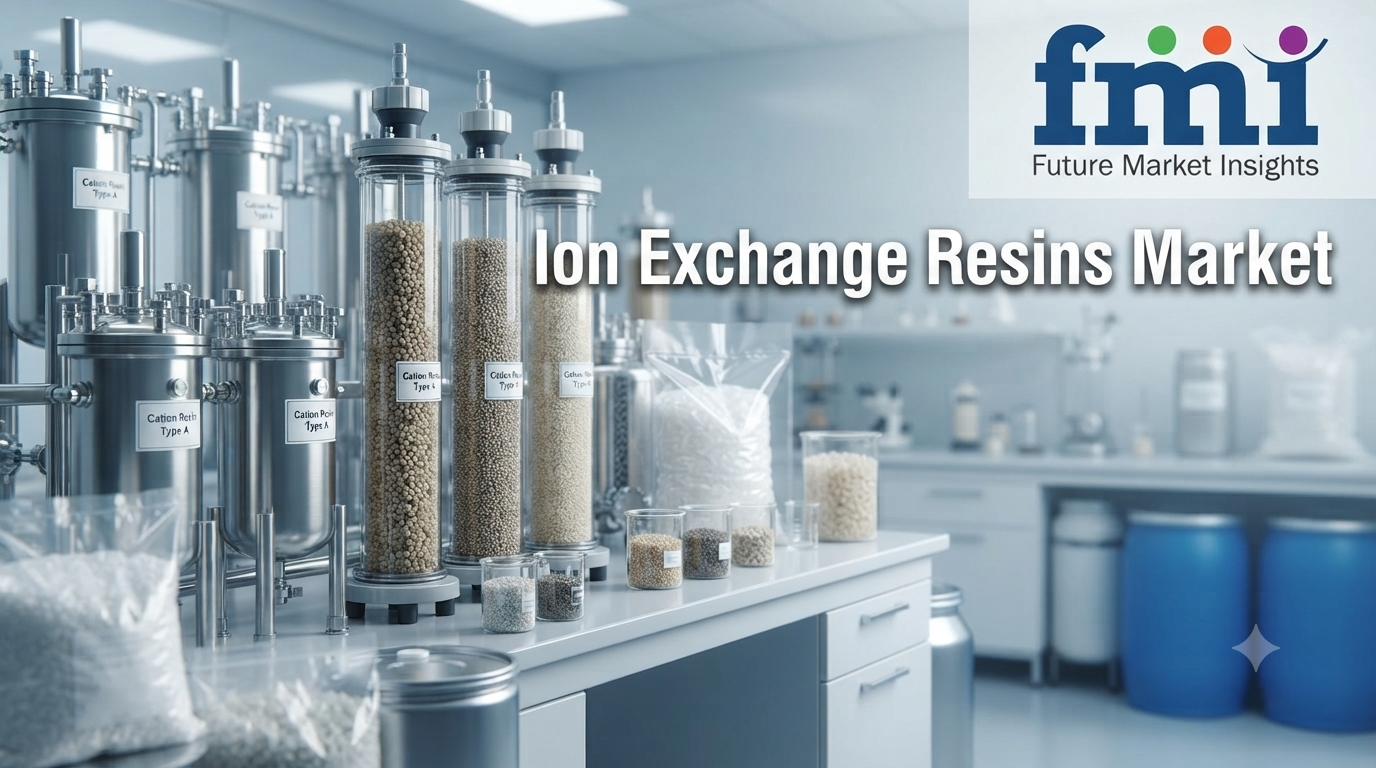
Ion exchange is a reversible chemical process in which dissolved ions are removed from a liquid and replaced with ions carrying an equivalent electrical charge. This process relies on synthetic ion exchange resins composed of cross-linked organic polymers that provide a stable hydrocarbon network capable of selectively exchanging ions.
These resins have become indispensable across industries where water quality, purification, decontamination, and chemical separation directly influence operational efficiency. Their ability to remove dissolved salts, heavy metals, hardness-causing minerals, and contaminants makes them a preferred technology in industrial and municipal water treatment systems.
Key Growth Drivers
- Rising global investment in municipal and industrial water treatment infrastructure.
- Increasing freshwater scarcity driving adoption of advanced purification technologies.
- Growing demand from power generation facilities requiring ultra-pure boiler feed water.
- Expansion of pharmaceutical, chemical, fertilizer, and paper manufacturing industries.
- Higher wastewater recycling targets supported by environmental regulations.
- Continuous innovation in mixed-bed demineralization and industrial purification systems.
- Increasing adoption of ion exchange technologies for mining wastewater treatment.
Technology & Innovation Trends
Technological advancement remains one of the strongest pillars supporting the evolution of the ion exchange resins market. Manufacturers are developing highly selective resin chemistries capable of improving operational efficiency while lowering maintenance requirements.
Mixed-bed ion exchange systems have become increasingly important in industrial demineralization, enabling higher water purity and improved process reliability. These systems are particularly valuable in heating systems, industrial boilers, and power generation facilities where mineral deposits significantly affect equipment performance.
One notable innovation comes from LANXESS, which introduced its Lewatit NM 3367 mixed-bed demineralization solution designed for charging and replenishing modern hot-water heating systems. Such developments demonstrate how resin technology continues to evolve beyond traditional water softening applications into highly specialized industrial processes.
Market Challenges & Restraints
Despite favorable long-term fundamentals, the ion exchange resins market continues to encounter several operational and commercial challenges.
Resin regeneration requires chemical inputs and periodic maintenance, increasing operating expenses for industrial users. Disposal of spent regeneration chemicals also requires compliance with environmental regulations, adding further complexity.
Competition from membrane filtration, reverse osmosis, and advanced oxidation technologies presents another restraint, particularly in large-scale desalination and municipal water treatment projects. These alternative technologies continue to improve in efficiency and cost competitiveness.
Segment Analysis
The market is categorized into two principal product segments:
Anion Exchange Resins
Anion exchange resins are projected to account for the largest share of industry demand. Their ability to remove negatively charged ions such as nitrates, sulfates, and chlorides makes them particularly valuable in industrial water purification and demineralization processes.
Increasing deployment in pharmaceutical manufacturing, semiconductor processing, and chemical production further strengthens this segment’s market outlook.
Cation Exchange Resins
Cation exchange resins remain essential for water softening and hardness removal by replacing calcium and magnesium ions with sodium or hydrogen ions. Their extensive use in domestic water treatment, industrial boilers, and municipal utilities ensures continued market relevance.
Regional Analysis
Water treatment continues to define regional demand patterns across the global ion exchange resins market.
The Middle East and Africa has emerged as one of the most promising regional markets due to increasing water scarcity, industrial expansion, and investments in wastewater treatment infrastructure. Rising demand for water treatment chemicals throughout the region continues to strengthen resin consumption.
South Africa represents an important innovation hub within the region. The country’s growing emphasis on mine wastewater treatment has accelerated research into advanced ion exchange technologies capable of removing hazardous metals from industrial effluents.
Research conducted by Mintek has significantly advanced resin-in-pulp ion exchange processes for removing uranium and other base metals from mining slurries. These developments highlight the expanding role of ion exchange technologies beyond conventional water purification into mineral processing and environmental remediation.
Competitive Landscape
Competition within the ion exchange resins market is centered on technological innovation, product performance, operational efficiency, and specialized application development.
Manufacturers continue investing in research aimed at increasing resin durability, improving regeneration efficiency, and enhancing contaminant selectivity. Strategic collaborations with industrial water treatment providers and engineering companies are also becoming increasingly common as customers seek integrated purification solutions.
Companies are focusing on application-specific products tailored for pharmaceuticals, power generation, mining, and chemical processing industries where water purity standards continue to tighten.
Leading Companies Analysis
Leading manufacturers continue strengthening their portfolios through advanced resin technologies designed to address evolving industrial requirements.
LANXESS remains one of the industry’s notable innovators with its Lewatit product portfolio supporting industrial demineralization and heating system applications. Product development efforts increasingly emphasize operational efficiency, longer service life, and reduced maintenance requirements.
Research institutions are also playing an important role in market development by expanding resin applications into mining wastewater treatment, heavy metal recovery, and sustainable resource management.
Investment & Strategic Developments
Investment activity is increasingly concentrated around water infrastructure modernization and industrial sustainability initiatives.
Governments and industrial operators are allocating greater resources toward wastewater recycling facilities, high-purity industrial water systems, and environmentally compliant treatment technologies. These investments directly support higher adoption of ion exchange resins across municipal and industrial sectors.
Future Outlook
The outlook for the ion exchange resins market remains favorable as industries continue transitioning toward sustainable water management practices.
Growing industrialization, stricter environmental regulations, expanding wastewater recycling programs, and increasing global water stress are expected to reinforce long-term demand. Continued research into selective resin chemistries, mining applications, and high-efficiency purification systems will further diversify market opportunities.
FMI Custom Research: Strategic Intelligence for Confident Decision-Making
In today’s rapidly evolving business environment, leadership teams need more than market data—they need clear, actionable intelligence tailored to their strategic objectives. FMI’s Custom Research solutions are designed around the specific business questions organizations need answered, enabling executives to evaluate growth opportunities, validate investments, assess competitive dynamics, and reduce uncertainty before making critical decisions. By combining deep industry expertise, primary research, and proprietary market intelligence, FMI delivers insights that help organizations move from assumptions to evidence-based strategies with greater speed and confidence.
Key Executive Benefits
- Decision-Ready Insights: Research tailored to your specific business challenges, growth plans, and investment priorities.
- Reduced Strategic Risk: Validate market opportunities, customer demand, and competitive positioning before committing resources.
- Market Entry Confidence: Assess opportunity size, regulatory barriers, channel dynamics, and competitive landscapes with precision.
- Competitive Advantage: Gain proprietary intelligence unavailable through syndicated reports or internal datasets.
- Faster Growth Decisions: Accelerate expansion, product development, portfolio optimization, and investment planning.
- Primary Market Validation: Access real-world customer, buyer, and stakeholder insights that support high-confidence decision-making.
- Global Industry Expertise: Powered by 100+ analysts, 20,000+ published reports, and 1.6 million+ hours of research experience.
- Proven Track Record: Over 7,000 market-entry engagements completed across six regions and 14 industry sectors with strong client retention.
Business Impact
FMI helps organizations transform market complexity into strategic clarity, enabling leadership teams to identify growth opportunities faster, optimize resource allocation, strengthen competitive positioning, and make high-stakes business decisions with confidence.
Related Report:
https://www.openpr.com/news/4389684/photo-activated-debondable-structural-adhesives-market
https://www.openpr.com/news/4389687/pfas-free-firefighting-foams-market-to-surge-to-usd-1-047-0
About Future Market Insights (FMI)
Future Market Insights (FMI) is a global market intelligence and consulting firm providing comprehensive market research, competitive intelligence, and strategic business insights across industries. The firm delivers detailed forecasts, technology analysis, and data-driven recommendations that support informed decision-making for manufacturers, investors, distributors, and policymakers worldwide.
For Press & Corporate Inquiries
Rahul Singh
AVP – Marketing and Growth Strategy
Future Market Insights, Inc.
+91 8600020075
For Sales – sales@futuremarketinsights.com
For Media – Rahul.singh@futuremarketinsights.com
For web – https://www.futuremarketinsights.com/