

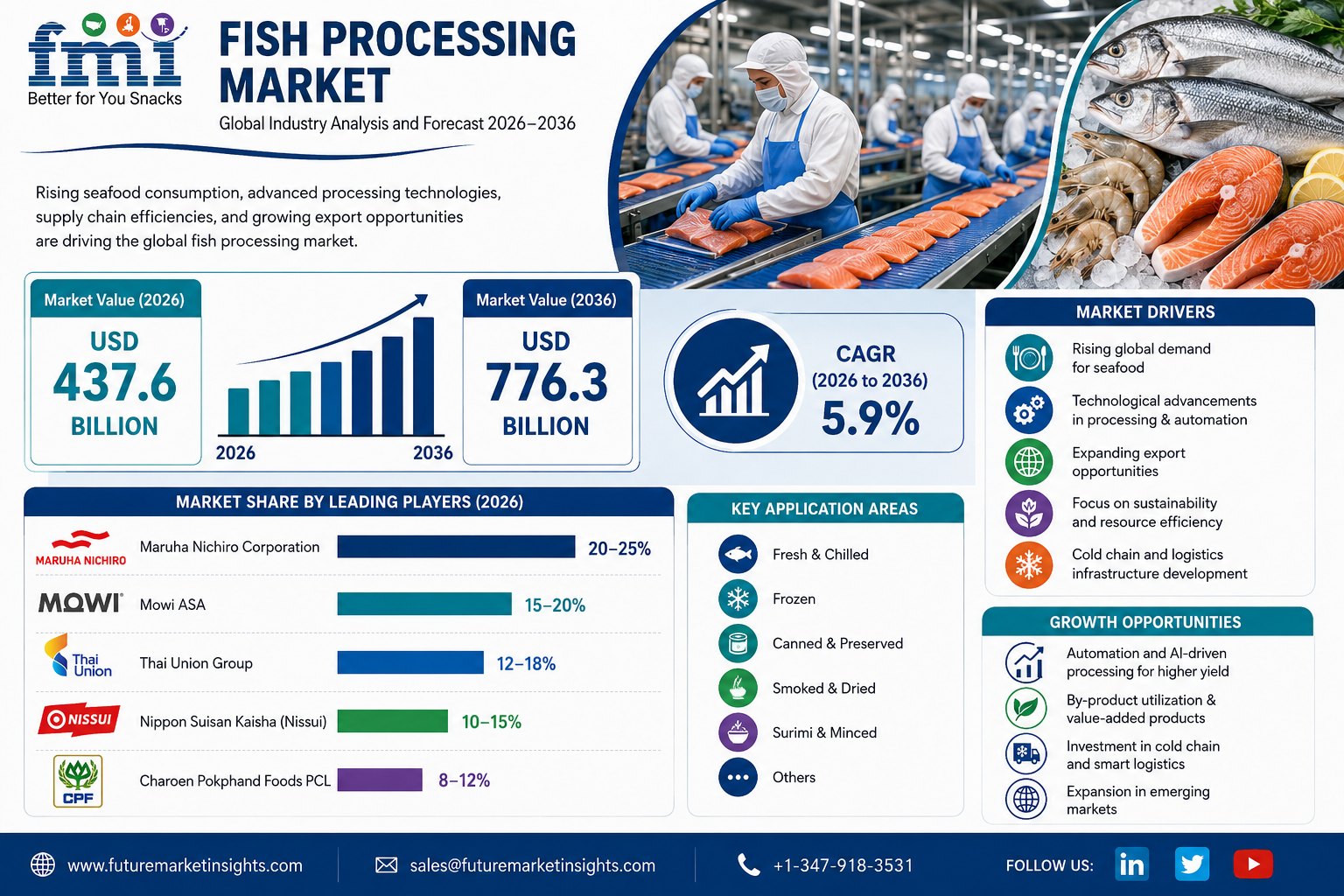
According to the latest insights by Future Market Insights, the global fish processing industry is witnessing a major technological transformation as processors increasingly focus on automation intensity, yield optimisation, cold chain reliability, and value-added processing solutions. In 2026, leading fish processing markets are investing in advanced robotics, machine vision systems, precision freezing technologies, and byproduct recovery solutions to improve operational efficiency and strengthen competitiveness.
Industry analysts highlight that while global processing volumes remain a key factor, technology leadership is increasingly determined by processing precision, labour economics, product consistency, export quality requirements, and supply chain control. Countries and companies capable of integrating automation with advanced quality management systems are better positioned to capture premium opportunities across seafood markets.
Automation Emerges as a Strategic Advantage in Fish Processing
Automation has become one of the most important drivers shaping modern fish processing technology adoption. Countries with higher labour costs are accelerating investments in robotics, artificial intelligence, and machine vision systems to improve efficiency and reduce operational dependency.
Advanced processing facilities are increasingly adopting:
- Automated filleting systems
• Machine vision inspection platforms
• X-ray bone detection technology
• Intelligent trimming solutions
• Automated grading equipment
Modern automated filleting systems analyse fish anatomy individually and adjust cutting patterns to maximise usable meat recovery. Unlike manual processing, automated systems deliver consistent performance by reducing variations caused by operator skill, fatigue, and processing conditions.
For large-scale processors, even small improvements in yield can create significant commercial value. Enhanced cutting precision, reduced waste, and improved product classification allow manufacturers to increase profitability while maintaining consistent quality standards.
Yield Optimisation Becomes a Key Driver of Market Competitiveness
Yield efficiency has become a central performance metric within the global fish processing industry. Processors are increasingly moving beyond volume-based strategies and focusing on extracting maximum value from every kilogram of raw material.
Advanced optimisation technologies support:
- Higher fillet recovery rates
• Reduced trimming losses
• Improved product consistency
• Better utilisation of premium cuts
• Enhanced production economics
Machine vision systems identify bone structures, fat distribution, colour variations, and quality characteristics, enabling processors to route products into the highest-value market segments.
As seafood demand continues to rise, companies achieving superior yield performance gain competitive advantages through improved margins and stronger resource utilisation.
Cold Chain Precision Strengthens Seafood Value Creation
Cold chain management has become one of the most critical factors influencing seafood quality, shelf life, and export opportunities.
Modern fish processing facilities are investing in:
- Rapid chilling systems
• Precision freezing technologies
• Temperature monitoring platforms
• Digital traceability solutions
• Refrigeration optimisation systems
Maintaining controlled temperatures throughout processing helps reduce microbial growth, protect texture quality, and extend product freshness.
Advanced freezing systems support better product preservation by controlling ice crystal formation and minimising moisture loss during thawing. This enables processors to maintain higher-quality frozen seafood products while meeting international export requirements.
Temperature monitoring technologies also provide transparency across supply chains, helping companies demonstrate quality assurance and strengthen relationships with premium buyers.
Byproduct Recovery Creates New Revenue Opportunities
Fish processing economics are increasingly influenced by the ability to convert processing residues into valuable ingredients.
Historically, materials such as fish heads, frames, skins, and viscera were considered low-value outputs. Today, advanced recovery technologies are transforming these materials into:
- Fish oils
• Protein hydrolysates
• Collagen ingredients
• Functional nutrition components
• Aquaculture feed inputs
Processing companies are integrating extraction and refining technologies to improve resource efficiency and create additional revenue streams.
Byproduct valorisation not only improves profitability but also supports sustainability goals by reducing waste and improving full-resource utilisation.
Processing Technology Innovation Drives Market Differentiation
Technology development continues to shape competitive positioning across the fish processing industry.
Leading processors are focusing on:
- Robotics integration
• Artificial intelligence-based quality control
• Smart production systems
• Digital monitoring platforms
• Sustainable processing methods
Automation suppliers and seafood companies are increasingly collaborating to develop customised processing solutions that address specific species characteristics and production requirements.
This collaboration enables faster innovation cycles and allows advanced processing technologies to move from specialised facilities into broader global markets.
Species Characteristics Influence Technology Adoption
The adoption of processing technology varies significantly depending on species, production systems, and market requirements.
Aquaculture species with uniform size, predictable quality, and concentrated production volumes are particularly suitable for automation because equipment can be optimised for consistent raw materials.
Meanwhile, multi-species processing operations face greater challenges due to:
- Size variability
• Different anatomical structures
• Seasonal availability
• Diverse processing requirements
This makes flexible automation solutions more valuable for processors handling multiple species.
As a result, technology adoption is increasingly linked to production consistency rather than simply processing volume.
Export Standards Accelerate Processing Innovation
Global seafood trade requirements are placing greater emphasis on traceability, food safety, and quality assurance.
Premium export markets increasingly demand:
- Verified temperature control
• Consistent product specifications
• Advanced quality documentation
• Sustainable processing practices
Processors investing in digital monitoring and quality management systems gain stronger access to high-value markets while improving customer confidence.
Compliance requirements are therefore becoming a strategic advantage rather than only an operational necessity.
Future Outlook
The future of the fish processing industry will be shaped by automation, precision engineering, sustainability, and advanced supply chain management. Manufacturers and processing companies are expected to accelerate investments in robotics, intelligent inspection systems, cold chain technologies, and byproduct utilisation solutions.
Growing demand for high-quality seafood, efficient resource utilisation, and sustainable production practices is expected to create new opportunities across global markets. Companies that successfully combine technological innovation with quality assurance and operational efficiency will be best positioned to strengthen their market presence.
As the industry continues evolving, automation capability, yield improvement, and processing intelligence are expected to remain the defining factors influencing global fish processing technology leadership.
Explore More Related Studies Published by FMI Research:
Seafood Market is projected to expand through 2036, supported by increasing seafood consumption, aquaculture growth, advanced processing technologies, and global supply chain development.
Food Service Industry: Global Industry Analysis 2015 – 2024 and Opportunity Assessment 2025 – 2035 About Future Market Insights (FMI)
Future Market Insights, Inc. (FMI) is an ESOMAR-certified, ISO 9001:2015 market research and consulting organization, trusted by Fortune 500 clients and global enterprises. With operations in the U.S., UK, India, and Dubai, FMI provides data-backed insights and strategic intelligence across 30+ industries and 1200 markets worldwide.
Contact Us:
Future Market Insights Inc.
Christiana Corporate, 200 Continental Drive,
Suite 401, Newark, Delaware – 19713, USA
T: +1-347-918-3531
Why FMI: https://www.futuremarketinsights.com/why-fmi
For Sales Enquiries: sales@futuremarketinsights.com
Website: https://www.futuremarketinsights.com
LinkedIn| Twitter| Blogs | YouTube