

NEWARK, Del., October 30, 2026 — The global carborane polymers market is gaining momentum as aerospace, defense, nuclear energy, and specialty chemical industries seek advanced materials capable of withstanding extreme temperatures, oxidation, and radiation exposure. Growing interest in hypersonic aerospace systems, high-temperature sealing applications, small modular reactor (SMR) technologies, and specialized radiation-shielding materials is creating opportunities for manufacturers of boron-rich polymers. Carborane-based elastomers, high-performance polymer networks, and advanced resin formulations are attracting attention for applications that require thermal stability and performance under demanding operating conditions.
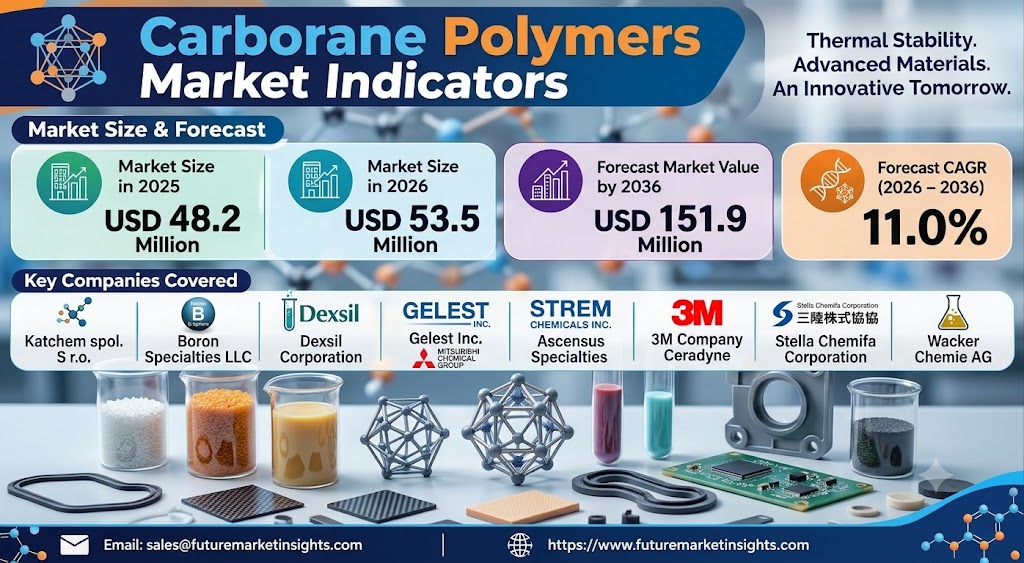
According to the latest market intelligence report published by Future Market Insights (FMI), the global carborane polymers market is estimated to reach USD 53.5 million in 2026, up from USD 48.2 million in 2025. The market is projected to reach USD 151.9 million by 2036, expanding at a compound annual growth rate (CAGR) of 11.0% from 2026 to 2036.
The market covers specialized polymer materials incorporating carborane structures for applications across aerospace, defense, nuclear shielding, analytical chemistry, and research-driven industrial technologies. Demand is supported by the need for materials that can retain structural integrity under demanding thermal and chemical conditions, alongside continuing research into boron-rich polymers for advanced engineering and medical applications.
Get Detailed Market Forecasts, Competitive Benchmarking & Industry Insights — Request a Sample Report: https://www.futuremarketinsights.com/reports/sample/rep-gb-36113
Carborane Polymers Market Size and Growth Forecast
FMI’s forecast highlights an expanding commercial opportunity for specialty chemical manufacturers, high-performance polymer producers, boron compound suppliers, and advanced materials developers. As aerospace and nuclear technology developers evaluate materials for extreme operating environments, suppliers have opportunities to develop specialized polymer formulations, improve processing capabilities, and support application-specific material qualification.
Key carborane polymers market indicators include:
- Market size in 2025: USD 48.2 million
- Market size in 2026: USD 53.5 million
- Forecast market value by 2036: USD 151.9 million
- Forecast CAGR, 2026–2036: 11.0%
- Leading cage isomer segment: Meta-carborane siloxane elastomers, accounting for 56.4% in 2026
- Leading backbone architecture: Polycarborane-siloxane elastomers, accounting for 62.8% in 2026
- Leading thermal regime: Ultra-high oxidative char, accounting for 58.2% in 2026
- Leading end-use sector: Hypersonic radome seals, accounting for 46.5% in 2026
- Leading sales channel: Direct defense contracts, accounting for 71.5% in 2026
- Fastest-growing profiled country: South Korea, with a projected CAGR of 12.4% through 2036
These indicators underscore the importance of thermal performance, polymer architecture, precursor availability, material qualification, and specialized customer relationships as suppliers compete in this technically demanding market.
Key Trends Shaping the Carborane Polymers Market
- Meta-Carborane Siloxane Elastomers Support Advanced Material Development
Meta-carborane siloxane elastomers are projected to account for 56.4% of the cage isomer segment in 2026. Their molecular structure supports the development of specialized polymer systems designed for demanding thermal and chemical environments.
For specialty chemical manufacturers, this creates opportunities to improve polymerization processes, refine material specifications, and develop formulations for high-temperature sealing and advanced engineering applications. Consistent material quality and application-specific testing remain important when qualifying products for demanding operating conditions.
- Polycarborane-Siloxane Elastomers Strengthen High-Temperature Applications
Polycarborane-siloxane elastomers are estimated to account for 62.8% of the backbone architecture segment in 2026. These materials are relevant to applications requiring thermal resistance and the retention of functional properties under challenging operating conditions.
Manufacturers can explore improvements in polymer synthesis, cross-linking, processing efficiency, and thermal characterization. Close collaboration with aerospace, industrial, and nuclear technology developers can help suppliers align material performance with specific engineering requirements.
- Ultra-High Oxidative Char Supports Thermal Protection Requirements
The ultra-high oxidative char segment is forecast to account for 58.2% of the thermal regime category in 2026. Materials designed to maintain protective char structures under intense heat are relevant to advanced aerospace and other high-temperature applications.
Suppliers can strengthen their offerings by evaluating oxidation resistance, thermal decomposition behavior, mechanical stability, and material performance under application-specific conditions. Testing and qualification are especially important where polymer failure could affect equipment reliability or operational safety.
- Hypersonic Radome Seals Create Specialized Demand
Hypersonic radome seals are expected to account for 46.5% of the end-use sector in 2026. High-speed aerospace systems can expose sealing materials to severe thermal and environmental stresses, creating a need for specialized polymer formulations.
Material developers can pursue opportunities through thermal testing, sealing-performance evaluation, and collaboration with aerospace engineering teams. Electrical properties and radar transparency are also important considerations when materials are designed for radome-related applications.
- Direct Defense Contracts Shape Procurement Relationships
Direct defense contracts are anticipated to account for 71.5% of the sales channel segment in 2026. Specialized defense and aerospace applications often require extensive technical evaluation, controlled procurement procedures, and product qualification before materials enter operational use.
Manufacturers can strengthen commercial relationships through documented material performance, traceability, reliable production, and compliance with applicable procurement and export-control requirements. Long qualification cycles and specialized technical specifications can also influence supplier selection and market entry.
Regional Opportunities: South Korea Leads Forecast Growth
FMI’s country-level projections identify several markets offering opportunities for carborane polymer manufacturers, specialty chemical suppliers, and advanced materials developers.
- South Korea: Projected to grow at a CAGR of 12.4% from 2026 to 2036.
- Japan: Forecast to expand at a CAGR of 11.9%.
- Czech Republic: Expected to record a CAGR of 11.8%.
- China: Projected to grow at a CAGR of 11.5%.
- United States: Forecast to expand at a CAGR of 10.6%.
- Germany: Expected to record a CAGR of 10.4%.
- United Kingdom: Projected to grow at a CAGR of 10.2%.
- France: Forecast to expand at a CAGR of 10.1%.
South Korea leads the profiled markets in projected growth, supported by opportunities associated with aerospace and defense development, nuclear technology, and specialized medical research. Japan also presents opportunities through advanced materials research, boron-related supply chains, and specialized industrial applications.
The Czech Republic represents an important market for carborane chemistry and precursor development, while the United States offers opportunities associated with aerospace programs, defense-related materials, and specialty chemical manufacturing.
For companies evaluating international expansion, these projections provide a starting point for assessing market-entry opportunities. Regulatory requirements, precursor availability, production costs, export controls, and customer qualification procedures remain important considerations when developing regional strategies.
Top Companies in the Carborane Polymers Market
FMI identifies the following companies among the notable participants in its competitive assessment of the carborane polymers market:
- Katchem spol. s r.o. — A specialty chemical company associated with boron and carborane compounds.
- Boron Specialties LLC — A supplier of specialized boron-containing chemicals and materials.
- Dexsil Corporation — A company associated with high-performance organosilicon and carborane-based polymer materials.
- Gelest Inc. — A specialty materials supplier serving silicone, organosilicon, and advanced chemical applications.
- Strem Chemicals Inc. (Ascensus Specialties) — A supplier of specialty chemicals and research materials.
- 3M Company (Ceradyne) — A technology and advanced materials business with activities in high-performance materials.
- Stella Chemifa Corporation — A specialty chemical manufacturer with expertise in fluorine chemistry and related high-purity chemicals.
- Wacker Chemie AG — A chemical manufacturer with expertise in silicones and polymer materials.
- Momentive Performance Materials Inc. — A supplier of specialty silicones and advanced performance materials.
- Shin-Etsu Chemical Co., Ltd. — A chemical manufacturer with significant capabilities in silicone and specialty materials.
This list identifies notable companies discussed in the market assessment and should not be interpreted as a ranking by market share.
Competition spans carborane compound producers, specialty chemical suppliers, silicone manufacturers, and advanced materials developers. Relevant competitive factors include precursor availability, polymerization expertise, thermal performance, material consistency, technical documentation, production capabilities, and the ability to meet demanding customer qualification requirements.
Business Outlook: Opportunities for Manufacturers and Suppliers
The projected expansion of the carborane polymers market creates opportunities across specialty polymer synthesis, high-temperature materials development, aerospace components, nuclear technologies, and advanced chemical research.
Manufacturers can evaluate investments in controlled synthesis, polymer processing, thermal characterization, and application-specific formulations. Suppliers can also collaborate with engineering teams to assess how carborane-based materials perform under thermal stress, oxidative conditions, and other demanding operating environments.
Aerospace and defense companies may evaluate specialized polymers for sealing, thermal protection, and related engineering applications. Nuclear technology developers and research organizations may explore suitable boron-containing polymer systems for radiation-related applications, subject to relevant technical and regulatory requirements.
However, sustained commercial performance will depend on more than market growth alone. Businesses must consider the cost and availability of boron-containing precursors, specialized production equipment, process safety, export controls, qualification timelines, and the technical requirements of end-use applications.
Companies that combine material innovation, reliable production, robust quality assurance, and application-specific technical support will be better positioned to pursue opportunities in this developing market.
About the Carborane Polymers Market Report
Future Market Insights’ Carborane Polymers Market report examines market size, forecast growth, cage isomers, backbone architectures, thermal regimes, end-use sectors, sales channels, regional opportunities, and the competitive landscape. The report covers the 2026–2036 forecast period and includes country-level projections across key markets.
Explore the Full Carborane Polymers Market Report: https://www.futuremarketinsights.com/reports/carborane-polymers-market
Frequently Asked Questions
What is the projected size of the carborane polymers market by 2036?
The global carborane polymers market is projected to reach USD 151.9 million by 2036, according to FMI.
What is the expected CAGR for 2026–2036?
The market is forecast to grow at a CAGR of 11.0% during 2026–2036.
Which cage isomer segment leads the carborane polymers market?
Meta-carborane siloxane elastomers are projected to account for 56.4% of the cage isomer segment in 2026.
Which backbone architecture holds the leading position?
Polycarborane-siloxane elastomers are estimated to account for 62.8% of the backbone architecture segment in 2026.
Which end-use sector leads the market?
Hypersonic radome seals are forecast to account for 46.5% of the end-use sector in 2026.
Which sales channel leads the carborane polymers market?
Direct defense contracts are anticipated to account for 71.5% of the sales channel segment in 2026.
Which country has the fastest projected growth?
South Korea leads the profiled countries, with a forecast CAGR of 12.4% from 2026 to 2036.
Which companies are identified in the competitive assessment?
Notable companies include Katchem, Boron Specialties, Dexsil Corporation, Gelest, Strem Chemicals, 3M, Stella Chemifa, Wacker Chemie, Momentive Performance Materials, and Shin-Etsu Chemical.
Related Chemicals & Advanced Materials Industry Reports
Bismaleimide Resins Market : https://www.futuremarketinsights.com/reports/bismaleimide-resins-market
Biopolymers Market : https://www.futuremarketinsights.com/reports/biopolymers-market
Emulsion Polymers Market: https://www.futuremarketinsights.com/reports/emulsion-polymers-market
Specialty Polymers Market : https://www.futuremarketinsights.com/reports/specialty-polymers-market
About Future Market Insights
Future Market Insights (FMI) is an ESOMAR-certified market research and consulting firm providing syndicated, customized, investment, and social media research across industries, including food and beverage, healthcare, chemicals, technology, and consumer products. FMI delivers market intelligence, competitive analysis, and strategic insights to help organizations evaluate emerging opportunities and make informed business decisions. The company has offices in the United States, the United Kingdom, the UAE, and India.
Media Contact
For Press & Corporate Inquiries
Rahul Singh
AVP – Marketing and Growth Strategy
Future Market Insights, Inc.
Phone: +91 8600020075
For Sales: sales@futuremarketinsights.com
For Media: Rahul.singh@futuremarketinsights.com
Website: https://www.futuremarketinsights.com