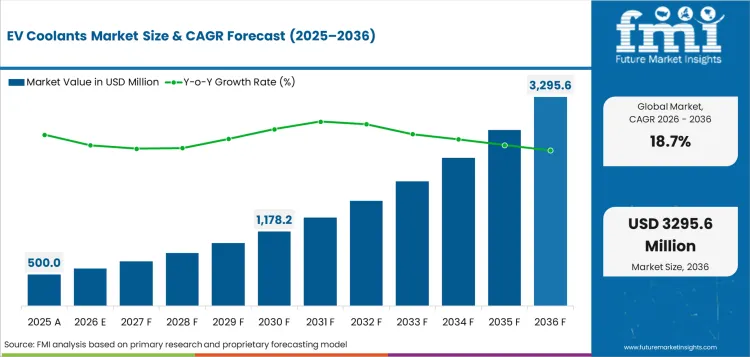
The development comes as EV manufacturers move from adapted conventional coolant formulations toward fluids designed specifically for electrified powertrains. Future Market Insights (FMI) finds that the EV Coolants Market was valued at USD 500.0 million in 2025 and is set to reach USD 593.5 million by 2026-end. The market is projected to grow at an 18.7% CAGR between 2026 and 2036, reaching USD 3,295.6 million by 2036.
The development of purpose-engineered coolant formulations for electric vehicles highlights the growing importance of thermal management as automakers and battery manufacturers increase energy density and production volumes. Coolant suppliers are increasingly developing dielectric, low-conductivity, glycol-based, and hybrid formulations designed around the specific requirements of batteries, power electronics, and electric motors.
Get detailed market forecasts, competitive benchmarking, and pricing trends:
https://www.futuremarketinsights.com/reports/sample/rep-gb-16579
Why are purpose-engineered EV coolant formats gaining commercial importance?
For EV manufacturers, coolant selection has become closely linked to battery safety, charging performance, vehicle range, and component durability. Unlike conventional vehicles, electric vehicles require thermal management across several electrically powered systems, including battery packs, power electronics, and electric motors.
Battery thermal management represents the most commercially important application because lithium-ion cells need to operate within controlled temperature ranges. Excessive heat can affect battery performance and lifespan, while inadequate temperature control can restrict charging and power delivery.
This is increasing interest in dielectric and low-conductivity formulations that can support direct-contact cooling applications. Such fluids need to satisfy electrical, thermal, and material-compatibility requirements while maintaining stable performance across vehicle operating conditions.
The procurement structure is also changing. EV coolant sourcing increasingly forms part of the vehicle manufacturing bill of materials, making OEM qualification and supplier validation important barriers to market entry. Suppliers that can meet automaker and battery manufacturer specifications can secure longer-term supply opportunities linked to EV production volumes.
What does the analyst see as the key commercial issue?
“Companies that can develop and qualify dielectric coolant formulations for direct battery cell contact applications are positioned to capture the highest value segment of the fast-growing EV coolant market.
The industry is transitioning from modified conventional coolant formulations to purpose-engineered EV thermal management fluids.
Battery cell manufacturer specification requirements are becoming as influential as vehicle OEM specifications in the procurement decisions of coolants.
Underlying this demand is the structural growth path of global EV production and the increasing thermal management complexity of high energy density battery systems.”
– Principal Consultant, Future Market Insights
Which vehicle types and applications are shaping demand?
Battery Electric Vehicles are projected to account for 52.6% of the vehicle type segment. Their leading position reflects the continued expansion of battery-powered vehicle production and the extensive thermal management requirements associated with high-voltage battery systems.
Electric Passenger Cars are expected to hold the leading position within the category segment, accounting for 48.9% share. Passenger EVs require integrated thermal management across batteries, motors, and power electronics, creating recurring demand for specialized coolant formulations.
Battery thermal management remains the dominant application because temperature control directly affects charging capability, range performance, battery safety, and service life. Power electronics cooling and electric motor cooling provide additional demand as manufacturers increase power density within increasingly compact vehicle architectures.
The coolant market also covers multiple formulation pathways. Ethylene glycol represents the largest coolant type, while dielectric and hybrid formulations are gaining importance as thermal management architectures become more sophisticated.
Market Segmentation Analysis
• Battery Electric Vehicles hold the leading vehicle type position with a 52.6% share.
• Electric Passenger Cars lead the category segment with a 48.9% share.
• Ethylene Glycol represents the largest segment based on coolant type.
• Battery Thermal Management represents the key application area.
• OEM Direct Supply remains a major distribution route as coolant qualification becomes part of EV production programs.
What is driving near-term demand?
The rapid expansion of EV production is creating the primary demand base for specialized coolants. As battery packs become larger and energy density increases, thermal management systems need to remove heat efficiently while maintaining stable operating conditions across different driving and charging cycles.
Battery cooling is particularly important because temperature variation across cells can affect charging performance and battery degradation. This makes coolant formulation part of the broader battery-management strategy rather than a simple consumable component.
Power electronics provide another important demand pathway. Inverters, converters, and other high-voltage electronics generate heat during operation and require controlled cooling. As EV manufacturers seek higher power output and improved efficiency, thermal loads within these components can increase.
Electric motors also require dedicated thermal management. Higher power density allows automakers to package more performance into smaller motor systems, but this can increase the importance of coolant flow, heat transfer, and material compatibility.
OEM platform standardization is further supporting structured procurement. Automakers increasingly develop common thermal management architectures across multiple EV models, allowing qualified coolant suppliers to participate in larger vehicle programs.
How are South Korea and the United States shaping market development?
South Korea is projected to record an 8.4% CAGR, making it the fastest-growing market among the profiled countries. Concentration of EV manufacturing and battery-cell production investments creates a strong environment for specialized coolant development and qualification.
The country’s position in battery manufacturing also makes battery-maker specifications increasingly relevant to coolant suppliers. Companies capable of developing formulations that satisfy both vehicle OEM and battery manufacturer requirements can access broader procurement opportunities.
The United States is forecast to expand at an 8.3% CAGR. EV production expansion and domestic battery manufacturing investments are supporting demand for thermal management fluids. As more battery manufacturing capacity is established, coolant suppliers can face increasingly specific requirements related to battery safety, conductivity, material compatibility, and thermal performance.
Why is OEM qualification becoming more important?
OEM direct supply remains a major route to market because EV coolant procurement is closely connected to vehicle manufacturing programs. Coolants must be validated for use with battery packs, cooling circuits, motors, power electronics, seals, hoses, and other materials used within thermal management systems.
This creates a higher technical barrier than conventional coolant supply. A formulation that performs adequately in one EV architecture may require modification for another because cooling-loop design, operating temperature, materials, and electrical requirements can vary.
The transition toward dielectric coolant also creates new opportunities for suppliers with specialized formulation capabilities. Direct-contact battery cooling requires fluids with suitable electrical properties while maintaining sufficient heat-transfer performance.
Aftermarket demand provides another channel, although its development depends on the expanding installed base of EVs. As more electric vehicles reach service age, replacement coolant requirements can increase, creating opportunities for qualified aftermarket formulations that maintain compatibility with original thermal management systems.