

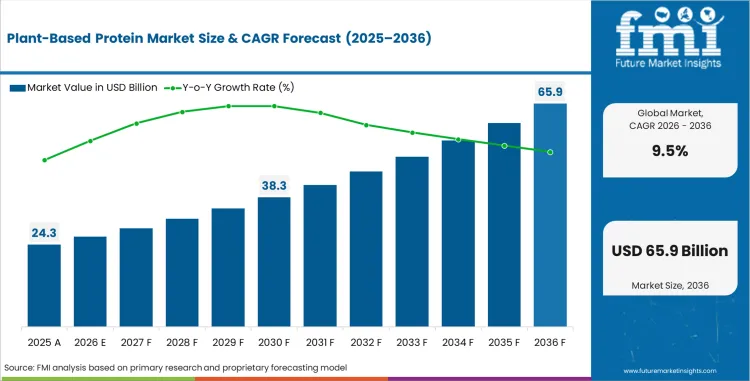
The global plant-based protein market is estimated at USD 24.3 billion in 2026 and is projected to reach USD 59.4 billion by 2036, expanding at a 9.5% CAGR during the 2026-2036 forecast period, according to Future Market Insights. Growth is being supported by increasing use of plant proteins in packaged foods, nutrition-focused products, snacks, beverages, and dairy-free formulations, alongside rising demand for protein enrichment across mainstream food categories.
Get detailed market forecasts, competitive benchmarking, and pricing trends:
https://www.futuremarketinsights.com/reports/sample/rep-gb-11442
Regional Segment Leaders
As this is a global Plant-Based Protein Market report, the segment analysis reflects product types, end-use applications, and evolving protein formulation requirements across key food markets.
- Soy Protein – 30.0% of Product Type demand in 2026: Soy protein is expected to lead the product type segment as manufacturers continue to value its established processing behavior, broad availability, and familiarity across commercial food formulations.
- Food and Beverage – 28.0% of End Use demand in 2026: Food and beverage applications represent a leading end-use segment, supported by the expanding incorporation of plant proteins into packaged foods, snacks, beverages, and dairy-free products.
- Isolates: Protein isolates are gaining relevance in premium formulations where manufacturers require higher protein content, controlled functionality, and improved dispersion characteristics.
Market Growth Context
The Plant-Based Protein Market is developing beyond its traditional role as an alternative protein category and is increasingly becoming a broader food formulation platform. Food manufacturers are incorporating plant proteins into everyday products as consumers and product developers place greater emphasis on protein enrichment and nutrition-focused positioning.
Soy protein is projected to maintain its leading position within the product type segment, accounting for 30.0% of demand in 2026. Its established processing characteristics and familiarity among food manufacturers continue to support commercial adoption across a range of formulations.
Food and beverage applications are expected to account for 28.0% of end-use demand in 2026. The broad application base of this segment includes packaged foods, snacks, beverages, dairy-free products, and other nutrition-oriented formulations where plant proteins can provide nutritional and functional value.
Protein enrichment is also moving further into everyday food formats. Manufacturers are evaluating plant proteins not only for their protein content but also for taste, texture, dispersion, processing behavior, and compatibility with existing production systems.
Isolates are expected to support premium formulations where higher protein concentration and controlled dispersion are important. As product developers expand the use of plant protein in more sophisticated formulations, suppliers may need to provide greater application support to reduce formulation trials and improve commercial-scale processing outcomes.
Geographic growth is also expected to contribute to market expansion. India is projected to lead country-level growth as protein fortification expands across mainstream food categories. China is also expected to record strong expansion as manufacturing capabilities and production scale support wider commercialization of plant protein products.
Supplier selection is increasingly tied to more than raw material availability. Food manufacturers are evaluating suppliers based on application expertise, taste control, processing reliability, documentation, and consistency of raw material supply. These factors can become particularly important when plant proteins are incorporated into established production programs.
Commercial opportunities through 2036 are expected to center on protein-enriched foods, isolates, dairy-free formulations, functional beverages, everyday snacks, and B2B ingredient supply contracts. Suppliers that can combine nutritional functionality with consistent processing performance may find opportunities across expanding food and beverage applications.
Competitive Landscape
The competitive landscape features major global ingredient manufacturers, specialty plant protein suppliers, and companies developing plant-based protein systems for food and nutrition applications.
- Major Global Players: ADM, Roquette, Ingredion, Cargill, PURIS, Cosucra, and Burcon are among the key companies identified in the Plant-Based Protein Market.
- Competitive Focus: Market participants are differentiating through protein functionality, raw material access, application expertise, taste management, processing reliability, and the ability to support customized food formulations.
Competitive differentiation increasingly depends on suppliers’ ability to address formulation challenges beyond basic protein content. Manufacturers require plant proteins that can integrate into finished products while maintaining acceptable taste, texture, dispersion, and production performance.
Soy, pea, and isolate systems are expected to gain commercial relevance where manufacturers can combine nutritional positioning with stable product and processing outcomes. Suppliers with dependable raw material access and stronger application support may strengthen relationships with food manufacturers developing repeat product programs.
Get the Complete Story – Read More About the Plant-Based Protein Market: https://www.futuremarketinsights.com/reports/plant-based-protein-market
Analyst Perspective
“The plant-based protein market is likely to favor suppliers that can solve formulation problems beyond basic protein content. Soy, pea, and isolate systems are expected to gain stronger commercial use when manufacturers can link nutrition claims with stable taste and production outcomes.” – Nandini Roy Choudhury, Principal Consultant for Food and Beverage, Future Market Insights
Explore More Research Reports by FMI
Plant Protein Market https://www.futuremarketinsights.com/reports/plant-protein-market
Pea Protein Market https://www.futuremarketinsights.com/reports/pea-protein-market
Soy Protein Market https://www.futuremarketinsights.com/reports/soy-protein-market
Protein Ingredients Market https://www.futuremarketinsights.com/reports/protein-ingredients-market
Meat Alternatives Market https://www.futuremarketinsights.com/reports/meat-alternatives-market
About Future Market Insights (FMI)
Future Market Insights, Inc. (FMI) is an ESOMAR-certified, ISO 9001:2015 market research and consulting organization, trusted by Fortune 500 clients and global enterprises. With operations in the U.S., UK, India, and Dubai, FMI provides data-backed insights and strategic intelligence across 30+ industries and 1200 markets worldwide.
For Press & Corporate Inquiries
Rahul Singh
AVP – Marketing and Growth Strategy
Future Market Insights, Inc.
+91 8600020075
For Sales: sales@futuremarketinsights.com
For Media: Rahul.singh@futuremarketinsights.com
For Web: https://www.futuremarketinsights.com/