The global mesh bag market is projected to grow from US$4.0 billion in 2026 to US$6.5 billion by 2036, registering a compound annual growth rate (CAGR) of 5.0% during the 2026–2036 forecast period, according to Future Market Insights (FMI). Increasing use of breathable packaging across agriculture, retail and industrial applications is supporting market expansion, as businesses prioritize packaging formats that combine product visibility, ventilation and handling efficiency.
Mesh bags are used to package and transport fresh produce, consumer goods and industrial materials. Their lightweight construction and open structure allow airflow and visibility, making them suitable for applications where ventilation and product inspection are important. As packing operations become more standardized, manufacturers are also focusing on consistent dimensions, seam strength and compatibility with automated filling equipment.
>> Get Detailed Market Forecasts, Competitive Benchmarking, and Pricing Trends: https://www.futuremarketinsights.com/reports/sample/rep-gb-8879
Nylon and Agriculture & Produce Lead Market Segments
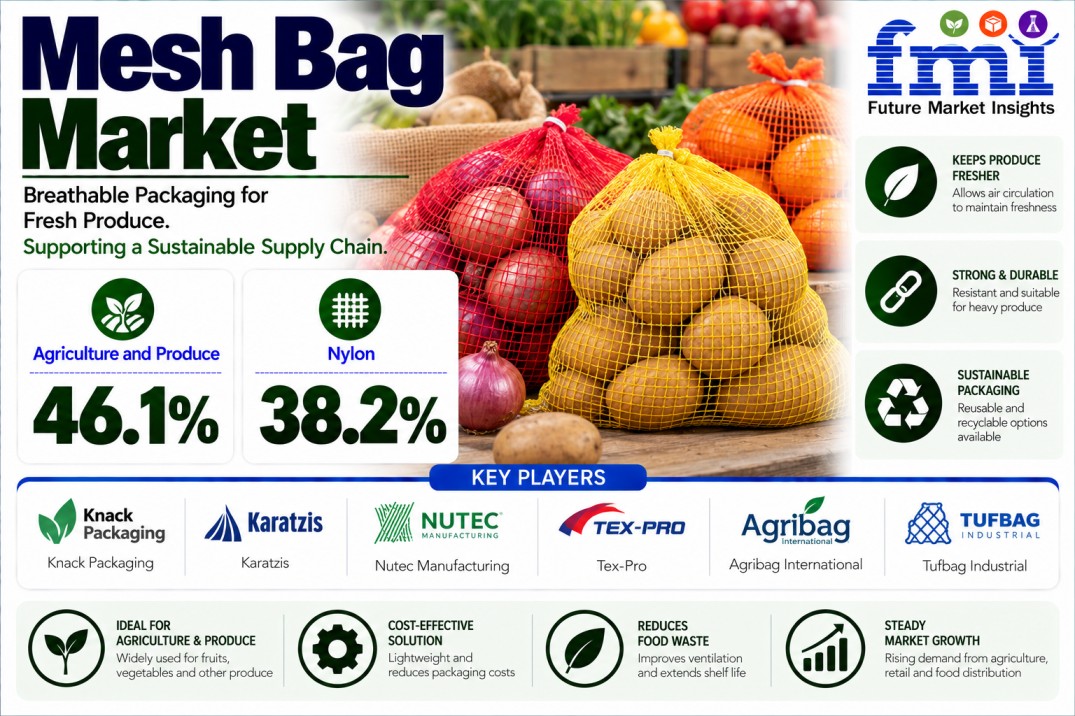
FMI expects nylon to account for 38.2% of the mesh bag market by material type in 2026. Its tensile strength and abrasion resistance make it suitable for applications requiring durability and repeated handling.
By application, Agriculture & Produce is projected to hold a 46.1% share in 2026. Fresh produce packers use mesh bags to support ventilation, product visibility and handling during distribution and retail display.
Other materials, including polyethylene and polypropylene, serve cost-sensitive retail and industrial packaging requirements. Cotton and other material formats also contribute to the market’s product diversity.
Fresh Produce Logistics and Reusable Packaging Drive Demand
Fresh produce logistics are an important growth driver. Mesh bags allow airflow and help reduce moisture buildup during handling and distribution. Their transparent structure also makes it easier to inspect packaged products, supporting their use across packing facilities and retail environments.
Reusable packaging programs are creating additional opportunities. Buyers increasingly evaluate seam strength, load tolerance and durability when selecting bags for repeated handling. Suppliers capable of delivering consistent product performance can strengthen relationships with agricultural packers, retailers and institutional buyers.
Automation is another important influence. Automated weighing, filling, labeling and tagging systems require mesh bags with consistent dimensions, closure placement and material behavior. Packaging manufacturers are therefore developing formats designed to reduce machine interruptions, improve filling accuracy and support stable production speeds.
Product Innovation and Industry Trends
Several developments are shaping the competitive landscape:
- Material performance: Manufacturers are prioritizing tensile strength, abrasion resistance and dimensional stability to improve product reliability.
- Application-specific designs: Different produce and industrial products require tailored mesh openings, bag sizes and load capacities.
- Automated filling compatibility: Consistent bag geometry and seam placement can improve integration with automated packaging equipment.
- Reusable formats: Stronger seams and improved durability can support multiple handling cycles and reduce packaging replacement requirements.
- Sustainable materials: Recyclable and biodegradable material development is creating opportunities for suppliers responding to environmental expectations.
For manufacturers, product development increasingly involves collaboration with packers and equipment suppliers to validate bag performance under actual operating conditions.
Regional Outlook: India Leads Country-Level Growth
FMI’s country-level forecasts identify India as the fastest-growing market, with a projected CAGR of 5.8% through 2036. Growth is supported by expanding retail and e-commerce activity, increasing use of reusable packaging and demand from agricultural and produce distribution operations.
Other country forecasts include:
- Vietnam: 5.5% CAGR, supported by fresh produce packaging and retail applications.
- China: 5.2% CAGR, driven by agricultural, industrial and urban logistics requirements.
- Brazil: 4.9% CAGR, reflecting demand across agricultural packaging and retail distribution.
- United States: 4.3% CAGR, supported by grocery, produce and industrial packaging applications.
These growth patterns highlight opportunities for suppliers to align their product portfolios with regional requirements. India and Vietnam offer potential for expansion through agricultural and retail packaging programs, while China and Brazil present opportunities across industrial and produce-handling applications.
Competitive Landscape: Top Players in the Mesh Bag Market
The global mesh bag market includes manufacturers serving agricultural packaging, retail distribution and industrial handling requirements. Competition is influenced by material quality, tensile strength, seam durability, customization capabilities and the ability to deliver consistent production volumes.
Companies identified in FMI’s report include:
- Knack Packaging Private Limited
- Karatzis S.A.
- Nutec Manufacturing, Inc.
- Tex-Pro Inc.
- Agribag International Ltd.
- Tufbag Industrial Co., Ltd.
- KB Poly Industries
- Vedder Industrial Ltd.
- Flexipol Packaging Limited
- Mega Plastic Industries
- Sagar Polypack
These companies participate in different areas of mesh bag manufacturing and supply. Their competitive positioning depends on their ability to meet application-specific requirements, maintain product consistency and support customers across agricultural, retail and industrial packaging programs.
Access Detailed Market Insights: https://www.futuremarketinsights.com/reports/mesh-bags-market
Business Priorities for Mesh Bag Manufacturers
The market outlook presents several opportunities for manufacturers and investors. Suppliers can prioritize product testing for tensile strength, seam integrity, load capacity and dimensional consistency. These performance factors are particularly important for customers operating high-volume packing lines.
Investment in automated production and quality screening can help manufacturers improve output consistency and reduce defects. Companies can also explore application-specific product portfolios for fresh produce, retail and industrial packaging rather than relying on a single standardized bag design.
Regional expansion is another strategic consideration. India’s projected growth offers opportunities to strengthen distribution networks and partnerships with agricultural packers and retailers. Suppliers targeting international markets should also evaluate local packaging requirements, customer specifications and supply-chain reliability.