

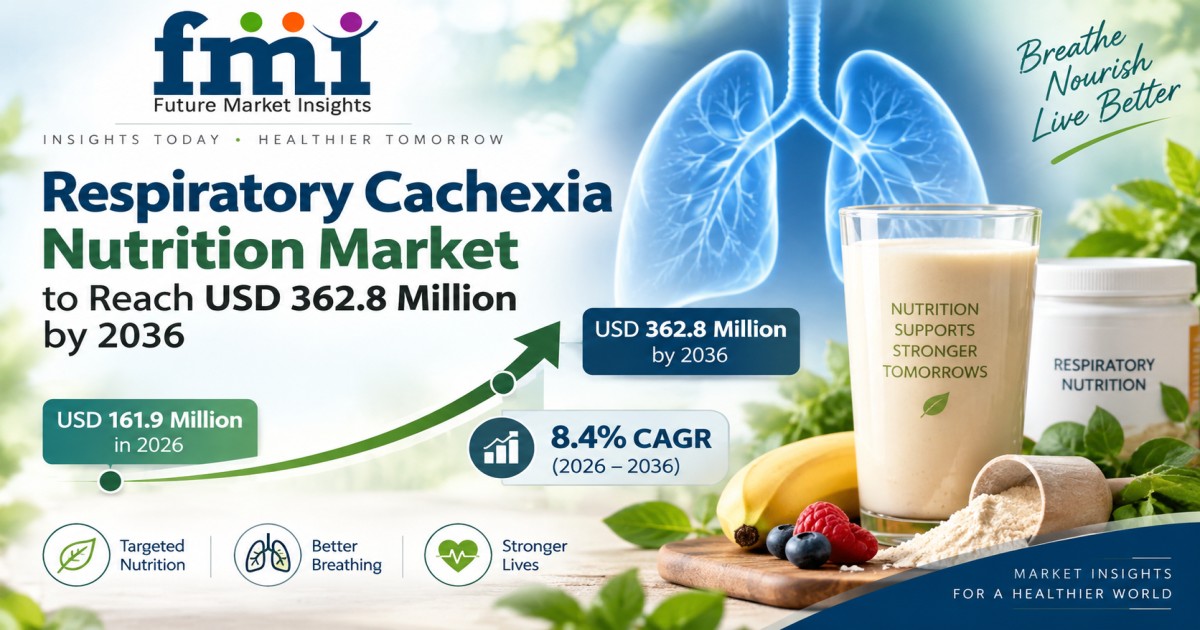
The global Respiratory Cachexia Nutrition Market is projected to grow from USD 161.9 million in 2026 to USD 362.8 million by 2036, advancing at an 8.4% CAGR during the forecast period, according to the latest research from Future Market Insights (FMI).
The market is being driven by pulmonology and clinical nutrition teams identifying involuntary weight loss, muscle wasting, and low BMI early in chronic pulmonary disease progression. Sizable investments across medical nutrition R&D such as specialized clinical innovation centers, concentrated high-protein formulations, and savory low-volume variants are establishing an efficient supply-side pathway to support patients, while structured screening guidelines (including GOLD 2026 and BAPEN protocols) accelerate formal nutrition interventions.
Get Detailed Market Forecasts, Competitive Benchmarking, and Pricing Trends:
https://www.futuremarketinsights.com/reports/sample/rep-gb-35302
Energy-dense low-volume oral nutritional supplements (ONS) are forecast to account for 49.5% of formulation demand in 2026. Severe breathlessness and early satiety make standard-volume clinical feeds difficult for patients to finish, making compact, calorie- and protein-dense servings essential to achieving daily nutritional targets without displacing regular meals.
By condition, advanced chronic obstructive pulmonary disease (COPD) is projected to capture 47.1% of market demand in 2026. Because respiratory muscle wasting and cachexia are clinically evident during routine COPD reviews, dietitians can link targeted supplementation directly to longitudinal weight monitoring and exacerbation history.
Ready-to-drink (RTD) formats are expected to lead the product form category with a 42.7% share in 2026. Pre-measured liquid servings remove powder mixing, reconstitution, and measurement friction for fatigued patients already managing complex daily inhaler and medication regimens.
Homecare Settings and Hospital Pharmacies Drive Repeat Procurement
Commercial adoption depends on bridging acute inpatient stabilization with sustained outpatient nutritional therapy. The homecare segment is estimated to represent 49.8% of end-user demand in 2026, as the majority of medical nutrition consumption occurs after hospital discharge under community care plans.
Hospital pharmacies lead the distribution channel category with a 47.3% share in 2026. Inpatient formulary inclusion during acute exacerbation admissions serves as the primary initiation point where dietitians assess cachexia risk and prescribe specific clinical formulas.
Adherence Fatigue and Reimbursement Disparities Restrain Market Conversion
Poor patient adherence and variable reimbursement criteria represent the primary commercial barriers to sustained market growth. Extended ONS regimens frequently suffer from taste fatigue, leading patients to discontinue nutritional support before achieving target weight or muscle restoration.
FMI highlights savory formulations and modular protein concentrates as major strategic openings. Compact high-protein cups (providing 20g of protein in small volumes) and savory, warm-soup formats offer practical alternatives to sweet dairy shakes, expanding daily compliance across geriatric and respiratory patient populations.
Regional Growth Driven by Clinical Guidelines and Aging Demographics
Adoption rates vary across major international markets, reflecting local screening practices, diagnostic rates, and public healthcare funding:
South Korea leads forecast expansion with an 8.9% CAGR, supported by a substantial underlying chronic respiratory disease burden, expanding multimorbidity management, and health authority initiatives addressing underdiagnosed COPD populations.
The USA follows at an 8.0% CAGR, driven by high diagnosed COPD prevalence in older adults and well-developed commercial medical nutrition distribution channels, even as oral products frequently rely on out-of-pocket or managed-care benefit designs.
In Europe, Germany is anticipated to advance at a 7.2% CAGR, guided by statutory health insurance evaluation concepts and strict medical necessity documentation for balanced enteral diets.
Competitive Landscape
The Respiratory Cachexia Nutrition Market features multinational clinical nutrition conglomerates alongside specialized modular medical food producers.
Key companies identified by FMI include Abbott Laboratories (PULMOCARE / Ensure), Nestlé Health Science, Nutricia (Danone), Fresenius Kabi, Meiji Co., Ltd. (Meiji Holdings), Medtrition, Inc., Megalabs USA, LLC, and B. Braun SE.
Competition centers on nutrient density per milliliter, flavor variety, clinical trial substantiation, and established hospital formulary distribution.
Recent industry developments cited in the report include Meiji launching its Meibalance Mini Cup HighPro series delivering 200 kcal in a compact 125 mL serving in September 2026, Danone acquiring Kate Farms in July 2025 to scale specialized clinical nutrition access across hospital and home channels, and Medtrition rolling out the ProSource Cup portfolio in March 2025 to provide concentrated protein in low-volume formats.
Analyst Perspective
“Respiratory cachexia nutrition should be evaluated by the amount a patient can consume each day, not by nutrient density alone. Commercial value follows once clinicians can start an appropriate formula and patients can obtain the same product consistently following discharge.” — Nandini Roy Choudhury, Principal Consultant, Future Market Insights
Read the full Respiratory Cachexia Nutrition Market report:
Future Market Insights – https://www.futuremarketinsights.com/reports/respiratory-cachexia-nutrition-market
Report Scope
FMI’s Respiratory Cachexia Nutrition Market study covers formulation (energy-dense low-volume ONS, omega-3 – EPA-enriched blends, leucine – HMB anti-catabolic products, others), condition (advanced COPD, ILD & pulmonary fibrosis, bronchiectasis, other respiratory conditions), product form (RTD, powders, puddings & semi-solids, others), end user (homecare, hospitals, long-term care, others), sales channel (hospital pharmacy, retail pharmacy, online, institutional tender, others), and region.
Explore More Related Studies Published by FMI
Enteral Nutrition Market: https://www.futuremarketinsights.com/reports/enteral-nutrition-market
Low-Glycemic Clinical Beverage Market: https://www.futuremarketinsights.com/reports/low-glycemic-clinical-beverage-market
About Future Market Insights (FMI)
Future Market Insights (FMI) delivers actionable, decision-focused market intelligence that goes beyond traditional research reports.
The company provides:
- In-depth pricing and cost benchmarking analysis
- Demand forecasting based on real industry inputs
- Procurement and buyer behavior insights
- Supply chain and trade flow intelligence
- Technology and application trend analysis across industries
FMI follows a robust bottom-up research methodology, combining insights from industry experts, procurement leaders, manufacturers, and technical professionals to ensure accurate and practical market intelligence.
For Press & Corporate Inquiries
Rahul Singh AVP – Marketing and Growth Strategy
Future Market Insights, Inc.
+91 8600020075
For Sales – sales@futuremarketinsights.com
For Media – Rahul.singh@futuremarketinsights.com
For Web – https://www.futuremarketinsights.com/