


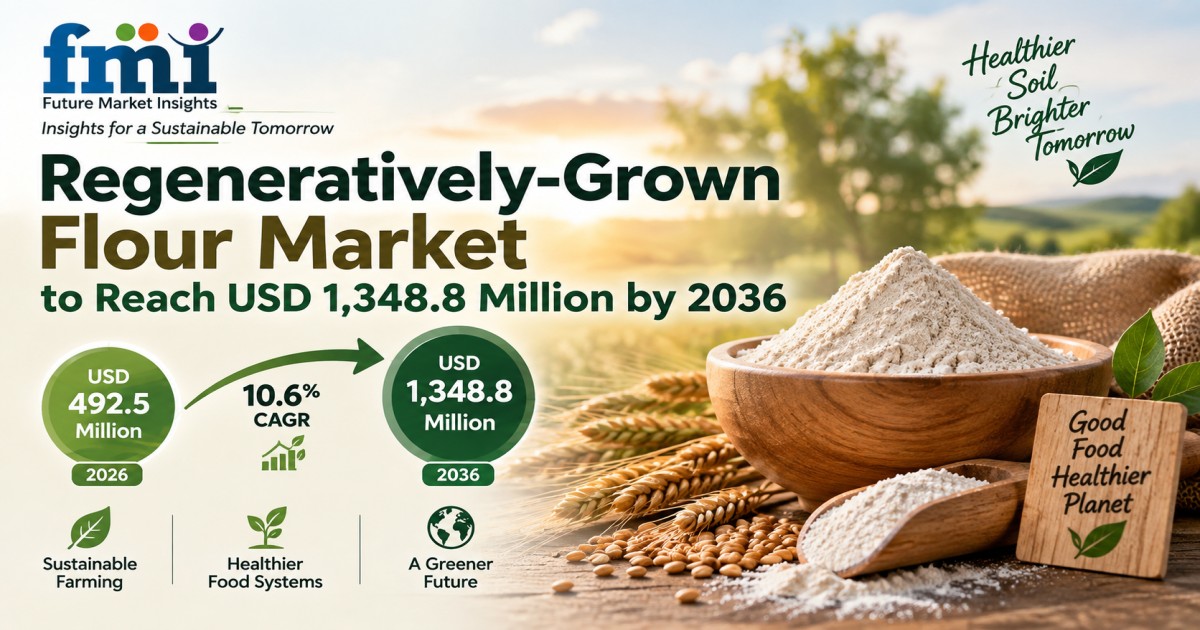
The global Regeneratively-Grown Flour Market is projected to grow from USD 492.5 million in 2026 to USD 1,348.8 million by 2036, advancing at a 10.6% CAGR during the forecast period, according to the latest research from Future Market Insights (FMI).
The market is driven by commercial food processors and industrial bakeries incorporating farm-level environmental targets directly into routine ingredient procurement. Sizable investments across grain origination, grower-contracting programs, and specialized milling infrastructure—such as multi-million-acre regenerative grower networks and identity-preserved cleaning facilities—are establishing an efficient supply-side route for verified wheat, while expanding corporate scope-3 carbon reduction commitments accelerate long-term contracted volume commitments.
Get Detailed Market Forecasts, Competitive Benchmarking, and Pricing Trends:
https://www.futuremarketinsights.com/reports/sample/rep-gb-35300
Standard milling grade is forecast to account for 38.0% of grade demand in 2026. Its baseline flour profile fits established commercial bread and roll formulas, enabling industrial mills to blend verified regenerative wheat pools without altering customer absorption tolerances or requiring modifications to bakery plant lines.
By form, powder – dry is expected to lead the market with a 48.0% share in 2026. Ambient dry flour integrates seamlessly into existing pneumatic handling systems, bulk storage silos, and automated metering infrastructure, allowing commercial bakeries to transition to regenerative wheat without costly machinery overhauls.
Conventional claims are projected to capture 51.0% share in 2026. By treating regenerative agriculture as a farm-practice sourcing attribute rather than an extra layer of organic certification, food processors secure broader access to transitioning wheat acreage while maintaining standard lot-level traceability and bakery flour specifications.
Bread and Roll Formulations Create Repeat-Purchase Commitments
Commercial demand is concentrated in staple bakery categories where high-volume flour replenishment occurs on continuous production schedules. The bread & rolls segment is expected to lead application demand with a 35.0% share in 2026, serving as the benchmark sector where protein strength, water absorption, and fermentation performance must remain consistent across multi-ton production runs.
Direct sales to industrial bakeries are estimated to represent 50.0% of distribution channel share in 2026. Large bakery enterprises require direct technical coordination, joint plant baking trials, and audited origin files before approving multi-season commercial grain supply contracts.
Grain Segregation and Assurance Disparities Govern Technical Qualification
Supply chain segregation and variable verification frameworks represent the primary operational hurdles for market participants. Because commercial bakeries evaluate flour primarily on protein content, falling number, and dough rheology, an environmental claim cannot compensate for baking inconsistency on high-speed automated lines.
FMI highlights bundled technical and sourcing dossiers as a primary commercial opportunity. Millers that pair accredited farm-practice records with standard Certificates of Analysis (CoA) allow brand owners to substantiate sustainability claims without adding administrative delays to routine ingredient qualification.
Regional Growth Driven by Agricultural Policy and Import Realities
Adoption rates vary across major international markets, reflecting local milling structures, grain import dependencies, and national farm-support programs:
Saudi Arabia leads forecast expansion with an 11.8% CAGR, supported by centralized wheat purchasing through GFSA international tenders and long-term food security programs. The UAE follows at an 11.4% CAGR, driven by port-based milling operations and trade hubs managing imported grain segregation.
In North America, the USA is forecast at a 10.8% CAGR, benefiting from extensive domestic grower enrollment programs that allow mills to contract verified wheat acreage close to processing plants.
Competitive Landscape
The Regeneratively-Grown Flour Market features integrated agribusiness corporations, specialized regional flour milling platforms, and consumer-facing baking brands.
Key companies identified by FMI include Ardent Mills, ADM, Bay State Milling, Limagrain Ingredients, GoodMills Group, King Arthur Baking Company, Bob’s Red Mill, Doves Farm, Manildra Group, and Scoular.
Competition centers on grower enrollment scale, verified grain segregation, technical bakery application support, and multi-region supply continuity.
Recent industry developments cited in the report include Ardent Mills acquiring Stone Mill in North Dakota in July 2025 to scale identity-preserved grain processing, ADM partnering with PepsiCo and Mars in September 2025 to enroll farmers across Poland into regenerative agriculture programs, and GoodMills Group investing €25 million to double capacity at its Kutno mill in Poland in June 2025.
Analyst Perspective
“Regeneratively-grown flour earns repeat orders when farm records stay linked to wheat lots that still meet bakery protein and absorption targets. Millers therefore compete on grain segregation and bake-test consistency because an origin claim cannot compensate for dough variation on commercial lines.” — Nandini Roy Choudhury, Principal Consultant, Future Market Insights
Read the full Regeneratively-Grown Flour Market report:
Future Market Insights – https://www.futuremarketinsights.com/reports/regeneratively-grown-flour-market
Report Scope
FMI’s Regeneratively-Grown Flour Market study covers grade (standard milling grade, fine – patisserie grade, organic certified, identity-preserved specialty), form (powder – dry, liquid, paste – semi-solid, granules – pieces), application (bread & rolls, cakes & muffins, biscuits & cookies, viennoiserie & pastry, other bakery & snacks), claim (conventional, clean label, organic, non-GMO – identity preserved), sales channel (direct to industrial bakeries, ingredient distributors, foodservice & artisan supply, online B2B), and region. The study assesses commercial flour sold with documented regenerative sourcing across North America, Latin America, Western Europe, Eastern Europe, East Asia, South Asia and Pacific, and the Middle East and Africa.
Explore More Related Studies Published by FMI
Flour Mixes Market: https://www.futuremarketinsights.com/reports/flour-mixes-market
Flour Substitutes Market: https://www.futuremarketinsights.com/reports/flour-substitutes-market
Bakery Improvers Market: https://www.futuremarketinsights.com/reports/bakery-improvers-market
About Future Market Insights (FMI)
Future Market Insights (FMI) delivers actionable, decision-focused market intelligence that goes beyond traditional research reports.
The company provides:
- In-depth pricing and cost benchmarking analysis
- Demand forecasting based on real industry inputs
- Procurement and buyer behavior insights
- Supply chain and trade flow intelligence
- Technology and application trend analysis across industries
FMI follows a robust bottom-up research methodology, combining insights from industry experts, procurement leaders, manufacturers, and technical professionals to ensure accurate and practical market intelligence.
For Press & Corporate Inquiries
Rahul Singh AVP – Marketing and Growth Strategy
Future Market Insights, Inc.
+91 8600020075
For Sales – sales@futuremarketinsights.com
For Media – Rahul.singh@futuremarketinsights.com
For Web – https://www.futuremarketinsights.com/