


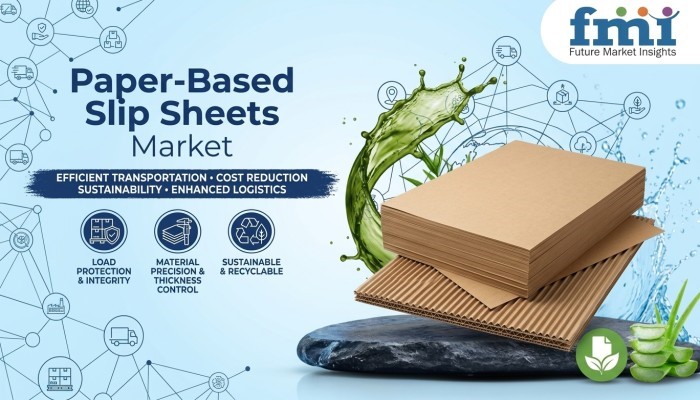
The global Paper-Based Slip Sheets Market is projected to reach USD 948.0 million by 2036, rising from USD 598.9 million in 2026 at a 4.7% CAGR, according to the latest market analysis by Future Market Insights (FMI). Demand is being shaped by distribution operators evaluating lighter load platforms for stable one-way shipments where pallet weight, empty-platform storage, and container utilization affect lane economics.
Paper-based slip sheets can reduce the material associated with conventional pallet platforms, but conversion depends on more than sheet cost. Receiving facilities need compatible push-pull equipment, suitable tab geometry, and trained operators before a lighter platform can deliver consistent freight and handling savings.
Lightweight Load Platforms Put Freight Economics Under Review
The clearest application case is found in stable export and distribution loads where the shipment itself does not require a reusable pallet platform. Signode connected this operating case to slip sheets in June 2025, describing them as export-ready pallet alternatives that can reduce material use and maximize container space.
That proposition is particularly relevant to high-volume distribution networks. Storage density and repeat handling costs become easier to measure when large numbers of similar loads move through established lanes.
Yet receiver capability remains a practical qualification point. A shipper may remove pallet weight, but the expected saving can narrow if the destination needs additional handling because it cannot unload the scored sheet reliably.
Get detailed market forecasts, competitive benchmarking, and pricing trends:
https://www.futuremarketinsights.com/reports/sample/rep-gb-34696
Kraft Paperboard and Single-Lip Designs Shape the Market
Material selection remains closely tied to load weight and handling requirements. Kraft paperboard is projected to account for 50.0% of the market in 2026, supported by its tensile strength and strength-to-thickness balance across thin load platforms.
Badger Paperboard described solid-fiber push-pull sheets in April 2025 as virgin kraft linerboard constructions that can incorporate laminated plies for additional strength. Packaging engineers can adjust basis weight and ply count according to load mass while retaining the established receiving method.
The single-lip segment is projected to hold 33.0% share in 2026. Its single scored grip edge supports a repeatable push-pull sequence on lanes where equipment approaches from a fixed direction.
Tab geometry can become a functional issue in automated environments. Badger Paperboard reported in January 2025 that torn tabs and multi-pick errors can interrupt automated push-pull or palletizer workflows, making sheet design part of equipment qualification.
Uncoated Sheets Lead Where Route Conditions Allow
Uncoated paper-based slip sheets are expected to account for 37.0% of the coating category in 2026. Dry indoor routes can avoid additional surface treatment when board strength and load containment provide sufficient performance.
Coated structures become more relevant when humidity, smooth cartons, or load movement creates a defined route risk. Badger Paperboard reported in October 2025 that its milling operations test paperboard on its own equipment and consider moisture exposure when evaluating shipment protection.
The opportunity for converters is therefore tied to route-specific engineering rather than coating adoption alone. Material documentation and exposure testing can help packaging teams qualify the right construction for individual lanes.
Direct and OEM Supply Supports Initial Qualification
Direct or OEM supply is forecast to lead the sales channel category with 40.0% share in 2026. The channel’s role reflects the specification work involved in matching board thickness, sheet dimensions, lip geometry, and handling equipment at shipping and receiving points.
Badger Paperboard reported in August 2025 that its team uses on-site visits to tailor solid-fiber push-pull sheets by thickness and size. Such technical interaction can reduce rework during early transport-packaging trials before recurring contract supply begins.
Country Growth Rates Remain Within a Narrow Band
The market shows different conversion conditions across major countries despite a relatively compact forecast range.
Brazil is forecast to expand at 5.0% CAGR, supported by export routes where lower tare weight can improve container utilization. The United Kingdom follows at 4.4%, while the United States is projected at 4.2%. Germany and Japan are forecast at 4.0% and 3.6%, respectively.
Country conditions vary. Brazil faces maritime moisture exposure and receiver-readiness considerations, while Germany combines recovered-paper availability with automated warehouse requirements. Japan’s standardized logistics workflows can preserve conventional pallet practices unless push-pull trials demonstrate comparable handling discipline.
Analyst Perspective
“Paper-based slip-sheet qualification starts at the receiving dock because a lighter sheet produces no saving if the destination cannot unload its scored tab reliably. Strong offers match load weight and lip geometry to receiver equipment before adding moisture protection or forecasting recurring sheet volume.”
Nandini Roy Choudhury, Principal Consultant, Future Market Insights
Competitive Landscape
The competitive environment includes global load-handling and industrial packaging providers alongside specialist paperboard converters. Notable companies identified in the report include Signode, Nefab Group, Badger Paperboard, Dura-Fibre, Hammond Paper, Southern States Packaging Company, Novapak Paper Products, and Marvatex, Inc.
Recent developments include Nefab Group’s acquisition of Vallos s.r.o. in Slovakia in April 2026, Signode’s September 2025 launch of the Octopus Prestige stretch wrapper, and Nefab’s opening of a 150,000-square-foot Southeast Hub in Braselton, Georgia, in September 2025.
Paper-Based Slip Sheets Market Report Scope
The report covers the market by material, lip configuration, coating, load capacity, end use, sales channel, and region. The assessment includes North America, Latin America, Europe, East Asia, South Asia and Pacific, and the Middle East and Africa, with country-level analysis for Brazil, the United Kingdom, the United States, Germany, Japan, and more than 20 countries overall.
The study uses primary and secondary research, market triangulation, company activity, trade indicators, regulatory developments, and country-level demand conditions to develop its estimates.
Related Reports Link:
https://plaza.rakuten.co.jp/fmiinsightd/diary/202609180005/
https://plaza.rakuten.co.jp/fmiinsightd/diary/202609180006/
FMI Custom Research: Strategic Intelligence for Confident Decision-Making
In today’s rapidly evolving business environment, leadership teams need more than market data—they need clear, actionable intelligence tailored to their strategic objectives. FMI’s Custom Research solutions are designed around the specific business questions organizations need answered, enabling executives to evaluate growth opportunities, validate investments, assess competitive dynamics, and reduce uncertainty before making critical decisions. By combining deep industry expertise, primary research, and proprietary market intelligence, FMI delivers insights that help organizations move from assumptions to evidence-based strategies with greater speed and confidence.
FMI Custom Research: Strategic Intelligence for Confident Decision-Making
In today’s rapidly evolving business environment, leadership teams need more than market data—they need clear, actionable intelligence tailored to their strategic objectives. FMI’s Custom Research solutions are designed around the specific business questions organizations need answered, enabling executives to evaluate growth opportunities, validate investments, assess competitive dynamics, and reduce uncertainty before making critical decisions. By combining deep industry expertise, primary research, and proprietary market intelligence, FMI delivers insights that help organizations move from assumptions to evidence-based strategies with greater speed and confidence.
About Future Market Insights (FMI)
Future Market Insights, Inc. (FMI) is an ESOMAR-certified, ISO 9001:2015 market research and consulting organization, trusted by Fortune 500 clients and global enterprises. With operations in the U.S., UK, India, and Dubai, FMI provides data-backed insights and strategic intelligence across 30+ industries and 1200 markets worldwide.
Contact Us:
Future Market Insights Inc.
Christiana Corporate, 200 Continental Drive,
Suite 401, Newark, Delaware – 19713, USA
T: +1-347-918-3531
For Sales Enquiries: sales@futuremarketinsights.com
Website: https://www.futuremarketinsights.com
LinkedIn| Twitter| Blogs | YouTube