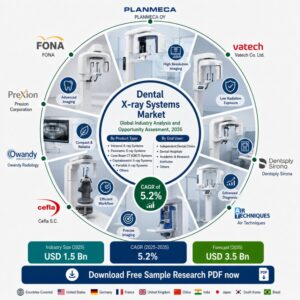


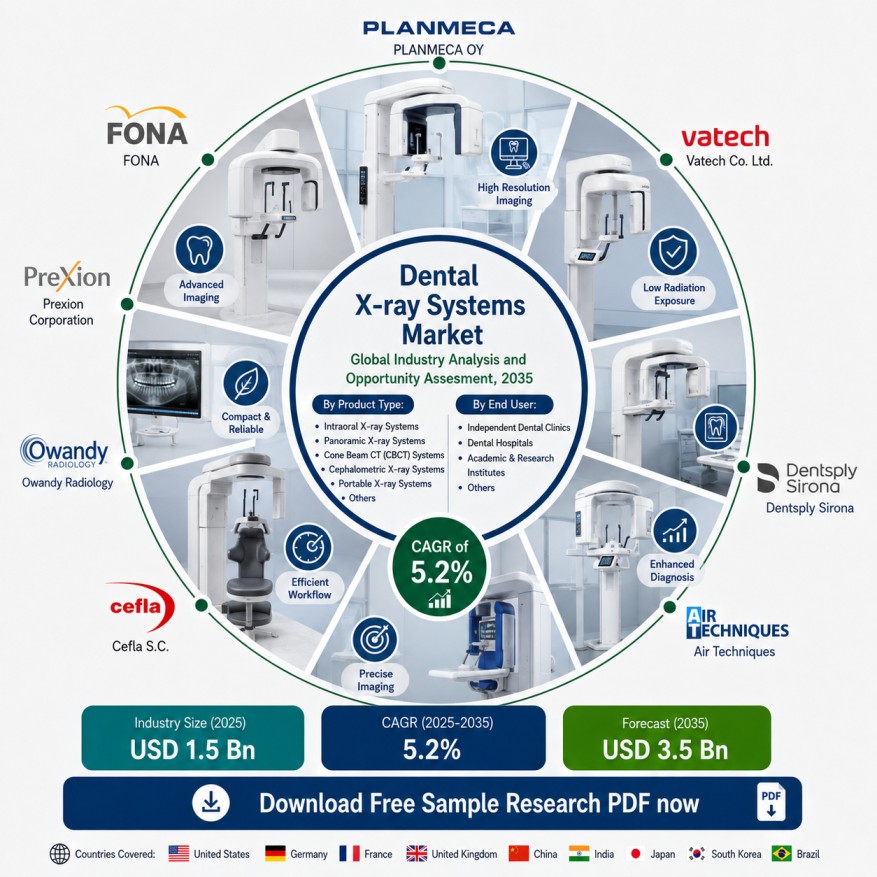
The global Dental X-Ray Systems Market is expanding as dental practices increasingly adopt digital imaging technologies for preventive diagnosis, treatment planning, implant procedures, and broader oral healthcare applications. According to Future Market Insights (FMI), the market is projected to grow from USD 1.5 billion in 2026 to USD 3.5 billion by 2036, registering an 8.8% CAGR during the forecast period.
Growth is being supported by increasing awareness of preventive dental care, wider adoption of digital imaging, demand for faster diagnostic workflows, and growing use of advanced imaging for cosmetic dentistry and implant procedures. Dental clinics are increasingly replacing conventional systems with digital platforms that can improve image acquisition and support more efficient clinical decision-making.
The market is expected to create an absolute dollar opportunity of approximately USD 2.0 billion between 2026 and 2036. Adoption will increasingly depend on image quality, radiation efficiency, system affordability, workflow integration, portability, software capabilities, and the ability of dental practices to modernize imaging infrastructure without significantly disrupting clinical operations.
Get Detailed Market Forecasts, Competitive Benchmarking, and Pricing Trends
Key Dental X-Ray Systems Market Highlights at a Glance
- Market Size (2026): USD 1.5 Billion
- Forecast Market Size (2036): USD 3.5 Billion
- Forecast Period: 2026–2036
- CAGR (2026–2036): 8.8%
- Absolute Dollar Opportunity: Approximately USD 2.0 Billion
- Leading Product Type: Panoramic X-Ray Systems (42.0% Share in 2026)
- Leading End User: Independent Dental Clinics (47.0% Share in 2026)
- Key Growth Areas: North America, Europe, and Asia Pacific
- Fast-Growing Countries: India and China
- Key Growth Drivers: Preventive Dental Care, Digital Imaging, Cosmetic Dentistry, and Advanced Treatment Planning
- Key Segments Covered: Product Type, End User, Application, and Region
Analyst Viewpoint
“The dental X-ray systems market is moving toward digital and clinic-friendly imaging platforms that support faster diagnosis and more efficient treatment planning. Panoramic X-ray systems retain an important position because dentists require broad diagnostic coverage while improving workflow speed and managing radiation exposure. Future adoption will increasingly depend on compact system design, software integration, affordability, and compatibility with modern digital dental workflows.”
Why Is the Dental X-Ray Systems Market Growing?
The increasing emphasis on preventive dental care is creating sustained demand for diagnostic imaging systems capable of identifying oral diseases at earlier stages.
Dental X-ray systems allow clinicians to assess structures that cannot be fully evaluated through visual examination alone. Imaging is routinely relevant to diagnosis, treatment planning, restorative procedures, implants, orthodontics, and other dental interventions.
The transition from film-based imaging toward digital workflows is another important growth driver. Digital systems can provide faster image acquisition and facilitate electronic storage, retrieval, and sharing across dental practices.
Growing investment in cosmetic dentistry is also encouraging clinics to adopt more precise imaging technologies for implant planning, aesthetic procedures, and other treatments requiring detailed anatomical assessment.
Key Growth Drivers
- Increasing focus on preventive dental care.
- Rising demand for early oral disease detection.
- Growing adoption of digital dental imaging.
- Increasing demand for faster diagnostic workflows.
- Expansion of cosmetic dentistry.
- Rising use of dental implants.
- Increasing dental clinic modernization.
- Growing adoption of portable X-ray systems.
- Advances in 3D dental imaging.
- Integration with CAD/CAM and digital treatment-planning systems.
The combination of preventive care and digitalization is expected to sustain demand for advanced dental imaging systems through 2036.
Why Do Panoramic X-Ray Systems Lead Product Demand?
Panoramic X-ray systems are projected to account for 42.0% of product-type demand in 2026, making them the leading product category.
Panoramic systems provide broad imaging coverage of the teeth, jaws, and surrounding structures, making them useful across a wide range of diagnostic and treatment-planning applications.
Their ability to capture a comprehensive view through a single examination supports efficient clinical workflows. Dental practices can use panoramic imaging for treatment planning, orthodontic assessment, implant evaluation, and broader oral diagnostics.
As clinics increasingly prioritize workflow efficiency and comprehensive imaging, panoramic systems are expected to maintain their leading position.
Why Do Independent Dental Clinics Dominate End-User Demand?
Independent dental clinics are projected to account for 47.0% of end-user demand in 2026.
Independent practices represent a significant portion of the dental-care delivery infrastructure and increasingly invest in compact digital imaging systems that can support high-volume clinical workflows.
Modern dental X-ray equipment can allow independent practices to provide diagnostic imaging without relying as heavily on external imaging facilities.
The growing availability of compact and portable systems may further support adoption among smaller practices operating under space and capital constraints.
How Are Digital X-Ray Systems Transforming Dental Imaging?
Digital dental X-ray systems are replacing traditional film-based workflows with faster electronic image acquisition and storage.
Digital imaging can allow clinicians to access diagnostic images more quickly and share them across treatment teams. Integration with dental practice-management software and electronic patient records can further streamline clinical workflows.
Radiation efficiency is another important consideration. Dental practices increasingly evaluate imaging systems based on their ability to provide diagnostically useful images while managing patient radiation exposure.
What Are the Latest Technology and Innovation Trends?
Innovation continues reshaping the dental X-ray systems industry.
Major trends include:
- Expansion of digital dental radiography.
- Increasing adoption of panoramic X-ray systems.
- Growth of portable intraoral X-ray systems.
- Development of advanced 3D imaging.
- Greater integration with CAD/CAM workflows.
- Increasing use of digital treatment planning.
- Improvements in image quality and resolution.
- Development of compact clinic-friendly systems.
- Greater emphasis on radiation-dose management.
- Increasing software integration with dental practice platforms.
Three-dimensional imaging is particularly relevant to implant planning and complex dental procedures, while portable systems can provide greater flexibility for smaller practices and specialized clinical environments.
What Are the Key Market Challenges and Restraints?
Despite strong growth prospects, equipment costs and technology integration requirements can restrict adoption.
Dental practices must evaluate equipment prices alongside installation, maintenance, software, training, and replacement costs.
Smaller clinics may find advanced imaging platforms difficult to justify without sufficient patient volumes. Portable and compact systems can address some of these limitations, but image requirements and clinical applications vary by practice.
Integration with existing dental software and practice-management systems can also create implementation challenges. Clinics increasingly require imaging equipment that can connect smoothly with existing digital workflows.
What Is the Regional Outlook?
- Asia Pacific represents an important growth opportunity for dental X-ray systems.
- India is expected to lead country-level growth as dental-care access improves, private clinic networks expand, and awareness of preventive oral healthcare increases.
- China is also expected to record strong market expansion as urban and rural dental infrastructure develops and healthcare providers increase investment in modern diagnostic equipment.
- North America and Europe remain important markets due to established dental-care systems, high technology adoption, and continued replacement of conventional imaging equipment.
- Key markets include the United States, Germany, France, the United Kingdom, China, India, Japan, South Korea, and Brazil.
What Is the Competitive Landscape?
Competition is increasingly focused on digital image quality, system compactness, software integration, portability, radiation efficiency, and overall workflow performance.
Manufacturers are strengthening their positions through panoramic imaging systems, intraoral equipment, 3D imaging technologies, digital software, compact platforms, and integrated dental solutions.
Key Companies
- FONA
- PLANMECA OY
- Prexion Corporation
- Owandy Radiology
- Vatech Co. Ltd.
- Yoshida Dental Mfg.
- Dentsply Sirona
- LED Medical Diagnostics
- Cefla S.C.
- Air Techniques
- Danaher Corporation
These companies compete through digital radiography systems, panoramic imaging, 3D technologies, portable X-ray solutions, software integration, and broader dental diagnostic portfolios.
Frequently Asked Questions
- What is the projected size of the Dental X-Ray Systems Market by 2036? The global market is projected to reach USD 3.5 billion by 2036, increasing from USD 1.5 billion in 2026.
- What is the expected CAGR of the Dental X-Ray Systems Market? The market is forecast to expand at an 8.8% CAGR between 2026 and 2036.
- Which product type dominates the market? Panoramic X-ray systems are projected to lead the product segment with a 42.0% share in 2026.
- Which end-user segment dominates the market? Independent dental clinics are projected to account for 47.0% of end-user demand in 2026.
- What is driving demand for dental X-ray systems? Preventive dental care, digital imaging adoption, cosmetic dentistry, dental implant procedures, faster diagnosis, and modernization of dental clinics are driving market growth.
- Which countries are expected to show strong growth? India and China are expected to be important growth markets as dental-care access and imaging infrastructure expand.
- What are the major technology trends in the market? Digital radiography, panoramic imaging, portable intraoral systems, 3D imaging, CAD/CAM integration, and digital treatment planning are among the major technology trends.
Related Reports
- The X-ray system market is expected to expand from USD 12.6 billion in 2026 to USD 17.8 billion by 2036. The market is anticipated to register a 3.5% CAGR during the forecast period.
- The X-Ray Device Market is projected to reach USD 29.2 billion by 2035, registering a compound annual growth rate (CAGR) of 7.5% over the forecast period.
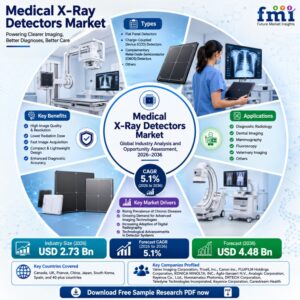
- The medical X-ray detectors market is projected to reach USD 2.73 billion in 2026, and is forecast to expand to USD 4.48 billion by 2036 at a 5.1% CAGR.
About Future Market Insights (FMI)
Future Market Insights (FMI) is a global market intelligence and consulting firm providing comprehensive market research, competitive intelligence, and strategic business insights across industries. The firm delivers detailed forecasts, technology analysis, and data-driven recommendations that support informed decision-making for manufacturers, investors, distributors, and policymakers worldwide.
For Press & Corporate Inquiries
Rahul Singh
AVP – Marketing and Growth Strategy
Future Market Insights, Inc.
+91 8600020075
For Sales – sales@futuremarketinsights.com
For Media – Rahul.singh@futuremarketinsights.com
For Web – https://www.futuremarketinsights.com