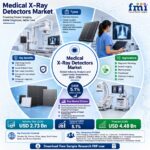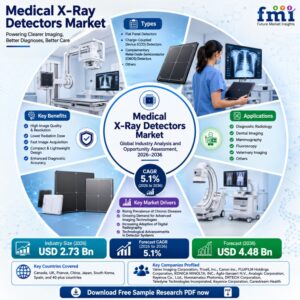


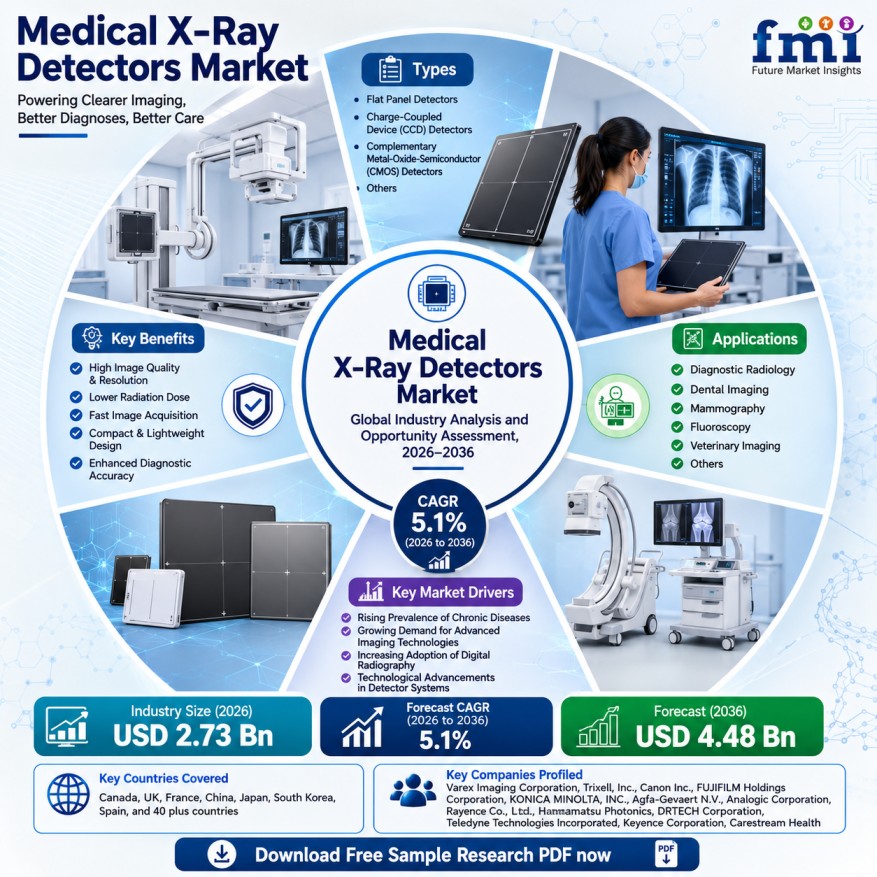
The global Medical X-Ray Detectors Market is expanding as healthcare systems transition from conventional computed radiography and cassette-based workflows toward flat-panel digital detector technologies. According to Future Market Insights (FMI), the market was valued at USD 2.59 billion in 2025, is projected to reach USD 2.73 billion in 2026, and is forecast to expand to USD 4.48 billion by 2036, registering a 5.1% CAGR during the forecast period.
Growth is being supported by the replacement of legacy imaging equipment, demand for faster image acquisition, improvements in diagnostic workflow efficiency, and the need to reduce radiation exposure where digital detector technologies can provide dose-efficient imaging.
The market is expected to generate a cumulative incremental opportunity of approximately USD 1.76 billion between 2026 and 2036. Adoption will increasingly depend on detector performance, image quality, dose efficiency, system compatibility, retrofit economics, equipment longevity, and the ability of healthcare providers to modernize imaging infrastructure without replacing entire X-ray systems.
👉 Get Detailed Market Forecasts, Competitive Benchmarking, and Pricing Trends
Key Medical X-Ray Detectors Market Highlights at a Glance
- Market Size (2025): USD 2.59 Billion
- Market Size (2026): USD 2.73 Billion
- Forecast Market Size (2036): USD 4.48 Billion
- Forecast Period: 2026–2036
- CAGR (2026–2036): 5.1%
- Cumulative Incremental Opportunity: USD 1.76 Billion
- Leading Product: Direct Flat-Panel Detectors (39.7% Share in 2026)
- Leading Panel Size: Large-Area Flat-Panel Detectors (68.5% Share in 2026)
- Fastest-Growing Country: China (5.3% CAGR)
- Key Growth Areas: China, South Korea, Spain, Canada, France, Japan, and the UK
- Key Segments Covered: Product, Panel Size, Application, End User, and Region
Analyst Viewpoint
“The medical X-ray detector market is increasingly shaped by replacement economics rather than imaging demand alone. Healthcare providers are assessing whether flat-panel detectors can improve acquisition speed, dose efficiency, image quality, and workflow productivity while preserving existing X-ray infrastructure. Retrofit solutions are particularly relevant for cost-conscious facilities because they can modernize legacy rooms without requiring complete equipment replacement. Future adoption will depend on detector reliability, interoperability, lifecycle economics, and the ability to demonstrate measurable workflow improvements.”
Why Is the Medical X-Ray Detectors Market Growing?
The transition from computed radiography to digital flat-panel detectors represents one of the most important structural changes affecting the medical X-ray detectors market.
Traditional cassette-based workflows can require additional processing steps before images become available for clinical review. Flat-panel digital detectors capture images electronically, supporting faster acquisition and more streamlined diagnostic workflows.
Healthcare providers are also evaluating detector technologies based on radiation-dose efficiency, image quality, operational productivity, and total cost of ownership.
Retrofit detector modules are expanding the addressable market by allowing healthcare facilities to digitize existing analog X-ray rooms without replacing the complete imaging system. This approach can be particularly relevant for facilities operating under constrained capital budgets.
Key Growth Drivers
- Transition from computed radiography to flat-panel digital detectors.
- Demand for faster image acquisition.
- Increasing focus on dose-efficient diagnostic imaging.
- Replacement of aging X-ray equipment.
- Growing need for improved workflow productivity.
- Demand for higher-resolution medical images.
- Expansion of digital radiography infrastructure.
- Increasing adoption of retrofit detector solutions.
- Modernization of hospital imaging departments.
- Reduction in operating costs associated with cassette-based workflows.
The combination of technological modernization and replacement demand is expected to sustain market expansion through 2036.
Why Do Direct Flat-Panel Detectors Lead Product Demand?
Direct Flat-Panel Detectors are projected to account for 39.7% of product demand in 2026, making them the leading product category.
These detectors are increasingly selected for diagnostic applications requiring efficient digital image acquisition and strong spatial resolution.
Their ability to support streamlined workflows makes them attractive to healthcare facilities upgrading from older radiography technologies.
Product selection, however, depends on more than image quality. Hospitals and diagnostic centers also evaluate detector durability, compatibility with existing systems, wireless functionality, service requirements, and lifecycle costs.
Why Do Large-Area Flat-Panel Detectors Dominate Panel Size?
Large-Area Flat-Panel Detectors are estimated to account for 68.5% of panel-size demand in 2026.
Large-area detectors can support broader anatomical coverage and are particularly relevant for general radiography applications where a larger imaging field is required.
Their widespread use across hospitals and diagnostic facilities contributes to their leading position. As healthcare systems modernize radiography departments, large-area digital detectors remain an important replacement category.
How Are Flat-Panel Detectors Transforming Medical Imaging?
Flat-panel detectors are changing X-ray workflows by enabling direct digital image acquisition and reducing reliance on cassette-based image processing.
Digital images can become available more rapidly for interpretation, potentially reducing examination turnaround time. Integration with hospital information systems and picture archiving and communication systems can further improve image accessibility.
Dose efficiency is another important consideration. Healthcare providers increasingly evaluate detector sensitivity and image performance as part of broader efforts to optimize radiation exposure while maintaining diagnostic quality.
What Are the Latest Technology and Innovation Trends?
Innovation continues reshaping the medical X-ray detectors industry.
Major trends include:
- Expansion of direct flat-panel detector technologies.
- Increasing adoption of large-area detectors.
- Development of wireless digital detectors.
- Advances in image resolution.
- Improvements in detector sensitivity.
- Greater emphasis on dose efficiency.
- Expansion of retrofit detector solutions.
- Increasing interoperability with digital imaging systems.
- Development of lightweight and portable detector designs.
- Increasing integration with automated radiography workflows.
Retrofit technologies are particularly significant because they allow facilities to modernize existing X-ray rooms while limiting the capital expenditure associated with complete system replacement.
What Are the Key Market Challenges and Restraints?
Despite growing digitalization, high equipment costs and replacement-cycle considerations can constrain adoption.
Healthcare facilities must evaluate detector prices alongside installation expenses, software compatibility, maintenance, calibration, and training requirements.
Interoperability can also create challenges when new detector technologies are introduced into older imaging infrastructure. Facilities may require additional hardware or software to integrate detectors with existing radiography systems and hospital information platforms.
Cost considerations are particularly relevant in emerging markets where healthcare providers may prioritize incremental upgrades rather than complete imaging-system replacement.
What Is the Regional Outlook?
- China is expected to lead among the key countries, recording a 3% CAGR through 2036. Expansion of healthcare infrastructure and continued modernization of diagnostic imaging capabilities are supporting demand.
- South Korea is projected to grow at 1% CAGR, while Spain is expected to record a 3.0% CAGR.
- Other important markets include Canada at 2.8% CAGR, France at 2.7%, Japan at 2.2%, and the United Kingdom at 1.9%.
- Regional adoption will depend on hospital modernization programs, equipment replacement cycles, healthcare expenditure, reimbursement environments, technology availability, and the economics of retrofitting existing X-ray rooms.
What Is the Competitive Landscape?
Competition is centered on image quality, detector sensitivity, dose efficiency, product durability, panel size, wireless functionality, interoperability, and lifecycle support.
Leading manufacturers are strengthening their market positions through digital detector innovation, expanded product portfolios, imaging-system integration, retrofit solutions, and global service networks.
Key Companies
- Varex Imaging Corporation
- Trixell, Inc.
- Canon Inc.
- FUJIFILM Holdings Corporation
- KONICA MINOLTA, INC.
- Agfa-Gevaert N.V.
- Analogic Corporation
- Rayence Co., Ltd.
- Hamamatsu Photonics
- DRTECH Corporation
- Teledyne Technologies Incorporated
- Keyence Corporation
- Carestream Health
These companies compete through detector design, digital radiography technologies, image-processing capabilities, panel configurations, retrofit products, and integration with broader medical imaging systems.
Frequently Asked Questions
- What is the projected size of the Medical X-Ray Detectors Market by 2036? The global market is projected to reach USD 4.48 billion by 2036, increasing from USD 2.73 billion in 2026.
- What was the Medical X-Ray Detectors Market size in 2025? The market was valued at USD 2.59 billion in 2025.
- What is the expected CAGR of the Medical X-Ray Detectors Market? The market is forecast to expand at a 5.1% CAGR between 2026 and 2036.
- Which product segment dominates the market? Direct Flat-Panel Detectors are projected to lead the product segment with a 39.7% share in 2026.
- Which panel size holds the largest market share? Large-Area Flat-Panel Detectors are estimated to account for 68.5% of panel-size demand in 2026.
- Which country is expected to grow fastest? China is projected to record the highest CAGR among the highlighted countries at 5.3% through 2036.
- What is driving the Medical X-Ray Detectors Market? The transition from computed radiography to flat-panel digital detectors, demand for faster imaging, dose efficiency, workflow modernization, and retrofit opportunities are key market growth drivers.
Related Reports
- The medical hyperspectral imaging market was valued at USD 216.1 Million in 2025, projected to reach USD 228.63 Million in 2026, and is forecast to expand to USD 401.79 Million by 2036 at a 5.8% CAGR.
- The medical pendant market was valued at USD 508.9 Million in 2025, projected to reach USD 540.96 Million in 2026, and is forecast to expand to USD 996.55 Million by 2036 at a 6.3% CAGR.
- The medical physics market was valued at USD 5.64 Billion in 2025, projected to reach USD 6 Billion in 2026, and is forecast to expand to USD 11.16 Billion by 2036 at a 6.4% CAGR.
About Future Market Insights (FMI)
Future Market Insights (FMI) is a global market intelligence and consulting firm providing comprehensive market research, competitive intelligence, and strategic business insights across industries. The firm delivers detailed forecasts, technology analysis, and data-driven recommendations that support informed decision-making for manufacturers, investors, distributors, and policymakers worldwide.
For Press & Corporate Inquiries
Rahul Singh
AVP – Marketing and Growth Strategy
Future Market Insights, Inc.
+91 8600020075
For Sales – sales@futuremarketinsights.com
For Media – Rahul.singh@futuremarketinsights.com
For Web – https://www.futuremarketinsights.com