

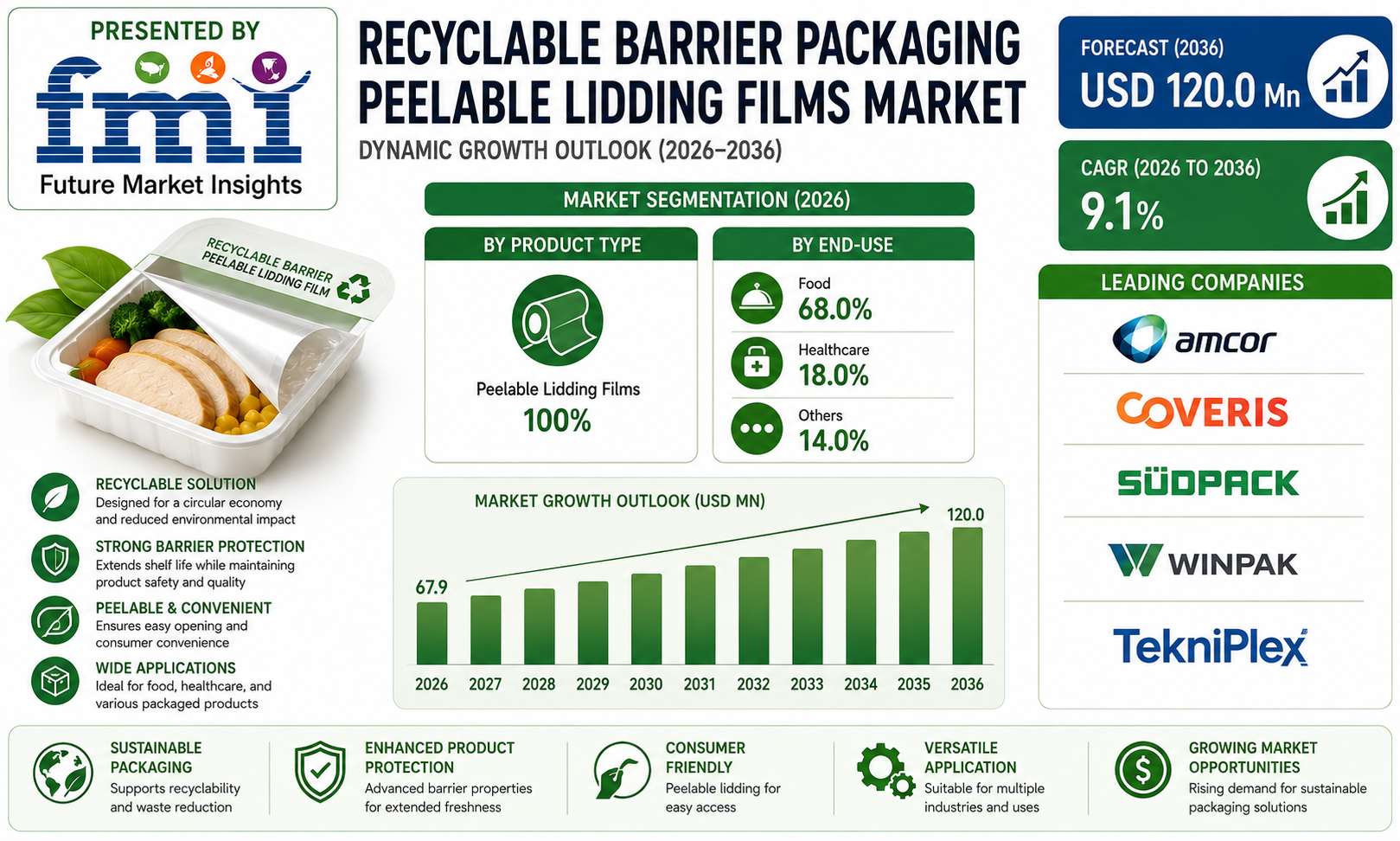
The recyclable barrier packaging peelable lidding films market is entering a strong growth phase as packaging manufacturers and food producers seek solutions that combine recycling compatibility, barrier protection, seal integrity, and easy opening performance. According to Future Market Insights, the market is estimated at USD 50.0 million in 2026 and is projected to reach USD 120.0 million by 2036, expanding at a 9.1% CAGR during the forecast period.
The market is being shaped by growing demand for simplified packaging structures, particularly mono-material films that can maintain barrier properties while fitting established recycling systems. Packaging engineers are increasingly required to evaluate the complete tray-and-lidding combination rather than assessing the film independently. Seal strength, peel consistency, material recovery, product compatibility, and processing performance are becoming important factors in commercial qualification.
Regulatory developments are also increasing design accountability. The European Union’s Regulation (EU) 2025/40, published in January 2025 and applying from August 12, 2026, is adding further importance to recyclability-oriented packaging development. As packaging producers prepare for changing requirements, suppliers with validated recyclable film structures and strong technical support are positioned to benefit.
Market Growth Drivers and Emerging Opportunities
The recyclable barrier packaging peelable lidding films market is benefiting from the increasing adoption of mono-material packaging structures. Mono-material PE is expected to account for 34.0% of the material segment in 2026, supported by familiar polyethylene processing routes and clearer assessment within established recovery systems. Manufacturers are increasingly conducting plant trials to evaluate peel force, sealing temperature, line speed, and performance under real production conditions.
The format segment is led by pouches, which are projected to account for 44.0% share in 2026. Their flexible dimensions and efficient material utilization make them suitable for products with different fill volumes and packaging requirements. Pouches can also be introduced across multiple product sizes using existing form-fill-seal equipment, providing flexibility for contract packers and food manufacturers.
Within barrier and functional features, grease-resistant films are expected to hold a 38.0% share in 2026. These films are particularly important for oily foods, seafood, prepared meals, and other products where oil or marinade can reach the sealing flange. Stable sealing performance under these conditions helps packaging plants maintain production consistency and reduce packaging failures.
Food remains the dominant end-use sector, accounting for an estimated 63.0% share in 2026. Chilled foods, prepared meals, protein products, and other perishable applications require packaging that combines shelf-life protection with controlled opening behavior. This creates demand for recyclable lidding films capable of delivering reliable barrier performance without compromising recycling objectives.
Sustainability Is Reshaping Film Selection
Sustainability is becoming a central consideration in packaging procurement. Brand owners and retailers are increasingly evaluating recyclable, reusable, and simplified packaging structures as part of broader environmental targets. This trend is encouraging the development of mono-material PE films, recycled-content structures, molded-fiber combinations, and other packaging systems designed around established recovery routes.
However, recyclability does not depend only on the primary film polymer. Barrier coatings, sealants, inks, adhesives, and other functional layers can influence the final recovery performance of a package. As a result, converters need to assess the complete structure before commercial approval.
Joint development between tray manufacturers, film suppliers, and packaging machinery providers represents an important opportunity. Coordinated trials can identify sealing and peel-performance issues earlier and help manufacturers avoid costly changes after a film has already been qualified.
Country-Level Market Outlook
The market is expected to experience strong growth across major packaging economies. The United States is projected to grow at a 9.4% CAGR through 2036, making it the fastest-growing country among the markets highlighted. Demand is supported by large chilled-food operations, established packaging laboratories, and increasing attention to recyclable packaging claims. Differences in state-level recovery systems, however, can create additional requirements for recyclability validation.
The United Kingdom is expected to register a 9.1% CAGR, supported by established chilled-food production and annual packaging recyclability assessments. Packaging suppliers need to keep product specifications aligned with applicable reporting methodologies as assessment requirements evolve.
Germany is projected to grow at 9.0% CAGR, supported by defined national packaging design requirements and advanced film-converting capabilities. The market is benefiting from increased attention to material selection and recycling compatibility.
In France, the recyclable barrier packaging peelable lidding films market is forecast to expand at an 8.6% CAGR. Environmental claim substantiation and retail packaging reviews are increasing the importance of documented evidence supporting recyclability and disposal claims.
Japan is expected to grow at an 8.4% CAGR, supported by established domestic film production, material traceability, and detailed packaging qualification practices. Consistent validation of sealing speed and peel behavior remains important across individual production lines.
Competitive Landscape
The competitive environment includes major packaging companies with capabilities across flexible films, lidding structures, barrier technologies, and application-specific packaging solutions. Amcor, Coveris, SÜDPACK, Winpak, TekniPlex, Constantia Flexibles, Klöckner Pentaplast, and ProAmpac are among the notable companies operating in the market.
Amcor, Coveris, and SÜDPACK have capabilities spanning recyclable lidding films and complementary tray or bottom-web solutions, particularly for food packaging. Winpak, TekniPlex, and Constantia Flexibles serve applications requiring controlled peel performance and barrier protection, while Klöckner Pentaplast and ProAmpac offer broader rigid and flexible packaging portfolios.
Recent industry developments demonstrate the direction of the market. Amcor expanded collaboration with Metsä Group and G. Mondini around molded-fiber tray systems with barrier liners and top webs. Coveris introduced MonoFlexBP for refrigerated food applications, while Constantia Flexibles and watttron worked on coordinated sealing approaches for polypropylene-based packaging. Winpak also introduced Medform DT, a recycle-ready polyethylene forming film for healthcare packaging.
Future Outlook
The recyclable barrier packaging peelable lidding films market is expected to move toward higher-performance, application-specific recyclable structures over the next decade. Packaging companies will increasingly evaluate films based on the combined performance of recyclability, barrier protection, sealing reliability, peel behavior, and compatibility with existing equipment.
With the market projected to increase from USD 50.0 million in 2026 to USD 120.0 million by 2036, the opportunity for manufacturers extends beyond supplying recyclable films. Suppliers capable of supporting complete packaging qualification, material recovery assessment, machinery trials, and application-specific development are likely to gain a stronger position as sustainability requirements become more closely integrated with commercial packaging decisions.
Related Research Reports:
Bio PE Pouches Market: The market was valued at USD 500.1 million in 2025 and USD 891.9 million by 2036.
PPWR-Compliant Recyclable PE/PP Stand-Up Pouch Recycling Systems Market: The PPWR-compliant recyclable PE/PP stand-up pouch recycling systems market to surpass USD 1.4 billion in 2026 at a CAGR of 15.3% during the forecast period.
Compostable & Biodegradable Refuse Bags Market: The compostable and biodegradable refuse bags market to cross USD 3.9 billion in 2026 at a projected CAGR of 10.7% during the forecast period.
About Future Market Insights (FMI)
Future Market Insights is a leading provider of market intelligence, consulting services, and syndicated research reports. FMI delivers actionable insights across packaging, logistics, industrial manufacturing, food and beverage, healthcare, chemicals, and emerging technologies, helping organizations identify growth opportunities and make informed strategic decisions in rapidly evolving markets.
Contact
Future Market Insights Inc.
Christiana Corporate
200 Continental Drive, Suite 401
Newark, Delaware 19713, USA