

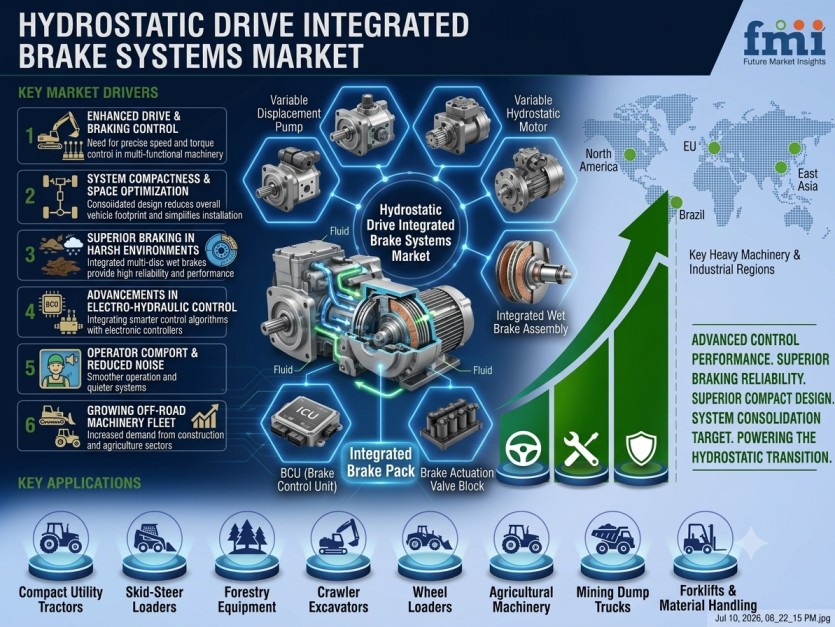
The global Hydrostatic Drive Integrated Brake Systems Market is projected to grow from USD 787.5 million in 2025 to USD 1.38 billion by 2036, registering a compound annual growth rate (CAGR) of 5.2% during the forecast period. Market growth is being fueled by increasing adoption of hydrostatic drivetrain technologies across construction and agricultural machinery, growing demand for integrated braking solutions, and rising OEM focus on improving machine safety, maneuverability, and operational efficiency.
Hydrostatic drive integrated brake systems combine hydraulic travel control and braking functions into a single machine subsystem, enabling smoother vehicle movement, improved slope holding, and enhanced low-speed control. As equipment manufacturers seek to simplify drivetrain architecture while improving performance and reducing maintenance complexity, integrated hydrostatic braking systems are becoming a preferred solution across next-generation off-highway platforms.
Rising Demand for Integrated Drivetrain Solutions Drives Market Expansion
Construction, agricultural, mining, forestry, and material-handling equipment increasingly require precise travel control under demanding operating conditions. Conventional braking systems are gradually being replaced or supplemented by integrated hydrostatic systems that combine propulsion and braking within a unified hydraulic architecture.
Unlike standalone braking components, hydrostatic drive integrated brake systems coordinate hydraulic pumps, motors, brake valves, parking brake modules, and control software to deliver smoother acceleration, precise creep-speed operation, and controlled braking.
This integrated approach reduces drivetrain complexity while improving machine responsiveness, particularly in applications involving frequent starts, stops, slope operation, and confined working environments.
Growing demand for safer and more productive off-highway equipment is expected to support long-term market expansion.
OEM Fitment Continues to Dominate Market Demand
OEM fitment is projected to account for 69.2% of global market demand in 2026, making it the largest sales channel.
Hydrostatic braking systems are closely integrated with machine hydraulics, axle configurations, transmission layouts, and electronic controls. Consequently, manufacturers prefer factory-installed systems that undergo complete vehicle validation before commercial production.
OEM-installed solutions ensure optimal calibration of travel response, braking performance, hydraulic pressure, and safety systems while minimizing installation errors and warranty concerns.
As equipment manufacturers continue developing highly integrated vehicle platforms, OEM partnerships will remain central to future market growth.
Closed Loop Systems Lead System Architecture
Among system types, closed loop hydrostatic drive systems are expected to represent 43.7% of market demand in 2026.
Closed loop hydraulic systems provide continuous fluid circulation between hydraulic pumps and motors, enabling highly responsive speed control, efficient reversing, and smooth braking performance. These systems are especially valuable in compact construction equipment and agricultural machinery that require precise movement in confined workspaces.
Improved energy efficiency, faster hydraulic response, and enhanced operator control continue to make closed loop architectures the preferred choice for modern hydrostatic drive applications.
Agricultural Machinery Emerges as the Largest Equipment Segment
Agricultural machines are forecast to capture 41.6% of market demand in 2026, reflecting increasing mechanization across global farming operations.
Modern tractors, sprayers, harvesters, and specialty farm equipment rely heavily on hydrostatic drive systems to maintain consistent operating speeds during planting, harvesting, spraying, and field maintenance activities.
Integrated brake systems provide reliable creep-speed control while improving machine stability on uneven terrain and sloped agricultural fields. Parking brake integration further enhances operator safety during equipment loading, unloading, and stationary field operations.
Growing investments in farm mechanization across emerging economies continue to strengthen long-term demand for hydrostatic braking solutions.
Construction Equipment Expands Market Opportunities
Construction equipment represents another major application area as contractors increasingly deploy compact loaders, excavators, skid steer loaders, and telehandlers capable of operating within restricted urban construction sites.
Hydrostatic drive systems provide smoother maneuverability during low-speed precision work, while integrated braking improves machine control when operating on slopes or transporting heavy loads.
As infrastructure investment accelerates worldwide, demand for construction machinery equipped with advanced hydrostatic drivetrain technologies is expected to increase steadily.
Machine Safety and Operational Efficiency Remain Key Priorities
Equipment manufacturers are placing greater emphasis on machine-level safety rather than focusing solely on individual braking components.
Modern hydrostatic drive systems integrate parking brakes, service brakes, dynamic braking circuits, hydraulic valves, control software, and axle assemblies into a coordinated safety platform. This allows operators to maintain precise vehicle control under varying load conditions while simplifying machine operation.
Integrated braking also reduces wear on mechanical components, improves hydraulic efficiency, and minimizes service complexity throughout the equipment lifecycle.
These operational advantages continue to support widespread adoption across multiple off-highway industries.
Technological Innovation Improves Hydraulic Performance
Advancements in hydraulic engineering are significantly enhancing hydrostatic drive system capabilities.
Manufacturers are introducing high-efficiency radial piston motors, electronically controlled hydraulic valves, improved filtration systems, and higher operating pressure capabilities that deliver greater torque while maintaining smoother machine movement.
Recent product developments featuring increased hydraulic flow rates, higher pressure ratings, and improved startup efficiency demonstrate how integrated hydrostatic systems continue to evolve toward greater performance and durability.
The incorporation of intelligent hydraulic controls and software-based machine management is expected to further improve braking precision and drivetrain optimization over the coming years.
Service-Friendly Designs Strengthen Aftermarket Growth
Although OEM installation dominates the market, aftermarket demand continues to grow as fleet operators seek modular replacement components that simplify maintenance.
Service providers increasingly prefer replaceable brake valves, hydraulic sealing kits, pump assemblies, and modular brake packages that reduce repair times while minimizing equipment downtime during seasonal operations.
Rental fleets, agricultural contractors, and construction companies particularly benefit from maintenance-friendly hydraulic systems capable of supporting rapid field repairs.
As equipment operating hours continue increasing worldwide, replacement demand is expected to remain an important contributor to market revenues.
Asia-Pacific Leads Future Growth
China is projected to record the highest growth among major markets with a CAGR of 6.7% through 2036, supported by expanding construction machinery production, increasing hydraulic system capabilities, and growing equipment electrification initiatives.
India is expected to register a 6.3% CAGR, driven by rapid infrastructure development, rising agricultural mechanization, and increasing domestic manufacturing of construction equipment.
Government support for farm machinery adoption, infrastructure expansion, and industrial automation continues to stimulate demand for advanced hydrostatic drivetrain technologies across the Asia-Pacific region.
Meanwhile, North America and Europe maintain stable demand supported by technologically advanced OEMs, mature agricultural equipment industries, and continued innovation in hydraulic power systems.
Competitive Landscape
Competition within the hydrostatic drive integrated brake systems market centers on hydraulic efficiency, braking performance, machine integration, and engineering support.
Leading manufacturers are investing in advanced hydraulic pumps, motors, brake valves, electronic control systems, and integrated axle technologies that improve overall drivetrain performance while reducing maintenance requirements.
Major industry participants continue collaborating closely with OEMs to develop customized hydrostatic drive packages tailored to specific equipment platforms. Companies offering complete hydraulic systems, validated braking performance, strong technical support, and modular service solutions are expected to strengthen their competitive position throughout the forecast period.
Future Outlook
The outlook for the global hydrostatic drive integrated brake systems market remains positive as off-highway equipment manufacturers continue transitioning toward highly integrated machine architectures.
Growing mechanization in agriculture, rising construction activity, increasing demand for compact equipment, and advances in hydraulic control technologies will continue driving market expansion through 2036.
As machine builders increasingly prioritize safety, efficiency, and simplified drivetrain design, integrated hydrostatic braking systems will play an increasingly important role in next-generation off-highway vehicles. Manufacturers capable of delivering reliable, service-friendly, and high-performance hydraulic braking solutions will be well positioned to capitalize on emerging opportunities in the evolving off-highway equipment industry.
Browse More Reports
HUD-Compatible Low-Haze Windshield Defogging Coating Systems Market – https://www.openpr.com/news/4575685/hud-compatible-low-haze-windshield-defogging-coating-systems
In-Cabin Lighting-Climate-Audio Synchronized Experience Systems Market – https://www.openpr.com/news/4575700/in-cabin-lighting-climate-audio-synchronized-experience
Railway System Market – https://www.openpr.com/news/4575709/global-railway-system-market-size-to-reach-usd-50-0-billion