

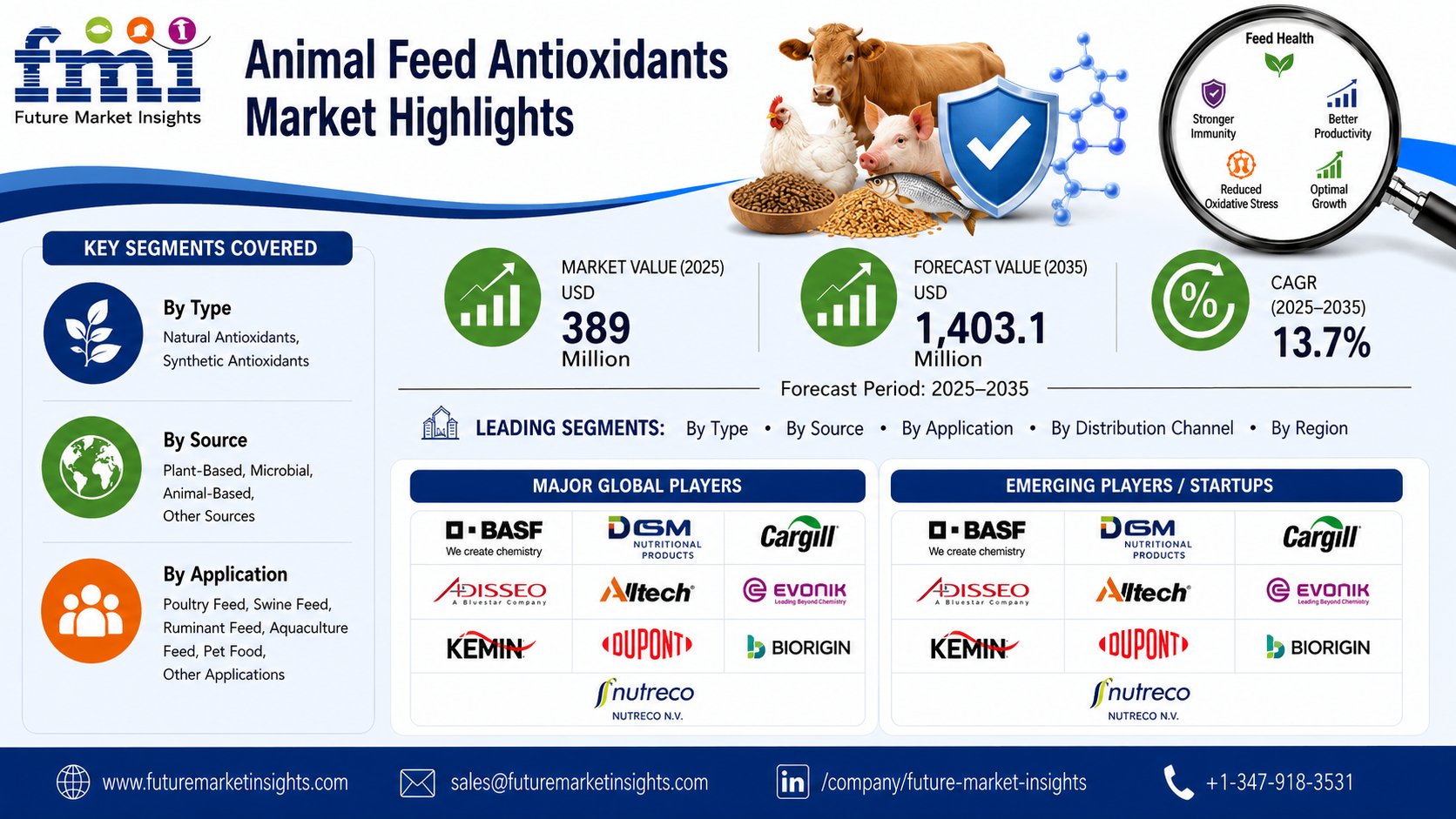
NEWARK, Del., July 14, 2026 — The global Animal Feed Antioxidants Market continues to witness sustained reliance on synthetic antioxidants as feed manufacturers prioritize oxidation control, shelf-life stability, formulation consistency, and cost efficiency over clean-label positioning. According to Future Market Insights (FMI), despite growing regulatory scrutiny and increasing demand for natural feed additives, synthetic antioxidants such as BHT, BHA, ethoxyquin, and propyl gallate remain difficult to replace due to their proven performance across high-fat and nutritionally sensitive feed formulations.
Synthetic antioxidants continue to dominate commercial feed applications because they provide superior oxidative protection, reliable dosage performance, heat stability during feed processing, and lower formulation costs compared to many naturally derived alternatives. Although clean-label ingredients are gaining attention, large-scale adoption remains limited by higher inclusion rates, inconsistent performance, and limited long-term stability data under commercial feed manufacturing conditions.
The market outlook suggests that the transition toward natural antioxidant systems will remain gradual as manufacturers continue evaluating efficacy, regulatory compliance, ingredient availability, and economic feasibility before replacing established synthetic antioxidant formulations.
Key Animal Feed Antioxidants Market Highlights
Publication Date: June 30, 2026
Key Synthetic Antioxidants: BHT, BHA, Ethoxyquin, Propyl Gallate
Key Alternative Solutions: Natural Antioxidants, Plant Extracts, Tocopherols, Rosemary Extracts
Major Applications: Poultry Feed, Aquafeed, Rendered Meals, Premixes, Compound Feed, High-Oil Feed Formulations
Leading Market Trend: Continued Dependence on Synthetic Antioxidants
Key Focus Areas: Oxidation Control, Shelf-Life Protection, Cost Efficiency, Feed Stability
Analyst Viewpoint
Nandini Roy Choudhury, Principal Consultant at FMI, says: “Synthetic antioxidants continue to play a critical role in commercial animal feed production because they deliver proven oxidation control, formulation consistency, and cost efficiency. While demand for natural alternatives is increasing, successful replacement will require stronger scientific validation, improved processing stability, and competitive economics.”
Why Does Synthetic Antioxidant Dependence Continue?
Despite increasing clean-label preferences, feed manufacturers continue relying on synthetic antioxidants because maintaining feed quality, preventing lipid oxidation, and extending shelf life remain operational priorities. Synthetic ingredients have demonstrated consistent performance across diverse feed formulations and processing conditions, making them the preferred choice in commercial feed production.
Key Growth Factors Supporting Synthetic Antioxidant Use
- Superior oxidation control performance.
- Lower formulation costs compared to natural alternatives.
- Proven shelf-life protection across feed applications.
- Excellent heat stability during feed processing.
- Reliable dosage efficiency and formulation consistency.
- Strong performance in high-fat and high-oil feed systems.
- Established commercial acceptance across global feed markets.
As feed manufacturers continue balancing performance, regulatory requirements, and sustainability goals, synthetic antioxidants are expected to remain essential components of commercial feed preservation strategies.
Why Are Natural Alternatives Difficult to Adopt?
Although natural antioxidants continue gaining market attention, many alternatives require higher inclusion rates and additional formulation optimization to achieve comparable oxidative stability. Manufacturers also seek stronger scientific validation regarding long-term stability, heat tolerance, batch consistency, and overall cost effectiveness before implementing large-scale transitions.
👉 Read the Complete Analysis: https://www.futuremarketinsights.com/reports/sample/rep-gb-15941
Alternative Ingredient Challenges
- Higher inclusion rates compared to synthetic antioxidants.
- Variable performance across feed formulations.
- Limited heat stability during processing.
- Greater batch-to-batch variability.
- Higher production and formulation costs.
Which Feed Applications Show the Highest Dependence?
The greatest reliance on synthetic antioxidants is observed in feed applications where lipid stability, nutritional preservation, and storage performance are essential. High-fat formulations require highly effective antioxidant systems to minimize oxidative degradation throughout manufacturing, transportation, and storage.
Leading Feed Applications
- Poultry Feed
- Aquafeed
- Rendered Meals
- Premixes
- High-Oil Feed Formulations
- Compound Feed
Market Dynamics
Market Drivers
Growing demand for longer feed shelf life, increasing use of high-fat feed formulations, superior oxidation protection, proven formulation reliability, and strong cost efficiency continue supporting widespread adoption of synthetic antioxidants.
Market Restraints
Rising clean-label demand, evolving regulatory frameworks, consumer preference for natural ingredients, sustainability concerns, and ongoing research into alternative antioxidant technologies remain key industry challenges.
Market Trends
Innovation continues shaping the animal feed antioxidants industry.
Major trends include:
- Development of next-generation natural antioxidants.
- Increased research on plant-based antioxidant systems.
- Improved formulation technologies.
- Greater focus on clean-label feed ingredients.
- Scientific validation of natural alternatives.
- Sustainable feed preservation solutions.
- Hybrid antioxidant formulations combining synthetic and natural ingredients.
Regional Outlook
Regions with large-scale commercial livestock production and significant feed cost sensitivity continue demonstrating the highest dependence on synthetic antioxidants. Feed manufacturers in these markets prioritize formulation performance, cost optimization, and supply consistency while gradually evaluating natural alternatives for future adoption.
Competitive Landscape
Manufacturers continue investing in antioxidant innovation, formulation research, regulatory compliance, performance validation, and sustainable ingredient development while balancing commercial requirements for oxidation control, feed quality, and production economics. Key Players: BASF SE, DSM Nutritional Products, Cargill, Incorporated, Adisseo, Alltech, Inc., Evonik Industries AG, Kemin Industries, Inc., DuPont de Nemours, Inc., Biorigin, Nutreco N.V.
Related Reports
Animal Feed Additives Market: Animal feed antioxidants sit within the wider feed additives ecosystem where feed mills evaluate stability, safety, performance, and cost control.
Natural Feed Additives Market: Natural feed antioxidants benefit from the broader shift toward chemical-free, sustainable, and cleaner livestock nutrition programs.
Compound Feed Market: Compound feed manufacturers are key buyers because antioxidants help protect mixed feed formulations during storage, transport, and feeding.
Pet Food Antioxidants Market: Pet food has stronger clean-label pressure, making it an important adjacent market for natural antioxidant positioning and premium claims.
Poultry Feed Market: Poultry feed is a major application area because high-volume production, feed efficiency, and oil-rich diets increase the need for oxidation control.
About Future Market Insights (FMI)
Future Market Insights, Inc. (ESOMAR certified, recipient of the Stevie® Award, and a member of the Greater New York Chamber of Commerce) provides deep insights into governing factors elevating demand in global markets.
FMI delivers market intelligence, consulting services, and syndicated research reports across chemicals, materials, food ingredients, pharmaceuticals, industrial manufacturing, sustainability, and advanced materials sectors.
With global expertise and industry-focused research capabilities, FMI provides actionable insights that help organizations understand market dynamics and identify emerging opportunities.
Contact
Future Market Insights Inc.
Christiana Corporate, 200 Continental Drive, Suite 401
Newark, Delaware 19713, USA
Rahul Singh
AVP – Marketing and Growth Strategy
Future Market Insights, Inc.
+91 8600020075
For Media: Rahul.Singh@futuremarketinsights.com
Email: sales@futuremarketinsights.com
Website: https://www.futuremarketinsights.com