

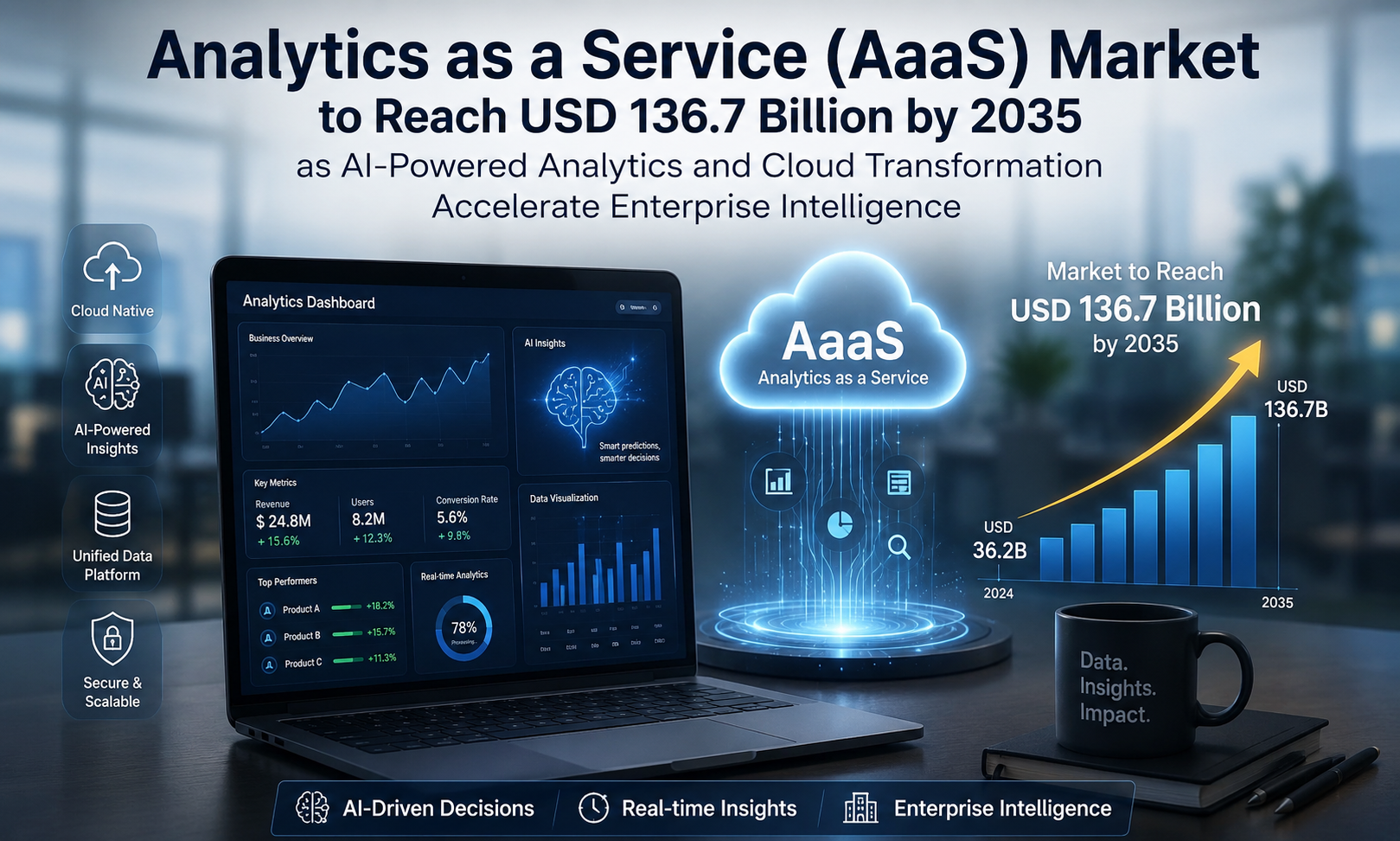
The global Analytics as a Service (AaaS) market is entering a high-growth expansion phase as enterprises rapidly shift toward cloud-based analytics, AI-powered decision systems, and real-time data intelligence platforms. According to industry analysis, the market is projected to grow from USD 14.91 billion in 2025 to USD 136.7 billion by 2035, reflecting a CAGR of 24.8%.
This strong growth is being fueled by accelerating digital transformation initiatives, rising adoption of cloud computing, and increasing demand for predictive and self-service analytics solutions. Organizations across finance, healthcare, retail, and manufacturing are leveraging AaaS platforms to enhance operational efficiency, improve customer experience, and unlock data-driven revenue opportunities.
The integration of machine learning algorithms, IoT-driven data ecosystems, and advanced data security frameworks is further strengthening market adoption. As enterprises transition from on-premise systems to hybrid and cloud-native analytics environments, AaaS is becoming a foundational pillar of modern business intelligence.
Get detailed market forecasts, competitive benchmarking, and strategic insights:
https://www.futuremarketinsights.com/reports/analytics-as-a-service-market
Market Overview
The Analytics as a Service (AaaS) market represents a cloud-based analytics delivery model that enables organizations to access advanced data analytics capabilities without investing in complex on-premise infrastructure. These platforms support predictive analytics, real-time reporting, visualization, and AI-driven decision-making.
Between 2025 and 2035, the market is expected to expand significantly due to rising demand for scalable analytics infrastructure, increasing enterprise data volumes, and growing adoption of automation-driven business intelligence systems.
Key growth enablers include:
• Expansion of cloud computing ecosystems
• Rising adoption of AI and machine learning
• Growing demand for real-time insights
• Increasing focus on cost-efficient analytics solutions
• Proliferation of IoT and connected devices
AaaS is evolving into a core enterprise capability that supports strategic decision-making, risk management, and operational optimization across industries.
Key Growth Drivers
The rapid expansion of the AaaS market is driven by structural shifts in enterprise technology adoption and data consumption patterns.
Key growth drivers include:
• Accelerating digital transformation across industries
• Rising adoption of AI-powered analytics tools
• Increasing demand for self-service analytics platforms
• Growth in cloud-first enterprise strategies
• Expansion of real-time predictive analytics use cases
• Rising need for data-driven customer experience optimization
Enterprises are increasingly prioritizing scalable analytics ecosystems that reduce infrastructure costs while improving agility and decision-making speed.
Technology and Innovation Trends
Technology innovation is reshaping the competitive landscape of the AaaS market.
Key innovation trends include:
• AI-driven predictive analytics and automation
• Machine learning-based data modeling
• Edge analytics and real-time data processing
• Blockchain-enabled secure data sharing
• Advanced data visualization tools
• Hybrid and multi-cloud analytics architectures
The integration of AI and machine learning into analytics workflows is enabling organizations to transition from descriptive analytics to predictive and prescriptive intelligence.
Additionally, advancements in cybersecurity and federated learning are improving data privacy and compliance across distributed environments.
Market Challenges and Restraints
Despite strong growth potential, the AaaS market faces several challenges:
• Rising concerns around data security and cyber threats
• Complex data integration across multiple platforms
• Strict regulatory compliance requirements (GDPR and others)
• High dependency on cloud service providers
• Vendor lock-in risks
• High implementation and migration complexity
Organizations operating across multiple jurisdictions face additional challenges related to data governance and privacy compliance.
Strengthening cybersecurity frameworks and improving interoperability standards will be essential for long-term market stability.
Segment Analysis
Predictive Analytics Leads Market Adoption
The predictive analytics segment is expected to dominate the AaaS market due to its ability to deliver actionable insights through AI-driven forecasting models.
Key advantages include:
• Enhanced demand forecasting accuracy
• Improved risk management capabilities
• Real-time anomaly detection
• AI-powered customer behavior analysis
• Optimized operational planning
Predictive analytics is widely adopted across banking, healthcare, and retail sectors, where data-driven forecasting plays a critical role in strategic planning and operational efficiency.
Hybrid Cloud Deployment Gains Strong Momentum
Hybrid cloud deployment models are becoming increasingly popular as enterprises seek a balance between scalability and security.
Key benefits include:
• Flexible workload distribution
• Improved data security and compliance
• Cost optimization across environments
• Seamless integration of private and public clouds
• Enhanced scalability for enterprise workloads
Hybrid cloud analytics is particularly important for regulated industries such as finance and government.
Industry Applications Expand Rapidly
AaaS adoption spans multiple industries, including:
• Banking and financial services
• Healthcare and life sciences
• Retail and e-commerce
• Manufacturing and industrial automation
• Telecommunications
• Government and public sector
Each industry leverages AaaS platforms to improve forecasting, automate decision-making, and enhance customer engagement.
Regional Analysis
North America Leads Global Market
North America dominates the AaaS market due to strong cloud adoption and advanced AI infrastructure.
Growth drivers include:
• Presence of major cloud service providers
• High enterprise digital maturity
• Strong adoption of AI-driven analytics
• Advanced regulatory frameworks supporting data security
Europe Focuses on Compliance-Driven Analytics
Europe is experiencing steady growth driven by:
• Strict data privacy regulations (GDPR)
• Expansion of digital transformation initiatives
• Growing adoption of cloud analytics in BFSI and manufacturing
Asia-Pacific Emerges as Fastest-Growing Region
Asia-Pacific is expected to witness the highest growth rate due to:
• Rapid cloud adoption in emerging economies
• Expansion of e-commerce and digital ecosystems
• Growth of smart cities and 5G infrastructure
• Increasing AI investment across enterprises
Countries such as China, India, Japan, and South Korea are leading regional adoption.
Competitive Landscape
The AaaS market is highly competitive and dominated by global cloud service providers and enterprise analytics platforms.
The market structure is characterized by:
• Large cloud ecosystem providers
• AI-first analytics innovators
• Industry-specific SaaS analytics vendors
Competition is intensifying as companies invest heavily in AI capabilities, data infrastructure, and real-time analytics platforms.
Leading Companies Analysis
Key players operating in the Analytics as a Service market include:
• Microsoft Azure
• IBM Corporation
• Google Cloud Platform
• Amazon Web Services (AWS)
• SAP SE
• Salesforce (Tableau)
• Oracle
• SAS Institute
• Teradata
• Qlik
These companies focus on:
• AI-powered analytics platforms
• Real-time data processing solutions
• Cloud-native business intelligence tools
• Industry-specific analytics applications
Investment and Strategic Developments
Recent industry developments highlight rapid innovation and expansion:
• Expansion of AI-powered analytics ecosystems across cloud providers
• Strategic acquisitions in data analytics and BI platforms
• Growth in hybrid cloud analytics infrastructure investments
• Increasing focus on edge analytics and real-time intelligence systems
Organizations are heavily investing in automation, predictive modeling, and advanced data governance frameworks to enhance analytics performance.
Explore the latest insights on digital analytics transformation:
https://www.futuremarketinsights.com/industry-analysis
Future Outlook
By 2035, the Analytics as a Service market is expected to evolve into a fully AI-integrated, autonomous analytics ecosystem.
Future growth will be shaped by:
• AI-driven decision automation
• Real-time predictive intelligence systems
• Expansion of federated and edge analytics
• Integration of blockchain for secure data sharing
• Advanced industry-specific analytics platforms
As enterprises continue to prioritize agility and intelligence-driven operations, AaaS will become a core enabler of digital business transformation.
Organizations that invest in scalable, AI-first analytics architectures will be best positioned to capture long-term competitive advantage.
FMI Custom Research: Strategic Intelligence for Confident Decision-Making
In today’s fast-changing business environment, organizations require actionable intelligence to support high-impact decisions.
FMI Custom Research delivers tailored insights designed to help enterprises:
• Improve strategic planning accuracy
• Reduce investment risk
• Identify high-growth opportunities
• Enhance competitive positioning
• Accelerate digital transformation initiatives
With deep industry expertise and proprietary research capabilities, FMI enables data-driven decision-making at scale.
Contact: sales@futuremarketinsights.com
Conclusion
The global Analytics as a Service (AaaS) market is undergoing rapid transformation, driven by cloud adoption, AI integration, and increasing demand for real-time data intelligence.
With market value projected to rise from USD 14.91 billion in 2025 to USD 136.7 billion by 2035, AaaS is becoming a critical foundation for enterprise analytics modernization.
As organizations continue to prioritize automation, predictive insights, and scalable cloud infrastructure, AaaS platforms will play a central role in shaping the future of global digital intelligence ecosystems.